Familiar Indian Flowers: with Coloured Plates/Poinsettia Pulcherrima
POINSETTIA PULCHERRIMA.
NATURAL ORDER, EUPHORBIACEÆ.
THE accompanying flower will be known in England as a “stove” or hot-house plant, but the blaze of colour can never be imagined from one or two plants seen in this way.
It is one of India’s most showy, most gaudy, and most familiar flowers, at least as far north as Agra, where it may be seen growing in the gardens of the Taj.
The shrub grows to eight or ten feet; it is an untidy, spreading bush, which requires much cutting back after it has blossomed.
The flowers are insignificant, about the size of a pea, bright yellow, and surrounded by large, crimson, bractial leaves, which are the striking part of the bush; they are limp and “fleshy” to the touch.
During the cold season these brilliant leaves are in full splendour and make a border very gay; they are often used to enliven Christmas decorations, as Holly is at home.
As a rule the green leaves are very seldom to be seen with the bright red bractial ones, but when grown in shade I have noticed the two adorning the branches at once, and this is a great improvement.
I find Ferminger mentions that this plant is a native of Mexico.
It is very easy to propagate, as it takes quickly from cuttings.
The milky juice of all the Euphorbiaceæ is to be found in the Poinsettia. I have never met any other variety, but Ferminger mentions one with greenish-white leaves; he, however, says, "it is not a striking plant.” 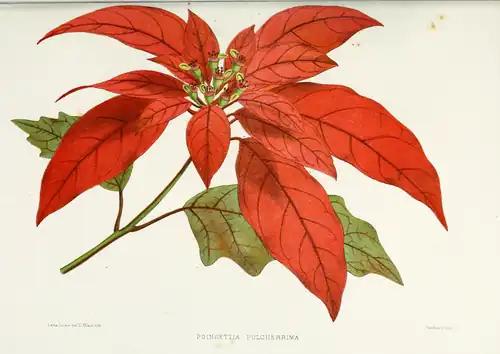
POINSETTIA PULCHERRIMA.