Familiar Indian Flowers: with Coloured Plates/Poinciana Pulcherrima
POINCIANA PULCHERRIMA.
BARBADOES PRIDE.
NATURAL ORDER, LEGUMINOSÆ.
THE foliage of the plant now before us is, perhaps, as ornamental as the flowers.
From the illustration it will be seen that the leaves are oblong leaflets, set in pairs up a thin stem. When seen in a mass, especially when waving in a breeze, these leaves look very eraceful and elegant.
This shrub is in blossom during the hot and rainy seasons; it bears, panicles of bright yellow, or red and yellow flowers, which are in great profusion at the ends of the stems.
The brilliant and gaudy effect may readily be imagined.
There are two varieties, one having pure yellow flowers, and the other yellow marked with red, as depicted in the plate before us.
The buds before expanding are like small round balls at the end of their stalks, about two inches long.
According to the advice given by Ferminger, fresh plants should be raised from seed every year; but my experience does not corroborate this, as a year would hardly allow the shrubs to attain their full perfection.
I find also, from the above authority, that this shrub cannot stand extreme cold, but attains greater perfection in hot climates.
When kept low and thick these shrubs make a capital hedge, from which fact I imagine it is occasionally called "Barbadoes Flower Fence,” but when treated in this manner the handsome look of the bush is completely spoilt.
For useful and medicinal purposes this plant is singularly valuable. Major Drury states "that a decoction is made by the natives of the West Indies of the leaves and flowers, which is serviceable in fevers,” and the roots and seeds are also used in pharmacy. The wood makes very good charcoal.
The height of the bush is about seven or eight feet; when first expanding the leaves are of a bright, light green. They have been very appropriately compared "to numerous fans floating and waving in the air.”
Great care is required in the treatment of young plants. They grow well from seed, but when a few inches high they cannot bear too much heat or too much rain, and also are often killed by the ravages of white ants. 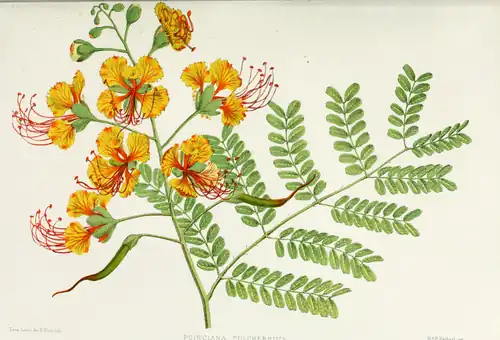
POINCIANA PULCHERRIMA.