Familiar Indian Flowers: with Coloured Plates/Plumbago Capensis
PLUMBAGO CAPENSIS.
NATURAL ORDER, PLUMBAGINACEÆ.
 UR present subject is a shrub of prostrate growth, about three or four feet high.
The foliage is arranged in a succession of whorls of lanceolate leaves from half an inch to two inches long, by no means attractive either in shape or colour.
From its untidy, straggling appearance this shrub is not ornamental or pleasing in its growth, and would hardly deserve a place in the garden were it not for its beautiful heads of azure-blue flowers.
The profusion of these lovely blue flowers is the beauty of the plant, and make up in a great measure for its otherwise unattractive appearance.
The Plumbago is a very familiar shrub in all parts of India, and seems to have no favourite locality, but thrives well in all districts.
During the hot weather it may be seen in its greatest perfection, but a few stray heads of blossom may be found at all times of the year.
The form and arrangement of the flowers have aptly been described by Ferminger and others as similar to the Phlox.
The soft mossy look of the buds and calyxes is a great addition to the prettiness of these flowers.
In addition to the present subject there are three varieties of the Plumbago, viz., "Plumbago Larpentæ," "Plumbago Rosea," and "Plumbago Zeylanica." The first of these three is a native of China, and, according to Ferminger, does not thrive in India; the flowers are a deeper blue and larger in size than the subject of our illustration, but otherwise there is a great resemblance between them.
"Plumbago Rosea," as the name suggests, has reddish flowers; they are borne on a spiral head, and blossom in the cold weather. This variety, however, is more delicate and difficult to cultivate than the foregoing.
Ferminger makes the following remarks regarding "Plumbago Zeylanica": "A small, slender, and not very pleasing shrub, bearing at all seasons racemes of small, white, sparkling flowers, very clammy and disagreeable to the touch." This variety is more uncommon than the preceding ones, owing perhaps to its being less showy and attractive.
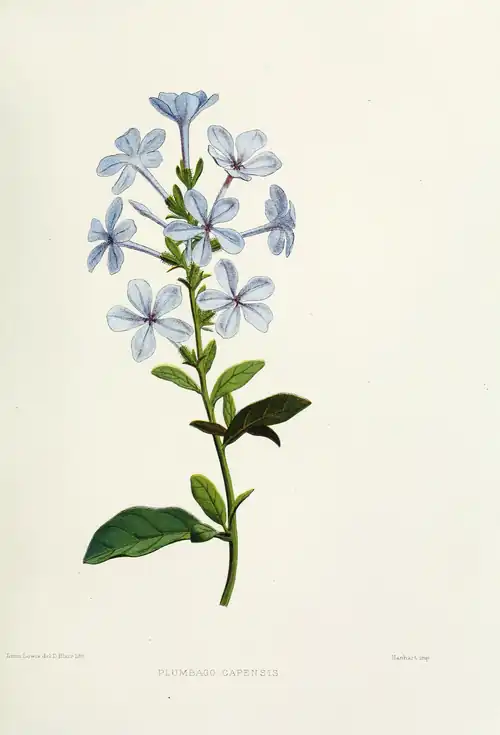
PLUMBAGO CAPENSIS.