Familiar Indian Flowers: with Coloured Plates/Petræa Stapelia
PETRÆA STAPELIA.
NATURAL ORDER, VERBENACEÆ.
THE plant now under consideration is a native of South America, and is not generally met with; in India it is considered a rare object, but it deserves a place in every garden and repays any trouble that may be taken in its culture.
The lovely, blue, starlike sprays of blossom remind one at a distance of the English creeper named “Wisteria,” though the actual form of the separate flowers is totally different.
When not in blossom there is nothing pleasing or attractive in the “Petræa,” for the leaves are small and very dry-looking, while the stems are bare and have a barren ugly appearance.
It is an extensively scandent shrub, requiring a strong framework as a support; the trunk often attaining to the size of a man’s leg.
It blossoms twice in the year, in February and October, but the former is when the flowers show to the best advantage and the shrub is at its greatest beauty; at that time a more enchanting object the eye could hardly rest upon.
The mass of colour and graceful drooping heads of blossom are most fascinating.
The dark plum-coloured centre adds considerably to the general beauty of the flower; it is raised from the five blue petals, and is the first to wither and fade.
The seed capsules are in the centre of the flower, consequently, when ripe, they drop with the petals, and are not left on the plant as is usually the case.
Plants have been raised by seed, but I always found cuttings by far the most satisfactory, though layers also are successful.
Occasionally young shoots appear from the parent shrub.
It remains in blossom some time, and is one of the choicest Flora that adorn our gardens. 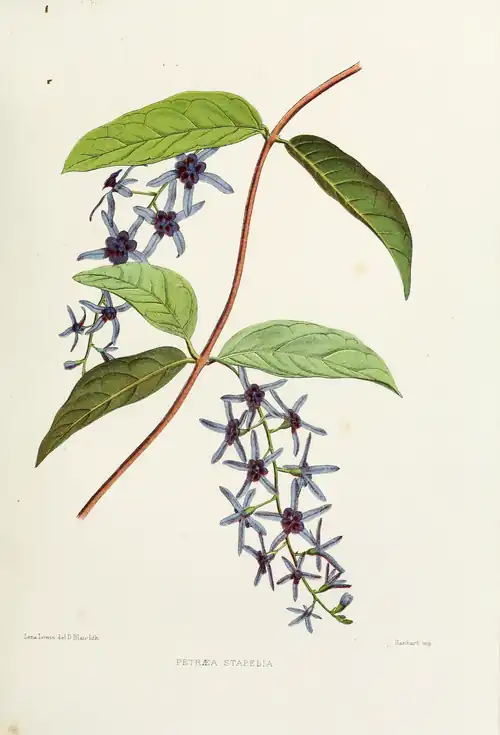
PETRÆA STAPELIA.