Familiar Indian Flowers: with Coloured Plates/Opuntia Vulgaris
OPUNTIA VULGARIS.
PRICKLY PEAR. INDIAN FIG.
NATURAL ORDER, CACTACEÆ.
I FIND that this, hke most of the Cactaceae, is a native of South America, and that Dr. Voigt states it had been introduced into Lower Bengal, but had never flowered. Possibly the climate there is too damp, for further north and in Chota Nagpore it blossoms most profusely.
It is a large, spreading, ramous bush, with thick, succulent, oval leaves, covered with numerous needle-like spines which spring from bunches of fine, penetrating hairs.
The thorns or spines are very sharp, about an inch or more in length, of a whitish colour except the tip; the small bristles or fine hairs are detached with the slightest touch, and being so fine are almost imperceptible, but give great pain and inconvenience if once they have penetrated the skin.
The flowers are of a beautiful bright yellow colour, proceeding from the edges of the thick succulent leaves. The outer petals are tipped with carmine.
I find the following interesting note concerning this flower in Ferminger: "A description of Cactus, which bears a large, pear-like fruit covered with sharp needle-like spines. On cutting open the thick, succulent rind of the fruit, a jelly-like pulp is found, which, though of little flavour, is cool and refreshing. It is sold in immense quantities in Egypt, where the poor almost live upon it.”
Roxburgh, too, has given a very minute account of this plant under the name of "Cactus Indicus”; he mentions that the “Cochineal insects lately brought from America thrive and multiply upon this plant.”
The natives often make use of this prickly bush as a garden fence, and a very impregnable one it is, as can well be imagined.
One leaf placed in loose mould or silver sand will soon grow and send out shoots.
The Cactaceae are generally considered to belong almost exclusively to America, but as many varieties grow wild in the jungles in this country they must have been naturalised at a very early period. 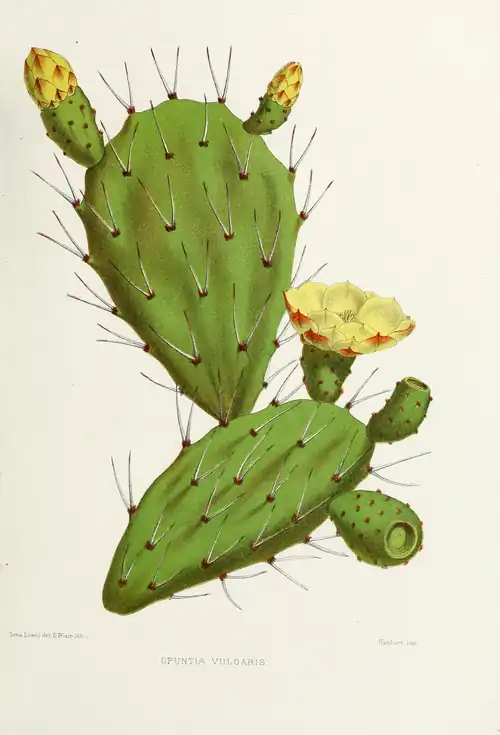
OPUNTiA VULGARIS.