Familiar Indian Flowers: with Coloured Plates/Lagerstromia Indica
Lagerstrœmia Indica.
Natural Order, Lythracæ
_(page_16_crop).png)
It has been impossible to do justice, either to the exquisite colour or delicate texture of the original, and also, being limited in space, the grand massiveness of the sprays is wanting, but, nevertheless, I trust the foregoing illustration may recall the lovely bush to the memory of those who have seen it, and give a fair idea of it to those who have not been so fortunate.
Owing to the crinkled, crumpled appearance of the flowers, this bush has obtained the name of the “Crape Flower.”
Three varieties of the Lagerstrœmia are much the same in growth and shape of the flowers, but they differ in colour, being pink, lilac, and white. They are all very beautiful, and, when growing in close proximity, make a gay and striking addition to a garden.
From the illustration it will be noticed that the flowers grow in pyramidic heads or sprays quite at the termination of the branches, whilst the leaves, which are oval-shaped, grow thick and close in the centre of the bush, thereby relieving the dazzling colours, and yet at the same time greatly enhancing by contrast the general beauty of the bush.
There is a slight resemblance between the Lagerstrœmia and our English May in growth and style of the bushes, but it does not extend beyond these.
There is a tinge of red on the buds and stalks.
During the cold season these shrubs present a most ugly and forlorn appearance, for, being deciduous, there is nothing to be seen but the bare and barren stems, which form a great contrast to the glory and splendour of a few months before.
Beddome mentions that the wood of the Lagerstrœmia is valued as excellent timber, and “much used for building, boat-making, ploughs, and axe-handles.” He also states that “Lagerstrœmia Regina has timber of a reddish colour, is tough, and very durable under water, though it soon decays under ground.” Quoting from the same authority, I find that in the Madras gun-carriage manufactory this wood is found most serviceable.
From Dr. Brandis, who writes from Burmah, we learn that, with the exception of teak, these trees are considered the most valuable and most useful of all timbers for a variety of purposes.
The season at which the Lagerstrœmias are at the height of their beauty is during the rains, and it is much to be regretted that, owing to the delicate, fragile arrangement of the petals, their loveliness is but of short duration, for the rain very soon batters and spoils the flowers.
With the exception of the usefulness of its wood the Lagerstrœmia has no other merits for utility, nor has it any medicinal properties. 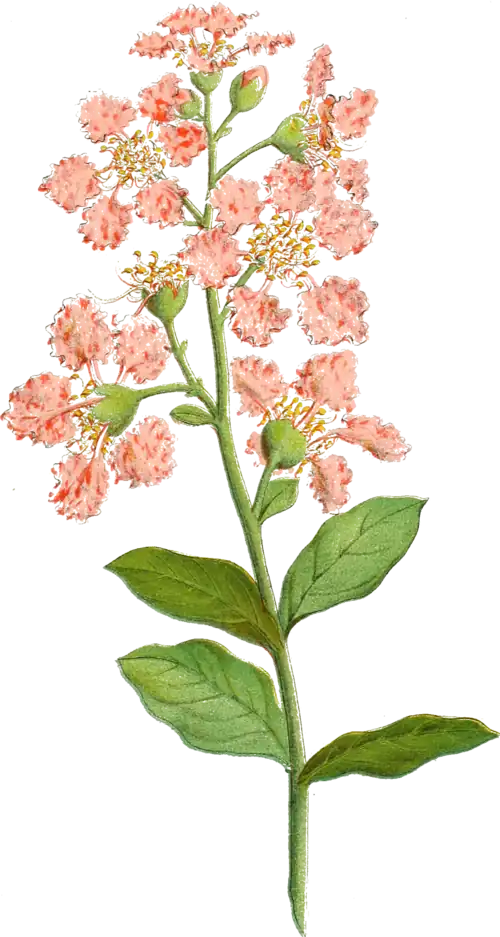
Lagerstromia Indica.