Familiar Indian Flowers: with Coloured Plates/Jatropha Multifida
JATROPHA MULTIFIDA.
PHYSIC NUT. CORAL PLANT.
NATURAL ORDER, EUPHORBIACEÆ.
THIS plant belongs to the same genus as the Tapioca, the botanical name of that being "Jatropha Manihot.”
There is much resemblance in the growth of both bushes, and in the palm-like, deeply serrated leaves, but the Tapioca plant could never claim the name of “coral” for its flowers, as they are of a pale, yellowish colour.
The style and character of the leaves is shown in the plate, but they crow so large that only a middling-sized one could be produced; they are borne at the summit of a long, rod-like stem, a large cluster at the head of each, with one bunch of these coral-like flowers shooting up from the centre.
The whole has a very graceful, pleasing appearance, especially when waving in the wind. It is necessary, however, to keep the bush pruned, or the stems get too scraggy, and give a woody, ugly look to the plant.
The foliage is both the peculiarity and the ornament of this shrub, from its long, much slit, and deeply cut lobes.
The trunk is short, dividing into the above-mentioned long, straight branches or "rods,” which are of an ash-coloured bark.
The bright red coral flowers are insignificant in themselves, though when numerous bunches are out at once they give a pretty, spangled look to the bush.
The seed is of a round, bullet shape, described by Ferminger as a “large nut.” These it bears profusely, and when turning ripe and yellow they look very bright and pretty.
I cannot find this particular species mentioned anywhere as being of use medicinally, but from the roots and juice of other varieties oil and medicines are extracted. When writing of the "Jatropha Manihot,” Drury remarks: “It is from the juice of this plant that the Red Indians in South America prepare the most deadly mandioc poison with which they tip their arrows; this is procured by distillation, and it is said that thirty drops will cause the death of a human being in six hours.”
“The pale or whey-coloured juice,” says Dr. Roxburgh, "which exudes from a fresh wound of this plant is employed by the Hindoos to remove films from the eyes.”
Like all members of the Euphorbiaceæ order, this plant exudes a milky juice when broken. It is met with in almost every part of India, but Coromandel and Travancore appear to be its favourites. 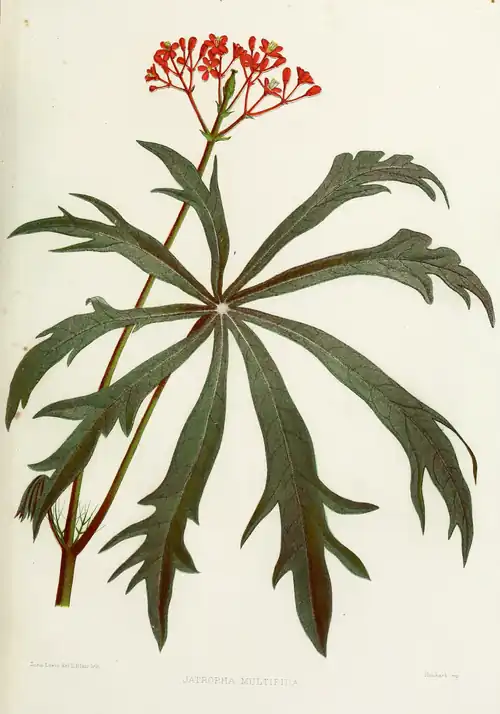
JATROPHA MULTIFIDA.