Familiar Indian Flowers: with Coloured Plates/Duranta Plumieri
DURANTA PLUMIERI.
NATURAL ORDER, VERBENACEÆ.
FROM what I can learn about this shrub there are only two varieties of it known in India, but both are very common, and seem to grow in all parts of the country. I have classed it among the shrubs of India, and in so doing am supported by Ferminger and other good botanical authorities; but, notwithstanding this, I have seen it attain to the height of a small tree, and possibly in an uncultivated state it may grow considerably higher and larger still.
It is a showy, pretty bush, growing in a thick compact form, and even when left unchecked it does not get straggling and unsightly as is generally the case with the Flora of this country.
Constant pruning and cutting back, however, improves these bushes, and should be unsparingly administered,
The leaves are bright and shining, and set the flowers off to great advantage. Like many of the flowers of this order, taken singly they are small and delicate, and might be passed over as insignificant; but when taken either in heads, like the ordinary Verbena, or in sprays, as in our present subject, they are both striking and pleasing to the eye.
This shrub looks green and fresh at all times, as not being deciduous it retains its leaves, and when the flowers fall they are succeeded by bright amber-coloured berries, making it a pretty object throughout the year. The berries are about the size of those of Holly, but each berry hangs separate, a short distance from the stem, instead of in a compact bunch upon the stalk, as is the case with Holly.
It is a common practice to make use of the Duranta as a hedge, for which purpose it is admirably suited, being thick and thorny; but it must be kept low, and never allowed to shoot upwards. When treated in the same manner as Box-edging is done at home it becomes almost, if not entirely, impenetrable.
The Durante is a native of the West Indies, but it thrives in India quite as well as many of the indigenous plants of that country.
It is propagated by either cuttings or seeds, of which latter it bears abundantly.
Soil is of no importance to these plants, as, being very hardy, they grow everywhere.
One botanist, in writing on the “Duranta Plumieri," states it has the perfume of almonds, but I have never been able to discover any scent about either of the varieties; nor is the fact mentioned by other botanical authorities.
The second variety of this shrub is called “Duranta Ellisii,” and the only perceptible difference between them is, that the flowers of this one are white instead of blue.
From a utilitarian point of view the Duranta, as far as I know, is of no use or importance; it possesses no qualities to render it of any value either in pharmacy or otherwise. 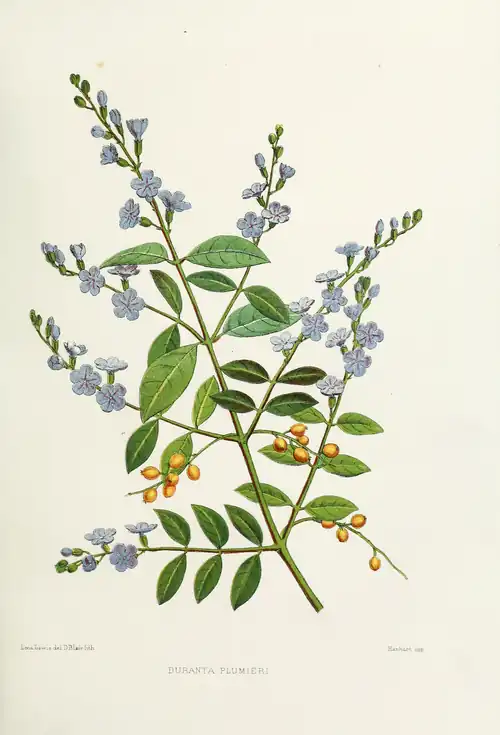
DURANTA PLUMIERI.