Familiar Indian Flowers: with Coloured Plates/Convolvulus Pentanthus
CONVOLVULUS PENTANTHUS.
NATURAL ORDER, CONVOLVULACEÆ.
TO amateurs and learners of botany the differences and distinctions of the Ipomea and Convolvulus tribes are very puzzling.
The shape of the flowers, the style, growth, and general appearance of the plants are so similar that it is only those who have studied minutely the construction of the flowers who can define the distinction.
The above name is the one usually given to this fascinating creeper by the generality of people, but Ferminger mentions that "it is commonly called ‘Ipomza Semperiflorens.'"
It is an annual, blossoming in the cold weather, when it is a lovely sight with its bright azure-blue flowers spangled over the green leaves, and often hanging in graceful festoons from a trellis or archway.
The young shoots are of a tender, pale green, tinged with pink, slightly hairy; the flowers grow at the end of thin, long stalks, several buds being in a cluster.
The thin, twining stems twist themselves into a “gigantic tangle,” and add much to the free, natural look of the plant; it requires a support, and does not thrive well if left to trail on the ground.
It is a common plant about Calcutta, and | have seen it in great beauty in Chota Nagpore.
The stamens are sinall and black. The throat is flatter than most of the Convolvulaceæ and is pure white. The flower has no scent and is only useful as an ornament to the garden. It seeds profusely and can also be propagated by division of roots.
The flowers wither and droop very quickly, but are soon replaced by other buds opening, and at noon this little creeper presents a lovely sight with its blaze of blossom open to the sun. 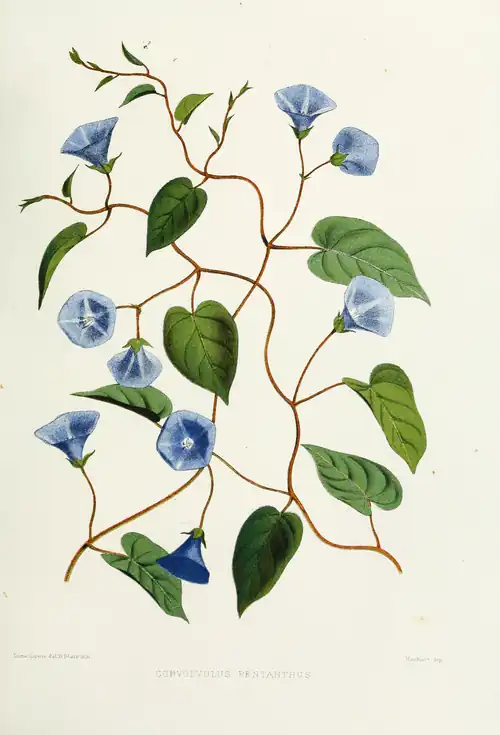
CONVOLVULUS PENTANCHERA.