Familiar Indian Flowers: with Coloured Plates/Bauhinia Acuminata
BAUHINIA ACUMINATA.
MOUNTAIN EBONY.
NATURAL ORDER, CÆSALPINEAEÆ.
THE plant now before us belongs to a very extensive genus, all the varieties of which are remarkable for the peculiar form of their leaves, which are like two oval leaflets united at the base. Ferminger tells us that the genus, “in consequence of this twin-like union, has been fancifully named after the two brothers Bauhin.” They were well-known French navigators. The variety depicted in the plate is a shrub or small tree about ten feet high, nearly always in blossom, being a pleasing object with its numerous pure white flowers.
There is little resemblance between the flowers of the various species of this extensive genus, but they are all exquisitely beautiful, both in colour and form.
“Bauhinia Variegata,” called by the natives “Kuchnar,” is a large tree, having a trunk about the size of a man’s body; it blossoms in February, and is then an object of great splendour. The flowers are purple and white, large and handsome, and having a great resemblance to those of a pelargonium. Many of the species have sulphur-coloured flowers speckled with purple.
Both medicinally and economically the Bauhinia plants are invaluable. "Bauhinia Tomentosa” Drury mentions as being used by doctors, while the leaves of various species are also valuable for a decoction made from them. The seeds are eaten, and said to be a tonic.
One of the most remarkable of this genus is, I think, ‘‘Bauhinia Vahlii.” It is a climber of great extent, covering tree after tree with its large leaves, until a whole wood or “Tope” becomes shaded by it. The flowers are cream-coloured with purple spots, and hang in spiral-like bunches. ‘The trunk of this species was the thickness of a man’s thigh in our garden, and the leaves I have sometimes seen nearly a foot in diameter.
“In the northern districts of the ‘Circars’ the leaves are sold in the bazaars for various purposes, such as plates and packages. Ropes are made from the bark. The natives boil and then beat it, which makes it soft and pliable. The ropes have been occasionally used for suspension bridges over the mountain torrents in the Himalayan valleys.” (Rogh. Fib, Plants.)
I find Roxburgh has described this variety under the name of “Bauhinia Racemosa,” and says: ‘It is a native of all the mountainous parts all over India, where it runs over the highest trees.” He also mentions that the seeds are flat, smooth, and brown. They are eaten raw; when ripe the taste is like that of cashew nuts. 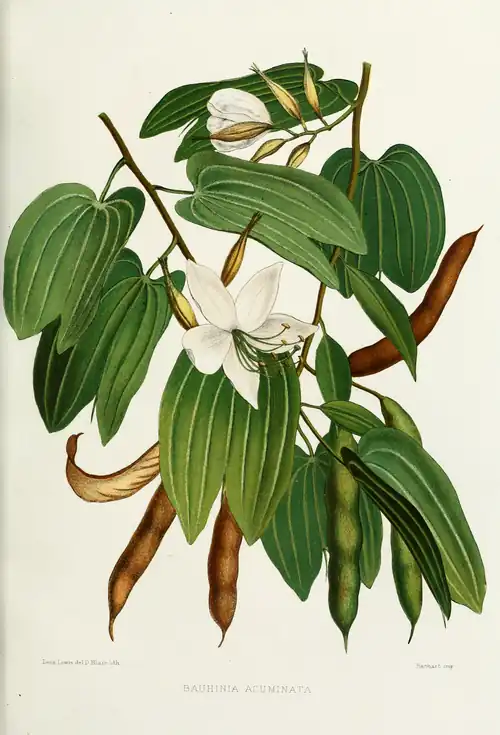
BAUHINIA ACUMINATA.