Familiar Indian Flowers: with Coloured Plates/Argyreia Nervosa
ARGYREIA NERVOSA.
ELEPHANT CREEPER.
NATURAL ORDER, CONVOLVULACEÆ.
THE English name of this plant gives a very fair idea of the size and magnitude to which it grows. Ferminger has briefly described its luxuriant and massive growth as follows: "It is quite unmanageable in a garden unless it can be trained up some tree or out- house.”
Roxburgh has a description of this plant under the name of "Lettsomia Nervosa," and mentions a rather strange occurrence, viz., that he "had some seeds sent him from England called ‘Convolvulus Speciosus,’ but which produced this identical plant. Stigma, &c., perfectly the same as in the original Bengal plant.”
It is a native of forests and hedges, and is one of the largest species of convolvulaceæ known.
The leaves are heart-shaped, and grow to a large size; they are smooth on the upper side, with parallel veins, and have a beautiful silky down underneath. The stems also are covered with silky down, and are of a pretty cream colour.
The umbels of the flowers are deep and very large. They generally grow in bunches, and the "bractes” “many, large, oval, white, waved, pointed, and caducous.” (Roxb.)
It is these white, crinkled-looking bractes which are one of the characteristics of the plant. They form a beautiful contrast to the dark handsome flowers.
It blossoms in Bengal during July and August, and seeds profusely.
I have seen it growing over a skeleton shed made of cross bars of wood, but during the time it was at the height of its perfection the shed had the appearance, when inside, of being thickly thatched, from the luxuriant and heavy growth of this plant.
During the cold weather it casts its leaves and looks equally bare and deplorable.
Major Drury mentions that this plant grows in the Malabar forests and in hedges in the Peninsula. He also states, quoting Ainslie and Gibson, that it is useful in pharmacy, the native doctors making different uses of the upper and under parts of the leaves.
Yor industrial purposes the “Elephant Creeper” does not appear to be conspicuous, as far as I can ascertain. 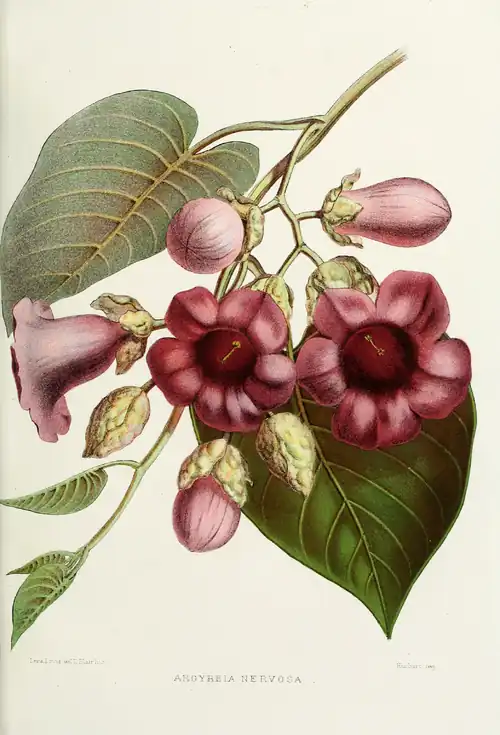
ARGYREIA NERVOSA.