Encyclopædia Britannica, Ninth Edition/Japan
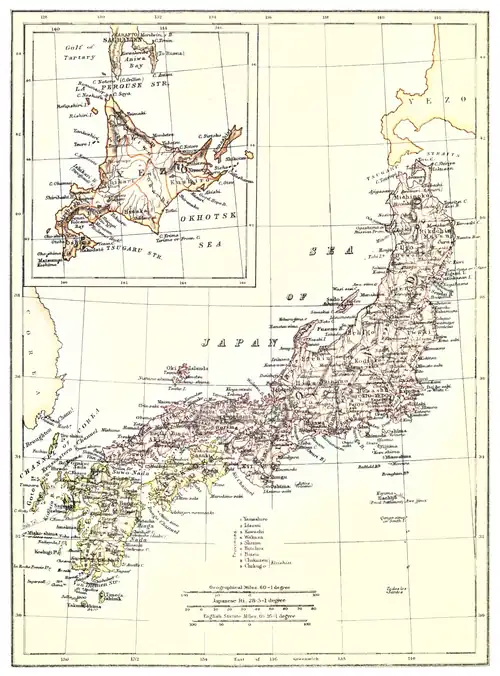
W & A. K. Johnston, Edinburgh, & London.
ENCYCLOPÆDIA BRITANNICA, NINTH EDITION
Japan
Plate IX.The empire of Japan consists of a long chain of islands separated from the eastern coast of Asia by the Seas of Japan and Okhotsk, and extending from 24° to 50° 40′ N. lat., and from 124° to 156° 38′ E. long. It commences with the Kurile Islands and descends in a southwesterly direction to the Loochoo group, to which the Japanese Government reasserted their claim in 1875. The southern portion of the island of Saghalien was ceded to Russia in exchange for the Kuriles. The whole empire is called by the natives Dai Nippon, or “Great Japan”; but Nippon or Nihon is often employed alone. Nippon means literally “sun’s origin,” i.e., the land over which the sun first rises, and thus denotes the position the empire occupies in the extreme East. The principal islands may be enumerated as follows:—
- 1. The main island, which does not bear any special name. In many of the older geographical works it is stated that Nippon is the distinctive appellation of this one island, but by the Japanese themselves the name is applied only to the whole country.
- 2. Kiushiu (lit., “the nine provinces”).
- 3. Shikoku (lit., “the four provinces”).
- 4. Yezo.
- 5. Sado.
- 6. Tsushima.
- 7. Hirado (often wrongly written Firando).
- 8. Awaji.
- 9. Ôshima (“Vries Island”) and the chain adjacent to it, terminating with Hachijô (misspelt on charts Fatsisio).
- 10. Iki, with several smaller isles.
- 11. The Oki group.
- 12. The Gotô group.
- 13. The Bonin group.
- 14. The Riukiu (Loochoo) group.
- 15. The Kurile group (Chijima; lit, “the thousand islands”).
Owing to the lack of reliable surveys, it is exceedingly difficult to form a correct estimate of the area of the Japanese empire. A few years ago the Government instituted surveying operations under the direction of skilled foreign engineers, and an ordnance map of the city of Tôkiô has already been prepared and published; but any correct calculation of the size of the whole country can hardly be obtained for some years to come. In a work on general geography published a few years ago by the Education Department at Tôkiô, the area of Japan is stated to be 24,780 square ri, which measurement, taking the linear ri as equal to 2.45 English miles, gives a total of about 148,742 miles, or nearly one-fourth more than the area of the United Kingdom. This estimate, however, is founded on maps which are far from correct.[1]
The old division of Japan into provinces was made by the emperor Seimu (131–190 A.D.), in whose time the jurisdiction of the sovereign did not extend further north than to a boundary line running from the Bay of Sendai, on the east coast of the main island, to near the present treaty port of Niigata on the west coast. The northern portion beyond this line was then occupied by barbarous tribes, of whom the Ainos (still to be found in Yezo) are probably the remaining descendants. The whole country was then divided into thirty-two provinces. In the 3d century the empress Jingô, on her return from her victorious expedition against Corea, portioned out the empire into five home provinces and seven circuits, in imitation of the Corean system. By the emperor Mommu (696–707) some of the provinces were subdivided so as to increase the whole number to sixty-six, and the boundaries then fixed by him were resurveyed in the reign of the emperor Shômu (723–756). The old division is as follows:—
I. The Go-kinai, or “five home provinces,” i.e., those lying immediately around Kiôto, the capital, viz.:—
| Yamashiro[2] | also called | Jôshiu |
| Yamato, | also called„ | Washiu. |
| Kawachi, | also called„ | Kashiu. |
| Idzumi, | also called„ | Senshiu. |
| Setsu, | also called„ | Sesshiu. |
II. The seven circuits, as follows:—
1. The Tôkaidô, or “eastern-sea circuit,” which comprises fifteen provinces, viz.:—
| Iga | or | Ishiu. |
| Isé | or„ | Seishiu. |
| Shima | or„ | Shishiu. |
| Owari | or„ | Bishiu. |
| Mikawa | or„ | Sanshiu. |
| Tôtômi | or„ | Enshiu. |
| Suruga | or„ | Sunshiu. |
| Idzu | or„ | Dzushiu. |
| Kai | or„ | Kôshiu. |
| Sagami | or„ | Sôshiu. |
| Musashi | or„ | Bushiu. |
| Awa | or„ | Bôshiu. |
| Kadzusa | or„ | Sôshiu. |
| Shimôsa | or„ | Sôshiu. |
| Hitachi | or„ | Jôshiu. |
2. The Tôzandô, or “eastern-mountain circuit,” which comprises eight provinces, viz.:—
| Ômi | or | Gôshiu. |
| Mino | or„ | Nôshiu. |
| Hida | or„ | Hishiu. |
| Shinano | or„ | Shinshiu. |
| Kôdzuké | or„ | Jôshiu. |
| Shimotsuké | or„ | Yashiu. |
| Mutsu | or„ | Ôshiu. |
| Déwa | or„ | Ushiu. |
3. The Hokurikudô, or “northern-land circuit,” which comprises seven provinces, viz.:—
| Wakasa | or | Jakushiu. |
| Echizen | or„ | Esshiu. |
| Kaga | or„ | Kashiu. |
| Noto | or„ | Nôshiu. |
| Etchiu | or„ | Esshiu. |
| Echigo | or„ | Esshiu. |
| Sado (island) | or„ | Sashiu. |
4. The Sanindô, or “mountain-back circuit,” which comprises eight provinces, viz.:—
| Tamba | or | Tanshiu. |
| Tango | or„ | Tanshiu. |
| Tajima | or„ | Tanshiu. |
| Inaba | or„ | Inshiu. |
| Hôki | or„ | Hakushiu. |
| Idzumo | or„ | Unshiu. |
| Iwami | or„ | Sékishiu. |
| Oki (group of islands). | ||
5. The Sanyôdô, or “mountain-front circuit,” which comprises eight provinces, viz.:—
| Harima | or | Banshiu. |
| Mimasaka | or„ | Sakushiu. |
| Bizen | or„ | Bishiu. |
| Bitchiu | or„ | Bishiu. |
| Bingo | or„ | Bishiu. |
| Aki | or„ | Geishiu. |
| Suwô | or„ | Bôshiu. |
| Nagato | or„ | Chôshiu. |
6. The Nankaidô, or “southern-sea circuit,” which comprises six provinces, viz.:—
| Kii | or | Kishiu. |
| Awaji (island) | or„ | Tanshiu. |
| Awa | or„ | Ashiu. |
| Sanuki | or„ | Sanshiu. |
| Iyo | or„ | Yoshiu. |
| Tosa | or„ | Toshiu. |
7. The Saikaidô, or “western-sea circuit,” which comprises nine provinces, viz.:—
| Chikuzen | or | Chikushiu. |
| Chikugo | or„ | Chikushiu. |
| Buzen | or„ | Hôshiu. |
| Bungo | or„ | Hôshiu. |
| Hizen | or„ | Hishiu. |
| Higo | or„ | Hishiu. |
| Hiuga | or„ | Nisshiu. |
| Ôsumi | or„ | Gûshiu. |
| Satsuma | or„ | Sasshiu. |
III. The two islands, viz.:—
- 1. Tsushima or Taishiu.
- 2. TsushimaIki or„ Ishiu.
Upon comparing the above list with a map of Japan it will be seen that the main island contains the Go-kinai, Tôkaidô, Tôzandô, Hokurikudô, Sanindô, Sanyôdô, and one province (Kishiu) of the Nankaidô. Omitting also the island of Awaji, the remaining provinces of the Nankaidô give the name Shikoku (“the four provinces”) to the island in which they lie; while the Saikaidô coincides exactly with the large island of Kiushiu (“the nine provinces”). This name Kiushiu must not be confounded with that of the one province of Kishiu on the main island.
In 1868, when the rebellious nobles of Ôshiu and Déwa, in the Tôzandô, had submitted to the mikado (the emperor), those two provinces were subdivided, Déwa into Uzen and Ugo, and Ôshiu into Iwaki, Iwashiro, Rikuzen, Rikuchiu and Michinoku (sometimes also called Mutsu). This increased the old number of provinces from sixty-six to seventy-one. At the same time there was created a new circuit, called the Hok’kaidô, or “northern-sea circuit,” which comprised the eleven provinces into which the large island of Yezo was then divided (viz., Oshima, Shiribéshi, Ishikari, Téshiwo, Kitami, Ifuri, Hitaka, Tokachi, Kushiro, and Nemuro) and the Kurile Islands (Chijima).
Another division of the old sixty-six provinces was made by taking as a central point the ancient barrier of Osaka on the frontier of Ômi and Yamashiro,—the region lying on the east, which consisted of thirty-three provinces, being called the Kuantô, or “east of the barrier,” the remaining thirty-three provinces on the west being styled Kuansei, or “west of the barrier.” At the present time, however, the term Kuantô is only applied to the eight provinces of Musashi, Sagami, Kôdzuké, Shimotsuké, Kadzusa, Shimôsa, Awa, and Hitachi,—all lying immediately to the east of the old barrier of Hakoné, in Sagami.
Chiu-goku, or “central provinces,” is a name in common use for the Sanindô and Sanyôdô taken together. Sai-koku, or “western provinces,” is another name for Kiushiu, which in books again is frequently called Chinsei.
Each province (kuni) is divided into what may be termed departments (kôri). The latter vary in number according to the size of the province. In the old system there were altogether six hundred and twenty-nine departments, but the addition of the Hok’kaidô has raised the number to considerably over seven hundred.
For purposes of administration the whole of the empire except the Hok’kaidô was again divided in 1872 into three cities (fu) and seventy-two prefectures (ken). The three cities are Yedo, Ôzaka, and Kiôto. In 1869 Yedo also received the name of Tôkiô, or “eastern capital,” as opposed to Saikiô (the new name for Kiôto), or “western capital.” This was in consequence of the removal of the emperor’s court from his old capital to Yedo. It may, however, be here remarked that, whilst the Japanese invariably speak of Tôkiô Fu, “the city of Tôkiô,” they use the name Kiôto Fu, “the city of Kiôto,” and not, as might have been supposed, Saikiô Fu. The limits of the prefectures (ken) were irrespective of the boundaries of the provinces. There were originally seventy-two, but a gradual process of amalgamation has considerably reduced the list; and in August 1876 a Government notification fixed the prefectures at only thirty-five, the names of which are given in the following table:—
- The Home Provinces (1½) Sakai, Hiôgo (part)—apart from the two cities of Ôzaka and Kiôto.
- Tôkaidô (8)—Ibaraki, Chiba, Saitama, Kanagawa, Yamanashi, Shidzuoka, Aichi, Miyé—apart from the city of Tôkiô.
- Tôzandô (11)—Awomori, Iwadé, Miyagi, Fukushima, Akita, Yamagata, Tochigi, Gamma, Nagano, Gifu, Shiga.
- Hokurikudô (2)—Niigata, Ishikawa.
- Sanindô (1)—Shimané.
- Sanyôdô (3½)—Hiôgo (part), Okayama, Hiroshima, Yamaguchi.
- Nankaidô (3)—Wakayama, Ehimé, Kôchi.
- Saikaidô (5)—Ôida, Fukuoka, Kumamoto, Nagasaki, Kagoshima.
From the above list it may be noted that in many instances a single ken now contains several provinces or portions of different provinces. In 1878–9 a separate prefecture (called the Okinawa ken) was created, including the Riukiu (Loochoo) group. Until that time Riukiu was governed by a king of its own, but being in fear of its powerful neighbours, China and Japan, it had for many years sent tribute to both. A question of double allegiance thus arose, which was solved by Japan asserting its sovereignty; the king received the title of noble of Japan, and the Okinawa ken was established. Whether this action on the part of the Japanese Government may not embroil them with China is a point not yet definitely settled.
Smaller islands.The total number of islands in the Japanese group, exclusive of the four main ones, is stated to be over three thousand. Many of these are mere barren rocks, uninhabited and uncultivated. Others, again, are of considerable size and exceedingly fertile, particularly the countless islets in the Suwo Nada, commonly known to Europeans under the name of the “Inland Sea,” lying between the main island on the north and the islands of Shikoku and Kiushiu on the south. The whole coast-line, too, is dotted with islands and rocks of all sizes. Ôshima, also called Vries Island, at the mouth of the Bay of Yedo, is one of considerable importance. It has many inhabitants, and its volcanic soil is fairly productive. It is the most northerly of a chain which extends as far south as the 27th degree of north latitude. The Bonin group, termed by the Japanese the Ogasawara Islands, lies far out at sea, to the south of the entrance of Yedo Bay; it consists of two large islands, separated from each other by 50 miles of sea, and a host of islets. The Japanese Government reasserted their sovereignty over the Bonins in 1878. The Kurile Islands are merely a chain of barren rocks, and the few inhabitants are chiefly occupied in the fisheries and in hunting the sea-otter. Due south from the province of Satsuma lie several minor groups, terminating with the Riukiu Islands. The Gotô group (lit. “the five islands”) extends in a westerly direction from the province of Hizen, in Kiushiu, to which it belongs.
Bays.Coast-line.—The bays along the coast are often of considerable size. The Japanese, strange to say, have no names for either their bays or their straits, the appellations found on maps and charts having been given by European navigators. Yedo Bay is perhaps the best known to foreigners, but Sendai Bay (on the east coast) and that running up to the north of the island of Awaji, and commonly called Ôzaka Bay, are also famous. Owari Bay, in the province of that name, is of considerable size. The Bay of Kagoshima, in the province of Satsuma, is long and narrow; it is well known to foreigners as having been the scene in 1863 of an attack on Kagoshima (the castle-town of the lord of Satsuma) by a British squadron. The entire coast-line teems with smaller bays and harbours, in many of which good anchorage can be found. An English man-of-war, the “Sylvia,” has for several years been employed as a surveying vessel to obtain soundings of the principal inlets and draw up charts of the coast.
Straits.The straits best known to foreigners are the Straits of Tsugaru (often miscalled Saugur in maps), which separate Yezo from the northern portion of the main island; the Straits of Akashi and of Idzumi, near the island of Awaji, at the eastern entrance of the “Inland Sea”; and the Straits of Shimonoséki, at the extreme western end of that sea, separating the main island from Kiushiu. The attack on Shimonoséki in 1864 by an allied squadron of English, French, Dutch, and American vessels, in retaliation for injuries inflicted upon foreign shipping passing through the straits by the batteries erected by the lord of Chôshiu (in which province Shimonoséki is situated) is a matter of historical note. The current in these straits is so swift that vessels have difficulty in stemming it unless under steam.
Capes.It will suffice to name a few of the almost countless promontories and capes along the coast. On the extreme north of the main island we have Riuhi-zaki and Fujishi-zaki in the Tsugaru Straits. Inuboyé no saki lies on the east coast just below the mouth of the Tonégawa. Su-saki in Awa and Miura no misaki (called by foreigners Cape Sagami) mark the entrance to the Bay of Yedo. Cape Idzu is in the province of that name, and at the southern extremity of the province of Kishiu are Idzumo-zaki and Shiwo no misaki. Muroto-zaki and Ashizuri no misaki are the chief promontories on the south coast of the island of Shikoku, both being situated in the province of Tosa. Tsutsui-zaki in Hiuga, and Sata no misaki (better known to Europeans as Cape Chichakoff) in Ôsumi are the extreme southern points of the island of Kiushiu. In the island of Yezo there are several noticeable promontories.
Harbours.The number of harbours and trading-ports called by the natives ô-minato (“large harbours”) is stated to be fifty-six, but many of these would no doubt be inaccessible to foreign vessels of heavy tonnage. They are, however, admirably adapted for the accommodation of coasting junks and fishing craft, and these vessels have no lack of places of refuge in heavy weather. In many instances the entrances are blocked by one or more small islands or rocks, which render the anchorage within even more secure. In Yezo the port of Matsumae is the one best known. The Bay of Yedo abounds with harbours, some being situated within the mouths of the rivers. In Idzu, Shimoda is one that deserves special mention; the water is there very deep, and it is a common occurrence for vessels beating up towards the entrance of Yedo Bay to seek shelter in it. Shimidzu in Suruga is also a well-known place; a long sandy promontory covered with fir trees defends the port from the sea on the south. In the province of Shima are Toba and Matoya, both magnificent harbours. The “Inland Sea” is, of course, especially rich in this respect, the harbour of Mitarai, between two islands near the province of Aki, being a favourite place of call. In Shikoku, Takamatsu in Sanuki is the best known. Kiushiu is abundantly supplied, Kagoshima in Satsuma being one of the largest and best. The harbours on the north-west coast of the main island are also numerous, and each of the islands Tsushima, Iki, and Sado possesses one. The ports thrown open to foreign trade since the year 1859 are Yokohama, Hiôgo (Kôbé), and Niigata on the main island, Nagasaki in Kiushiu, and Hakodaté in Yezo.
MountainsMountains.—Japan, as might reasonably be expected in a country where volcanoes are so numerous, is very hilly; and in some districts there are many mountains of considerable height. The most extensive plains are those of the Kuantô and Echigo, and the north of Ôshiu. The provinces of Mikawa, Mino, and Owari are also very flat. Half-way between Tôkiô (Yedo) and Kiôto lies the great watershed of the east of Japan, the table-land of Shinano, elevated some 2500 feet above the level of the sea. The ridges around or forming part of it are very lofty, particularly those of the province of Hida. The plain of Yedo lies to the east of this table-land, about 1800 feet below, while to the north the hills gradually slope away to the province of Echigo. Another range of considerable height runs due north from Aidzu to Tsugaru, thus dividing the old provinces of Ôshiu and Déwa. The province of Kai is almost entirely surrounded by mountains, and the hill scenery in Kishiu and near Kiôto is exceedingly fine. Shikoku possesses some large ridges, and the south of Kiushiu, especially in the provinces of Higo and Hiuga, is also by no means deficient. Even in the wide rice-plains throughout the country there may often be seen minor elevations or hills, rising abruptly, in some cases to a considerable height. The mountain best known to foreigners is Fuji-san,—commonly, but most erroneously, termed Fusiyama or Fusi-no-yama in geographical works. It rises more than 12,000 feet above high-water level, and is in shape like a cone; the crater is 500 feet deep. It stands on the boundary line of the three provinces of Kai, Suruga, and Sagami, and is visible at a considerable distance seaward. It is regarded by the natives as a sacred mountain, and large numbers of pilgrims make the ascent to the summit at the commencement of summer. The apex is shaped somewhat like an eight-petaled lotus flower, and offers from three to five peaks to the view from different directions; it is visible from no less than thirteen different provinces. Though now apparently extinct, it was in former times an active volcano, and Japanese histories mention several very disastrous eruptions. The last of these occurred in 1707, when the whole summit burst forth into flames, the rocks were shattered and split by the heat, and ashes fell even in Yedo (about 60 miles distant in a direct line) to a depth of several inches.[3] After Fuji-san may be mentioned Gassan in the province of Uzen, Mitaké in Shinano, the Nikkô range in Shimotsuké, Ôminé in Yamato, Hakusan in Kaga, Tatéyama in Etchiu, Kirishima-yama in Hiuga, Asosan in Higo, Tsukuba-san in Hitachi, Onsen-ga-také in Hizen, Asama-yama in Shinano, Chôkaizan in Ugo, and Iwaki in Michinoku. There are several active volcanoes in the country, that best known to foreigners being Asama-yama. This mountain is 8500 feet in height. The earliest eruption of which records now exist seems to have taken place in 1650; after that the volcano was only feebly active for one hundred and thirty-three years, when there occurred a very severe eruption in 1783. Even so lately as 1870 there was a considerable emission of volcanic matter, at which time, also, violent shocks of earthquake were felt at the treaty port of Yokohama. The crater is very deep, with irregular rocky walls of a sulphury character, from apertures in which sulphurous fumes are constantly sent forth. At present very little is known in regard to the heights of the mountains, but the subject is one that has attracted the attention of foreign residents in Japan for several years past. The following is an approximate estimate:—
| 1. |
|
12,365 feet | (above high-water mark at the town of Numadzu). | ||
| 2. |
|
8,500 feet„ | |||
| 3. |
|
7,800 feet„ | |||
| 4. |
|
5,400 feet„ | |||
| 5. |
|
5,000 feet„ | |||
| 6. |
|
4,100 feet„ | (according to Siebold). |
Rivers.Rivers.—The rivers of Japan, although very numerous, are in no case of any great length. This of course is easily explained by the fact that the islands are narrow and hilly. The longest and widest river is the Tonégawa, which rises in the province of Kôdzuké, and flows due east to the Pacific, throwing off, however, at Sékiyado in Shimôsa, a branch that flows into Yedo Bay near the capital.[4] The length of the Tonégawa is over 170 miles. At Sékiyado (which is a large and thriving river-port) the water is no less than 40 feet in depth, while a few hundred yards above that town foot-passengers can ford the stream without any great difficulty. The Shinano-gawa and Kiso-gawa, both of which take their rise in the province of Shinano, rank next to the Tonégawa. The former flows first in a north-westerly direction, next due north, and then north-east through Echigo to the sea at Niigata; the Kiso-gawa flows to the westward and then to the south, between the provinces of Mino and Owari, and finally falls into the sea at Kuwana. The Ôi-gawa rises in the south-west of Kai, and traverses the province of Tôtômi; it is less remarkable for the length of its course than for the great breadth of its bed, which near the mouth is 2½ miles across, its current being also very swift. The Fuji-kawa, flowing due south from the mountains of Kai through the province of Suruga, is famous as being one of the swiftest streams in all Japan. In the north, the Sakata-gawa flows due west from the range of mountains separating the provinces of Uzen and Rikuzen, and enters the Sea of Japan at the town of Sakata, from which it takes its name. Nearly all the rivers are fed by countless tributary streams, which in many cases form a complete network in the lower portions of the country, and thus greatly facilitate transport from the interior to the coast. On the Tonégawa and a few other streams of greater depth small river steamers ply for several miles; but in general large flat-bottomed boats, drawing as a rule but a few inches of water, are employed. It is by no means uncommon to see boats of this description in process of construction even in remote country villages on the banks of streams in which the depth of water is but from 12 to 18 inches at ordinary times. Floods are of frequent occurrence, especially at the commencement of summer, when the melting of the snows on the mountain ranges causes at times an almost incredible downflow from the higher lands to the plains. These floods invariably occasion great destruction of property, as the bridges spanning the rivers are only built of wood and turf, supported by piles. In some localities, notably in the western portion of the province of Shimôsa, traversed by the southern branch of the Tonégawa, large tracts of rice-land are almost entirely destroyed by the fine sand from the bed of the river, swept over the fields during inundations. In addition to boats, long rafts of timber are constantly to be seen descending the larger rivers; the logs are floated down in a rough state, to be afterwards thinned and sawn up at the seaport towns where the timber trade is carried on.
Lakes.Lakes.—Japan contains a large number of lakes, but only one—the Biwa Lake, in the province of Ômi—is worthy of special notice on account of its size. Its length is about 50 miles, and its greatest breadth about 20 miles. At a village called Katada, some 10 miles from its southern extremity, it suddenly contracts to a breadth of only a mile and a half, after which it again slightly expands. This lake derives its name from a fancied resemblance to the biwa or Japanese lute; the scenery around it is particularly beautiful, and it is a favourite resort for sightseers from Kiôto. An ancient Japanese legend asserts that in the year 286 B.C., in the reign of the emperor Kôrei, there occurred a terrible earthquake, when the earth opened and Lake Biwa was formed; at the same time rose the mountain called Fuji-san. In Ômi there is a small hill called Migami, which in shape slightly resembles Fuji-san, and this fact is quoted by the natives in support of the theory connecting the lake with the sacred mountain; and the inhabitants of Ômi were privileged to undertake the ascent of Fuji-san after only seven days’ purification, instead of one hundred days’, the prescribed term for all other persons. After Biwa may be noted the lakes of Chiuzenji, Suwa, and Hakoné, all of which lie far above the level of the sea. That of Chiuzenji is situated at the foot of the mountain called Nantai-zan, in the Nikkô range in the province of Shimotsuké. The scenery in its vicinity has given rise to the proverb that he who has not seen Nikkô should not pronounce the word “beautiful.” The lake of Suwa is in the province of Shinano, and can be reached by a road called the Nakasendô, running north-west from Tôkiô through the heart of the country to Kiôto. The Hakoné Lake lies in the range of hills bearing the same name just to the east of Fuji-san; the water is exceedingly cold, and of great depth. A Japanese legend, indeed, asserts that it has never been fathomed. The hill scenery around it is very picturesque, and large numbers of foreign residents from Tôkiô and the neighbouring port of Yokohama visit it during the summer months. The Inawashiro Lake, in the province of Iwashiro, is said to be about 10 miles in length. It is fed by two streams flowing from the east and north-east, while out of it flows the Aka-no-gawa, which falls into the sea near Niigata. It is surrounded by hills of no great elevation; the temperature there is cool, and in winter the streams are frozen for several weeks. On the boundary line of the provinces of Hitachi and Shimôsa there are also large tracts of water, or lagoons (Japanese numa), fed by the Tonégawa; these, though not actually lakes, may almost be classed under that heading, as their connexion with the river itself consists in many cases of but one narrow outlet. Those of chief note are the Ushiku-numa in Hitachi, and the Imba-numa, Téga-numa, and Naga-numa in Shimôsa. The country in this vicinity is as a rule exceedingly flat, but the Imba-numa is for some distance along its eastern shore bordered by small hills, thickly wooded down to the water’s edge, the whole forming a very pretty landscape. The lagoons are well stocked with fish, the large eels found in the Ushiku-numa being especially prized for excellence of flavour; in the winter months they teem with wild fowl. The inhabitants of the numerous villages along the shores are, in fact, almost entirely maintained by fishing and shooting or trapping.
Minerals.Minerals.—Japan is particularly rich in minerals, among which may be specially mentioned gold, silver, iron, copper, coal, and stone of various kinds. The gold was first discovered and melted in the year 749 A.D., during the reign of the emperor Shômu; it came from the department of Oda in the province of Ôshiu, and in the following year more was found in the province of Suruga. During the long period of Japan’s seclusion from the rest of the world, the gold discovered remained in the country, and the amount augmented year by year; and this no doubt tended in a great degree to convey to the earlier foreign visitors the impression that the supply was far more abundant than was actually the fact. The quantity of bullion exported by the Portuguese during their stay in Japan (1550–1639) may be estimated at the least at fifty-nine and a half millions sterling, or an average of £660,000 yearly. Dr Kaempfer even speaks of some years with an export of two and a half millions of gold. From 1649 to 1671 the Dutch also exported large quantities, together with silver and copper, and the total value of gold and silver alone sent out of Japan during the 16th and 17th centuries may be estimated at nearly one hundred and three millions sterling. At an exhibition held in Kiôto in 1875 were shown about twenty samples of gold ore found in different provinces. The ore is generally poor, and many gold-yielding places are now lying unworked, because the increased cost of labour renders it very difficult to work them with profit. Pure auriferous quartz has been found in the provinces of Satsuma and Kai, gravel in Ôsumi, and quartz in Rikuchiu and at the mine of Aikawa in the island of Sado. The mode in which the Japanese work the gold ores nearly resembles Western methods. They understand perfectly the separation of even the smallest quantities of gold dust from stones and gravel by means of a system of washing and levigation. They do not, however, possess any good process for the separation of gold from silver, and hence all Japanese gold contains a greater or less proportion of the latter metal. Silver ore was discovered accidentally in the year 667 A.D., in the island of Tsushima; this ore produced the first Japanese silver metal, in the year 674. From 1400 to 1600 it was obtained and melted in Japan in far larger quantities than at the present time. It generally occurs in comparatively small quantities as an admixture in several copper and lead ores. The principal mines are in the provinces of Jôshiu, Iwami, and Setsu; but it is also found mixed with lead in Hida, Iwashiro, Echizen, Echigo, Rikuchiu, Suwô, Hiuga, and Higo. Of the numerous iron ores to be found, the principal is magnetic iron ore, which forms the main basis of the Japanese iron industry. Loadstone was discovered in the year 713 in the province of Ômi. The exact date of the first manufacture of iron is unknown; it is certain only that the Japanese have worked their iron ores from the 10th century onward. The principal seats of the industry are in the provinces of Idzumo, Bingo, Ôshiu, Hiuga, Tajima, Wakasa, Bizen, Bitchiu, Shinano, Tôtômi, Kai, Suruga, and Satsuma. The best steel is manufactured in Harima, Hôki, Idzumo, and Iwami. The excellent temper of the Japanese sword-blades is well known. The most noted smiths formerly resided in the provinces of Sagami, Bizen, and Kishiu, and in the neighbourhood of Kiôto. Japanese legends assert that the first sword was forged in the reign of the emperor Sūjin (97–30 B.C.), but this statement is of course open to considerable doubt. Copper was, it is said, smelted in Japan for the first time in the year 698 at Inaba in the province of Suwô; and in the year 708 the first Japanese copper coin was cast, in the province of Musashi. Since the 10th century enormous quantities of ore have been smelted, and this metal formed the chief trade of the Dutch and Chinese at Nagasaki from 1609 to 1858,—the amount exported by the former being more than four millions of piculs and by the latter undoubtedly still more.[5] It is perhaps the metal most commonly found in Japan, and is used for all kinds of household goods, doors to storehouses, ornaments, temple-furniture, mirrors, bronzes, smoking utensils, and current coinage. It is found and smelted in all parts of the country, particularly in the northern and western provinces, and its export figures considerably in the trade returns of the treaty ports during the past few years. As a rule Japanese copper is exceedingly free from the presence of injurious metals. After the year 1600 many bronze guns were cast in Japan, the workmanship being exceedingly good; these old guns are often to be seen even now, though by far the larger number, together with the temple bells, &c., made from the same material, have been broken up and exported as old bronze by European merchants. Of other metals Japan also produces lead, quicksilver, and tin. Coal is found in large quantities, particularly in Kiushiu, where the province of Hizen contains the well-known mines of Karatsu, and in the island of Takashima, near the treaty port of Nagasaki. Coal-fields also exist in the large northern island of Yezo. Nearly all the steamers plying between Japan and China coal at Nagasaki, where this trade attracts a good deal of enterprise. The numerous quarries throughout the empire afford large quantities of stone. Marble and granite are found principally in the provinces of Shinano, Mino, and Kôdzuké; freestone is also procured from Setsu and Idzu. The huge blocks of which the ramparts of the castle at the capital are built were originally brought from the latter province. In the old castle of Ôzaka, in Setsu, there is an enormous piece of granite measuring thirteen paces in length and about 9 feet in height. The foundations of all the more ancient temples throughout the country are formed of large blocks, and these, together with the long flights of steps, still remain to prove the durability of the old style of architecture. It is strange, however, that at the present moment stone is but sparingly used for building purposes; even in the great cities the dwelling-houses are almost entirely constructed of timber, stone being used only for bridges and for edifices on a larger scale than ordinary.[6]
Climate.Climate.—The climate of Japan, as might naturally be expected in view of the great length of the chain of islands, varies to a considerable extent in different localities.[7] Thus we find that while the Riukiu and Bonin groups, lying close to the tropics, enjoy perpetual summer, the Kurile Islands in the far north of the empire share the arctic temperature of Kamtchatka. The climate is, on the whole, favourable for Europeans, although its frequent changes often prove trying to foreign residents. All the mountain ranges are wrapped deep in snow throughout the winter months; indeed, from many peaks snow never entirely disappears. In the northern provinces it has been known to fall to a depth of no less than 8 feet, and the province of Echigo is specially noted in this respect. At the treaty port of Niigata, in that province, small bamboo sheds are built out from the fronts of the dwelling-houses so as to form a covered way along which pedestrians can pass when the rest of the town is snowed up. At Tôkiô snow falls some three or four times during the winter; it covers the ground to a depth of from 3 to 5 inches on an average, but does not lie long. In January 1876, however, a remarkably severe snowstorm occurred, when the whole city was covered to a depth of 2 feet or more; so unusual was this phenomenon deemed that a large number of photographs of the landscape were taken to perpetuate the memory of the event. Farther to the south and west the cold is not, as a rule, so intense, while in the summer months the heat is far greater. Near Yokohama and Tôkiô the summer commences in May, but the heat only becomes oppressive in July and August, when the thermometer has been known to register 104° F. At the break-up of the summer there are heavy rains, which render the interior of the houses exceedingly damp and uncomfortable. After the winter there also occurs a short rainy season. The best months for making excursions into the interior are April and October, as the weather is then generally of a mean temperature. Southerly winds blow from the middle of May, and often even from April, until the end of August. On the Sea of Japan south-west winds (known as the south-west monsoon) prevail, while in Yokohama and all parts of the country adjacent to the Pacific Ocean southerly winds predominate. The south-west monsoon sets in in April and prevails until the middle or end of September; but the regularity with which the monsoons set in and blow on the Chinese coasts is unknown in Japan. On calm days land and sea breezes alternate on the Japanese coast in the same manner as elsewhere. Mention should here be made of the violent revolving storms, known as typhoons, which are closely related to the West Indian hurricanes and to the cyclones of the Indian seas. These generally occur in the months of July, August, or September; they invariably occasion great damage, not only to shipping, but also to property on land. Large trees are often snapped asunder like mere twigs, while the roofs and chimneys of foreign-built edifices suffer severely. As a rule, one of these storms is experienced every year.
Earthquakes.Destructive earthquakes have often taken place, while slight shocks are of frequent occurrence, several having been felt lately within the space of a few days. Japanese histories furnish numerous records of these phenomena. The ancient legend of the great earthquake in 286 B.C., when Mount Fuji rose and the Biwa Lake was formed, has already been noticed; but it is not possible to procure reliable information for several centuries later than the date mentioned in that fanciful tale. The earliest authentic instance is perhaps that which is said to have occurred in 416 A.D., when the imperial palace at Kiôto was thrown to the ground. Again, in 599, the buildings throughout the province of Yamato were all destroyed, and special prayers were ordered to be offered up to the deity of earthquakes. In 679 a tremendous shock caused many fissures or chasms to open in the provinces of Chikuzen and Chikugo, in Kiushiu; the largest of these fissures was over 4 miles in length and about 20 feet in width. In 829 the northern province of Déwa was visited in similar manner; the castle of Akita was overthrown, deep rifts were formed in the ground in every direction, and the Akita river was dried up. To descend to more recent instances, in 1702 the lofty walls of the outside and inside moats of the castle of Yedo were destroyed, tidal waves broke along the coast in the vicinity, and the road leading through the famous pass of Hakoné (in the hills to the east of Fuji-san) was closed up by the alteration in the surface of the earth. Of late years these disastrous earthquakes have fortunately been of more rare occurrence, and the last really severe shocks were those felt in 1854 and 1855. In the former year the provinces of Suruga, Mikawa, Tôtômi, Isé, Iga, Setsu, and Harima, and also the large island of Shikoku, were severely shaken. It was this earthquake which destroyed the town of Shimoda, in the province of Idzu, which had been opened as a foreign port in Japan, while a Russian frigate, the “Diana,” lying in the harbour at the time was so severely damaged by the waves caused by the shock that she had to be abandoned. The earthquake of 1855 was felt most severely at Yedo, though its destructive power extended for some distance to the west, along the line of the Tôkaidô. It is stated that on this occasion there were in all 14,241 dwelling-houses and 1649 fire-proof storehouses overturned in the city, and a destructive fire which raged at the same time further increased the loss of life and property.
Meteorological observations have for some time back been carefully taken at the college in Tôkiô, and efforts are now (1881) being made to start a seismological society in the capital. Japan is peculiarly a country where a learned society of this nature could gather most interesting and useful information from actual observation.
General Aspect of the Country.—The physical structure of the islands alternates between mountain ranges, rugged upland regions, wide plains, and lands consisting of an endless succession of dale and down, level fields and small ridges. Yezo has not yet become thoroughly known to foreigners; but it possesses both hills and plains, the latter being in some cases very sandy. The northern portion of the main island of Japan is exceedingly mountainous, though large moors and uncultivated steppes are to be observed on all sides. To the south-east lies the wide plain of Yedo, remarkably fertile, and closed in by lofty ranges. From this away to the west the country is hilly in the centre, with lower ground to the north and south; while in the large islands of Kiushiu and Shikoku the high ground is far in excess of the plain.
Rice.Vegetable Products.—The greater part of the cultivated land consists of rice-fields, commonly termed “paddy-fields.” These are to be seen in every valley or even dell where farming is practicable; they are divided off into plots of square, oblong, or triangular shape by small grass-grown ridges a few inches in height, and on an average a foot in breadth,—the rice being planted in the soft mud thus enclosed. Narrow pathways intersect these rice-valleys at intervals, and rivulets (generally flowing between low banks covered with clumps of bamboo) feed the ditches cut for purposes of irrigation. The fields are generally kept under water to a depth of a few inches while the crops are young, but are drained immediately before harvesting. They are then dug up, and again flooded before the second crop is planted out. The rising grounds which skirt the rice-land are tilled by the hoe, and produce Indian corn, millet, and edible roots of all kinds. The well-wooded slopes supply the peasants with timber and firewood. The rice-fields yield two crops yearly. The seed is sown in small beds, and the seedlings are planted out in the fields after attaining the height of about 4 inches. The finest rice is produced in the fertile plains watered by the Tonégawa in the province of Shimôsa, but the grain of Kaga and of the two central provinces of Setsu and Harima is also very good. Prior to the revolution of 1868–9 the fiefs of the various daimiô or territorial nobles were assessed at the estimated total yield of rice. Until very recently there existed a Government prohibition against the export of the grain. Rice not only forms the chief food of the natives, Saké.but the national beverage, called saké, is brewed from it. In colour the best saké resembles very pale sherry; the taste is rather acid. None but the very best grain is used in its manufacture, and the principal breweries are at Itami, Nada, and Hiôgo, all in the province of Setsu. Of saké there are many varieties, from the best quality down to shiro-zaké, or “white saké,” and the turbid sort, drunk only in the poorer districts, known as nigori-zaké; there is also a sweet sort, called mirin.
Forests.The whole country is clothed with most luxuriant vegetation, except in some of the very hilly regions. The principal forests consist of Cryptomeria (Japanese cedar) and pine; the ilex, maple, mulberry, and giant camellia also abound. Some of the timber is remarkably fine, and the long avenues following the line of the different high roads afford a most grateful shade in summer. On the road from Tôkiô to the celebrated temples at the foot of the Nikkô hills is an avenue nearly 50 miles in length, of cedars and pines, some of the trees being fully 50 or 60 feet in height. Unfortunately these noble specimens are fast disappearing, as the wood-cutter’s axe and saw have been ruthlessly plied during the past few years. In Japanese wood-felling a common plan is to kindle a fire at the roots of the tree; this dries up the sap in the trunk, and renders the wood harder and firmer. Two principal varieties of the pine occur, called respectively the red and the black, from the colour of the bark. The former thrives in sandy ground, while the latter grows in softer black soil. It is said that, if one of these varieties be transplanted to the soil bearing the other, it will also in time change in colour till it resembles its new companions. The tints of the maple foliage, bright green in summer and brown-red in autumn, contribute in no slight degree to the beauty of a Japanese landscape. The mulberry tree grows well in the eastern regions, where the silkworm is reared and the silk industry carried on. The bamboo is especially useful and plentiful. Bamboo clumps are seen at frequent intervals in the rice-land; they line the river banks, and flourish equally well on the higher grounds; and it would be impossible to enumerate the multifarious purposes for which the cane is used. Fruits.Of fruit-trees Japan possesses the orange, apple, walnut, chestnut, plum, persimmon, damson, peach, and vine. The fruit, however, is in most cases of quality far below that of European orchards. The best oranges come from the province of Kishiu; these have a smooth and very thin rind, and no seeds. The larger oranges, with thick and rough rind, grow throughout the country. The so-called apple resembles the large russet, but only in colour and shape; it has absolutely no flavour, and is hard and stringy. The plum, of which there are several varieties, may be said to be the best fruit obtained, next to the orange and persimmon. This latter is exceedingly plentiful and has two varieties, the soft and the hard; it is often dried, and sold packed in boxes like figs. The peaches are not remarkable either for size or flavour. The best grapes are grown in the provinces of Kai and Kawachi; both the black and the white are found, but the fruit is small, and only continues in season for a short time. The tea-plant grows well in Japan, and tea forms one of the chief exports to foreign countries. The best leaf comes from the neighbourhood of Uji, in the province of Yamashiro, to the south-east of Kiôto; but it is also largely exported from Yokohama, being produced in the fertile district in the east of the main island. The production of vegetable wax has always formed one of the principal industries of the island of Kiushiu, and the trees bearing the wax berries grow in great number on the hill slopes and round the edges of most of the cultivated fields (excepting rice-land) in the provinces of Hizen, Higo, Chikuzen, and Chikugo; in Satsuma, however, they are not so plentiful. The cotton-plant, introduced from India in 799, also thrives. The camphor tree is found in most parts of the country, particularly in some of the higher regions; on account of its agreeable smell the wood is largely used in the manufacture of small cabinets and boxes. Amongst the minor vegetable products the sweet potato is particularly plentiful; it has several varieties, that known as the Satsuma potato being perhaps the best. Water melons and gourds of various sizes and shapes thrive in the more sandy soil; and onions, carrots, small turnips, tomatoes, and beet-root are also cultivated. The brinjal bears a dark purple fruit shaped like a pear. The long white radish, called by the Japanese daikon (lit. “great root”), is exceedingly common, and forms one of the chief articles of food amongst the lower classes, who eat it either raw or dried and pickled; the average size of the root is from 18 inches to 2½ feet in length, and 1½ inches or so in diameter. Beans and peas can also be grown. The climate of Yezo is said to be very favourable for both wheat and barley, and it is probable that in future years this large island may thus prove a source of considerable gain to the Japanese. In the island of Shikoku the indigo plant is found in abundance, and it also occurs in the eastern portion of the main island. The poppy is grown in Shikoku. In ferns and creepers of various kinds Japan is particularly rich, but her list of flowers is not very lengthy. The rose, peony, azalea, camellia, lotus, and iris are, however, to be seen.[8]
Mammals.Animals.—As regards animal life Japan is well provided. The domestic animals comprise the horse, ox, dog, and cat; while the wilder tribes are represented by the bear, deer, antelope, boar, fox, monkey, and badger. In Yezo are found very large bears, so powerful as to be able to pull down a pony; in the central provinces of Shimotsuké and Shinano a small black species exists. The deer, antelope, and monkey are caught in nearly all the hilly regions throughout the whole country. Sheep do not thrive, although the hardier goat does,—the reason assigned for this being that the “bamboo grass,” with its sharp-edged and serrated blade, proves very deleterious as pasture. In the western part of the province of Shimôsa a sheep-farm was started a few years ago; but it is not yet possible to judge whether the venture will prove successful in any great degree. In the meantime sheep are usually imported from China. The Japanese horses, or rather ponies, are not very powerful animals; they stand on an average from 13 hands 2 inches to 14 hands 2 inches in height. They are thick-necked and rather high-shouldered, but fall off in the hind quarters. Large numbers of ponies are imported from China. At the Shimôsa farm experiments have been made in putting an Arab or Barb to a Japanese mare; the half-bred animal thus obtained compares very favourably with the pure native breed, being of better shape and of far superior speed. The oxen are small but sturdy, and it is probable that, if the vast tracts of moorland at present lying uncultivated in the northern provinces were utilized for breeding cattle, substantial gains would be secured. The ordinary Japanese dog is very like the Eskimo dog, and is generally white, grey, or black in colour. A few, however, are red-brown, and much resemble the fox; these are used by the hunters in the pursuit of game. There are several species of monkeys, and large numbers of these animals, taken in the hills of Kai and Shinano, are brought into the Tôkiô market, where they are sold for food; the flesh is white and very palatable. Wild birds[9] are represented in Birds.Japan by the cormorant, the crane (Grus leucauchen, Jap. Tan-chiyan, is the national crane), wild goose (at least eight species), swan (Cygnus musicus), mallard, widgeon, teal (four species, including falcated teal or Yoshi-gamo), pheasant, woodcock, wood-pigeon, plover, and snipe. There are also found the bittern, the heron, and the white wader, commonly known as the “paddy-bird.” Prior to 1868 there existed very stringent laws prohibiting the ordinary Japanese from shooting or snaring the crane, goose, or swan. One species of bittern was even deemed worthy of a special rank of nobility, and is to this day known as the go-i sayi, or “bittern of the fifth grade,”—a quaint conceit, reminding us of the well-known jest of Henry VIII. in knighting the loin of beef. Many varieties of domestic fowls exist, the tiny bantam being one of the most celebrated; there is also a large game-cock said to have been originally imported from Siam. Flocks of tame pigeons are to be seen in nearly every farm-yard. The lark, swallow, and common sparrow are as numerous as in England. One of the most beautiful birds is the drake of the species generally called the “mandarin-duck” (Aix galericulata, Jap. Oshi-dori), found on small streams in country districts. When in full plumage this drake presents an exquisite combination of bright colours, and two broad feathers, of a deep golden tint and shaped like a fan, stand erect above the back from under the wings. Fishes.The Japanese fisheries are marvellously productive, and afford occupation to the inhabitants of the countless villages along the coasts. Herrings are caught off the island of Yezo, and the bonito, cod, sole, crab, and lobster are found in great plenty on nearly every part of the coast. In some of the rivers in Yezo, and also in the Tonégawa, fair-sized salmon are caught; and there is also a fish very much resembling the trout. The tai, a large fish of the carp species, is esteemed a special delicacy: of this there are two varieties,—the red tai, caught in rivers with sandy beds, and the black tai, found at the mouths of streams where the darker soil of the sea bed commences. Eels, small carp, and fish of many other kinds are freely taken in nearly all the minor lakes and streams. The oyster is found in considerable quantities in the shallows at the head of the Bay of Yedo and elsewhere. To any student of zoology a visit to Japan would prove in the highest degree interesting.[10]
Communication.—The means of transport, although not exceptionally good, have yet improved considerably during the past few years. Railway.There are but two lines of railway in Japan, both very short. The first (opened to traffic in 1872) runs from Tôkiô to Yokohama, and is but 18 miles in length. Shortly afterwards a line of about the same length was completed between the port of Hiôgo end the city of Ôzaka, and this line was in 1877 extended from the latter place to the city of Kiôto, the opening ceremony taking place on the 5th of February in that year. Both these lines were opened by the emperor in person. Surveying operations have been going on for some years, with a view to the construction of other railways, and in some districts the direction of future lines has already been staked out. Mention has been already made of the great facilities for transport afforded by the network of small streams throughout the country. Roads.The system of roads, too, is very fair, although in remote districts the work of supervision and repair is not done so carefully as is really necessary. Of the highways the Tôkaidô is that best known to foreigners. This is nearly 307 miles in length, and connects Kiôto and Tôkiô. Its course lies along the south-eastern coast of the main island, and it is the only road in the country which is named after the circuit that it traverses. Dr Kaempfer, one of the early residents in the Dutch factory at Nagasaki, gives in his well-known History of Japan a graphic and entertaining account of his journey from Nagasaki to Yedo in 1691, part of which he made by the Tôkaidô. One of the most remarkable works recently completed by Japanese labour, without aid from foreign engineers, is a tunnel on this road. It is situated about 6 miles to the westward of the large town of Shidzuoka, and about 106 miles west of Tôkiô. The tunnel is cut through a high ridge of hills intersecting the Tôkaidô. The old line of road passed over the summit of the ridge, but this engineering work renders the journey far shorter and easier. A good roadway, some 18 feet in breadth, leads up the ridge on either side, in a zigzag direction, so as to admit of wheeled vehicles passing along it with perfect safety; and the tunnel runs through the centre of the hill, thus connecting the two roadways. The passage is about 200 yards in length; at the eastern end it is faced with stone, then the roof is supported by timber arches for some distance; a small portion is next hewn out of a stratum of solid rock; and finally the timber arches are again continued as far as the western extremity. The breadth throughout is about 12 feet, and the height about 10 feet. As the tunnel runs in a curved line, owing to the formation of the hill, and is thus very dark, lamps are placed in it at intervals; while at each end are fixed in the ground several posts, each surmounted by a brightly polished oblong plate of tin, to reflect the rays of the sun into the interior. This important work was commenced in 1873, but was not completed until March 1876. Another road between Kiôto and Tôkiô is the Nakasendô, also called the Kiso-kaidô; this runs through the heart of the country, to the north of the Tôkaidô, and is a little over 323 miles in length. Some of the hill scenery on the western half of this road is exceptionally grand; the elevation in many parts is so great that in winter the roadway is much obstructed by snow. The longest high road in Japan is the Ôshiu-kaidô, running northward from Tôkiô to Awomori on the Tsugaru Straits. It traverses the provinces of Musashi, Shimotsuké, Iwashiro, Rikuzen, Rikuchiu, and Michinoku, and its length is given at nearly 444 miles. Two roads from Tôkiô to Niigata exist, the longer being about 264 and the shorter about 225 miles in length; the latter is said to be impassable in winter. Neither of these possesses a name, and for a considerable distance each is identical with the Nakasendô. Another road, which, though far shorter than those already mentioned, still possesses great interest for the traveller on account of the beauty of its mountain scenery, is the Kôshiu-kaidô. It unites Tôkiô and Kôfu, the chief town in the province of Kai, and is 77 miles in length; from Kôfu a continuation of it joins the Nakasendô at Shimo-no-suwa, in the province of Shinano, some 32 miles further. To the west of Kiôto lie many other roads, but they are of less importance because there is little traffic in the Sanindô, while that of the Sanyôdô is conducted in junks which ply on the Inland Sea. In the islands of Shikoku and Kiushiu the roads are stated to be very bad, particularly in the mountainous regions lying in the southern portion of the latter, on the confines of the provinces of Hiuga, Higo, and Satsuma.
The question of road superintendence is one of which the Japanese Government has fully realized the importance. At a general assembly of the local prefects held at Tôkiô in June 1875 there was brought forward a bill to classify the different roads throughout the empire, and to determine the several sources from which the sums necessary for their due maintenance and repair should be drawn. After several days discussion all roads were eventually ranged under one or other of the following heads:—
- I. National roads, consisting of—
- Class 1. Roads leading from Tôkiô to the various treaty ports.
- Class 2. Roads leading from Tôkiô to the ancestral shrines of Japan in the province of Isé, and also to the various fu (“cities”), or to the military stations.
- Class 3. Roads leading from Tôkiô to the various ken (“prefecture”) offices, and those forming the lines of connexion between the various fu and military stations.
- II. Ken (“prefecture”) roads consisting of—
- Class 1. Roads connecting different prefectures, or leading from the various military stations to their several outposts.
- Class 2. Roads connecting the head offices of the various cities and prefectures with their several branch offices.
- Class 3. Roads connecting noted localities with the chief town of such neighbourhoods, or leading to the seaports convenient of access from those localities.
- III. Village roads, consisting of—
- Class 1. Roads passing through several localities in succession, or merely leading from one locality to another.
- Class 2. Roads specially constructed, for benefit of irrigation, pasturage, mines, manufactories, &c., consequent upon measures determined by the local population.
- Class 3. Roads constructed for the benefit of Shintô shrines, Buddhist temples, or for cultivation of rice-fields and arable land.
Of the above three headings, it was decided that all national roads should be maintained at the national expense, the regulations for their repair, cleansing, &c., being entrusted to the care of the prefectures along the line of route, but the cost incurred being paid from the imperial treasury. Ken roads are to be kept up by a joint contribution from the Government and from the particular prefecture, each paying one-half of the sum needed. Village roads, being for the convenience of the local districts alone, are to be maintained at the expense of such districts under the general supervision of the corresponding prefecture. The width of the national roads was determined at 7 ken[11] for class 1, 6 ken for class 2, and 5 ken for class 3; the prefecture roads were to be from 4 to 5 ken; and the village roads were optional, according to the necessity of the case.
Vehicles.On most of the high roads run small stage waggons of various sizes, but these are as a rule badly made, insecure, and for the conveyance of passengers alone. In the mountainous regions, and especially in the hills immediately behind the foreign settlement (Kôbé) at Hiôgo, in the province of Setsu, small bullock cars are to be seen. These are roughly made of untrimmed timber, and are anything but strong; each rests on three wheels of solid wood, and is drawn by one bullock. They are, however, very useful for the conveyance of blocks of stone from the hills, and for rough country work. In the large towns, and also on all fairly level roads, passengers may travel in small two-wheeled carriages called jin-riki-sha; these are in shape like a miniature gig, and are as a rule drawn by a single coolie, though for rapid travelling two men are usually employed. In the city of Tôkiô alone there exist over 10,000 of these jin-riki-sha, and various improvements as regards their style, shape, and build have been introduced since 1870, the year in which they first came into use. Many are of sufficient size to carry two persons, and on a good road they travel at the rate of about 6 miles an hour; the rate of hire is about 5d. per Japanese ri, or about 2d. per mile. For the transport of baggage or heavy goods large two-wheeled carts are in use; these are pushed along by four or six coolies. Until very lately the only vehicle employed in travelling was the palanquin. Of these there were two kinds, viz., the norimono, a large litter carried by several bearers, and principally used by persons of the better class, and the kago, still to be seen in hilly districts where carriages cannot pass. The kago is a mere basket-work conveyance, slung from a pole carried across the shoulders of two coolies; and it is easy to see that the substitution of the wheeled jin-riki-sha drawn by only one man was a great improvement as regards both economy of labour and facility of locomotion. In country districts, and wherever the roads are stony or narrow, long strings of pack-horses meet the eye. These animals are shod with straw sandals to protect the frog of the hoof, and their burden is attached by ropes to a rough pack-saddle without girths. They go in single file, and move only at a walk. To their necks is attached a string of small metal bells,—a survival of the ancient usage whereby a state courier was provided with bells to give timely warning of his approach at the different barriers along his route, and so to guard against any impediment or delay. The peasants also often employ oxen as beasts of burden in hilly regions; these animals, too, are shod with straw sandals, having a portion raised so as to fit into the cleft in the hoof. Burdens of moderate weight are usually carried by coolies, one package being fastened at each end of a pole borne across the shoulder. In remote districts even the Government mails are thus forwarded by runners. In all the post-towns and in most of the larger villages are established transport offices, generally branches of some head office in the capital, at which travellers can engage jin-riki-sha, kago, pack-horses, and coolies, or make arrangements for forwarding baggage, &c. The tariff of hire is fixed by the Government, and this is paid in advance, a stamped receipt being given in return. Travelling guilds.Most of the inns in the post-towns subscribe to one or another of the so-called travelling guilds, each of which has a head office in Tôkiô, and often in Kiôto and Ôzaka. Upon application at this office, the traveller can obtain a small book furnishing general information as to the route by which he proposes to proceed,—such as the distances between the halting places, the names of rivers and ferries, and hints as to places of interest along his road. It also contains a full list of the inns, &c., enrolled on the books of that guild, a distinction being made between lodging-houses and places where meals alone are provided. To this list each landlord is obliged, at the traveller’s request, to affix his stamp or seal at the time of presenting his account; and by this system cases of incivility or overcharge can be reported at the head office, or application made there in the event of articles being forgotten and left behind at any inn. The Japanese themselves seldom travel in the interior except under this system, and were foreign visitors only to follow their example they might avoid a good deal of the inconvenience they not unfrequently experience.
Cities.Towns.—The towns and villages are very numerous along the line of the great roads. The three great cities are Tôkiô (Yedo), Ôzaka, and Kiôto. The last-named was the ancient capital, and had been in existence for centuries before Tôkiô, and also for a very considerable time before Ôzaka was built. Now, however, these two have rapidly outstripped Kiôto both in size and importance, and are in fact the two great centres of trade throughout the whole country. The emperor’s court now resides at Tôkiô, and it is there that the foreign legations are stationed. The city of Ôzaka (often wrongly spelt Osacca) is purely mercantile; it is intersected by numberless canals spanned by bridges that are in some cases of great length, and a very large proportion of the buildings are storehouses for merchandise. The Japanese mint (opened in April 1871) is at Ôzaka. Treaty ports.Next in importance to these three cities may fairly be classed the various ports thrown open, under the treaties with Western powers, to foreign trade. Commencing from the north, we come first to Hakodaté (erroneously spelt Hakodadi) in the south of the island of Yezo. There is here no distinct foreign settlement, the houses of the few Europeans being mingled with those of the natives. The chief exports are dried fish and seaweed. On the main island the most northern port is Niigata, in the province of Echigo, where also no foreign settlement as yet exists. The trade is exceedingly small, owing to the bad anchorage. A bar of sand at the mouth of the river (the Shinano-gawa) prevents the approach of foreign-built vessels, and the roads off the river mouth are so unprotected that when a heavy gale blows the European ships often run across to the island of Sado for shelter. Some little trade, however, is carried on, the neighbourhood being very fertile; rice and copper are the chief productions. Yokohama, about 18 miles to the south of the capital, and situated on the western shore of the Bay of Yedo, enjoys by far the greater proportion of the whole foreign trade of Japan. The foreign settlement is very large, and numerous bungalows and small villas of the European residents are also built on a hill (known as the “Bluff”) overlooking the “settlement” proper. The chief exports are tea and silk; the former goes principally to the United States and to England, and the latter to the French markets. Large business transactions also take place in silkworm eggs and cocoons, as well as in copper, camphor, and sundry other articles of trade. Proceeding westward, we come to the port of Hiôgo, in the province of Setsu. The foreign settlement, generally called Kôbé, is not so large as that of Yokohama, but the streets are wider and more commodious. A railway connects this place with Ôzaka, where there is also a foreign settlement, though of very small size. The principal exports here are tea, silk, camphor, vegetable wax, &c. Nagasaki, the best known by name of all the open ports, is in the province of Hizen, in the large south western island of Kiushiu. The foreign settlement is small, though the native town is of considerable extent. Coal is the staple export. Dr Kaempfer’s History of Japan gives a most exhaustive and interesting description of the everyday life of the early Dutch residents at this port, where they were pent up in the tiny peninsula of Deshima (commonly misspelt Decima or Dezima) in the harbour. Castle towns.Throughout the rest of the country the largest towns are as a rule those that were formerly the seats of the territorial nobles (daimiô), and are even now commonly known as “castle-towns.” It is easy to conceive that in the olden days, under the feudal system, the residence of the lord of the district formed a kind of small metropolis for that particular locality; and the importance thus attaching to the castle-towns has in most cases survived the departure of the nobles to the capital. The castles usually stood some slight distance from the rest of the town, often on a hill or rising ground overlooking it. In the centre rose the keep or citadel, a strong tower of three or five stories, commanding the whole of the fortifications; this was surrounded by high earthen ramparts, faced on the outside with rough-hewn blocks of stone and defended by a moat, which was often of considerable width. The gateways were square, with an outer and an inner entrance, constructed of stone and heavy timbers. The lines of fortification were as a rule three in number. Above the ramparts rose a slight superstructure of wattled stakes, whitewashed on the outside and loopholed for musketry and archers’ shafts. The whole produced a very striking effect when viewed from some slight distance, the grey stone and the brighter whitewash showing distinctly from among the dark foliage of the trees in the pleasure grounds within the enclosure. It was not, however, every castle that was built on the scale just described; many of them were exceedingly small, and were defended only by narrow ditches and weak wooden gates, the buildings within being thatched with straw and hardly superior to the ordinary peasant’s dwelling. Most of these castles have been demolished, but a few yet remain nearly intact to tell the tale of the former pomp and state of the feudal nobility. On the outskirts of the castle dwelt the retainers of the daimiô, Houses.their houses being sometimes situated within the outermost moat, and sometimes, again, completely beyond it. The houses of the townspeople still stand in their original positions. They are constructed almost entirely of wooden posts, beams, and planks, the roofs being generally tiled. The floors are raised to a height of about 18 inches from the level of the ground, and are covered with large straw mats an inch and a half in thickness. These mats are nearly all 6 feet in length by 3 in breadth, are covered with a layer of finely plaited straw, and have the edges bound with some dark cloth. The doors to the rooms are formed of sliding screens of wooden framework covered with paper; these are 6 feet high, and move in grooves in the beams fixed above and below them. In the houses of well-to-do persons, these slides are often covered with coarse silken stuff, or formed of finely planed boards, usually decorated with paintings. At one side of the room is generally seen a recess, with a low dais; on this various ornaments or curiosities are ranged, and a painted scroll is hung at the back of the whole. A few years back, before the wearing of swords was prohibited, a large sword-rack (often of finely lacquered wood) usually occupied the place of honour on the dais. The ceilings are of thin boards, with slender cross-beams laid over them at intervals. Except in the larger towns, there are hardly any buildings of more than two stories, though the inns and lodging-houses sometimes have as many as four. The front of the dwelling is either left entirely open, or, with the better class of tradespeople, is closed by a kind of wooden grille with slender bars. Those who can afford it usually shut in the frontage altogether by a fence, through which a low gateway opens upon a small garden immediately in front of the entrance to the dwelling. At the back there is generally another tiny garden. All round the house runs a narrow wooden verandah, of the same height as the floor, over which the roof protrudes; this verandah is completely closed at night or in stormy weather by wooden slides known as “rain-doors,” moving in grooves like the slides dividing the rooms in the interior. Next in importance to the castle-towns come the Post-towns.post-towns along the high roads, where travellers can obtain accommodation for the night, or engage conveyances and coolies for the road. The houses are similar to those already described, but are built on a smaller scale, and most of them are thatched instead of being tiled. The inns and tea-houses are the grand feature of these towns; as a rule the accommodation there to be obtained is excellent, though this is of course only on the great highways. In remote country districts the traveller is frequently forced to rough it, and put up with what he can find in the way of shelter. Each post-town possesses an office for the receipt, forwarding, and delivery of the postal mails; as a rule the mayor or vice-mayor of the district is charged with this duty.
Villages.Rural Life.—The agricultural villages are often very poor places, the houses being dilapidated, and the food and clothing of the peasants meagre in the extreme. In many instances the farm-buildings are situated in the midst of the rice-fields or on a hill slope, at some little distance from the road. Even the women and children go out to till the ground from early morn until late in the evening, their labour being sometimes varied by felling trees or cutting brushwood on the hills. In some localities they eke out their means of livelihood by snaring birds, or by fishing in the numerous ponds and rivulets. Those who can afford to do so keep a pack-horse or an ox to be used either as a beast of burden or to draw the plough. Farming operations.The farming implements are in many cases very primitive. The plough is exceedingly small, with but one handle, and is easily pulled through the soft mud of the rice-fields by a single pony or a couple of coolies. To separate the ears of grain from the stalks the latter are pulled by hand through a row of long iron teeth projecting from a small log of timber; the winnowing fans are two in number, one being worked by each hand at the same time. The spades and hoes used are tolerably good implements, but the sickle consists merely of a straight iron blade, some 4 inches in length, pointed, and sharpened on one side, which projects from a short wooden handle about 15 inches long. When the grain is gathered in, the straw is stacked in small sheaves and left in the fields to dry, after which it is used for thatching or as litter for cattle. In the wilder districts the peasantry are wretchedly poor, and cannot indeed afford to eat even of the rice they cultivate; their ordinary food is millet, sometimes mixed with a little coarse barley. The potato and the long radish (daikon) are almost the only other articles of food within their means. Agrarian riots are not unfrequently occasioned by bad harvests or scarcity from other causes, and the consequences are sometimes very disastrous, the peasants, when once excited, being prone to burn or pillage the residences of the local officials or headmen of the villages. These riots do not, however, arise as in former days from the exactions of the lords of the soil. There is no doubt that prior to the revolution of 1868–69 the peasantry were in too many cases grievously oppressed by their feudal chiefs, especially on those estates owned by the hatamoto or petty nobility of the shôgun’s court at Yedo. These nobles, with some very rare exceptions, resided continuously in the city, leaving their fiefs under the control and management of stewards or other officers; whenever money was needed to replenish the coffers of the lord, fresh taxes were laid on the peasantry, and, should the first levies prove insufficient, new and merciless exactions were made. Under the present central Government, however, the condition of the Japanese agricultural classes has been greatly ameliorated. A fixed land-tax is levied, so that the exact amount of dues payable is known beforehand. In the event of inundations, poor harvests, or similar calamities, Government grants are constantly made to the sufferers.
Education.Education.—Throughout the whole country schools have been established, for the support of which the Government often gives substantial assistance. The cost of tuition in these establishments is generally fixed at a rate within the means of the poorest classes. In most of the remote villages the schoolhouse is now the most imposing building.
Administration.Administration.—Court-houses have been erected in each prefecture, where the laws are administered by Government officials appointed by the department of justice at the capital. These courts are placed under a smaller number of superior courts, to which appeals lie, and these are in turn subordinate to a supreme court of appeal in Tôkiô. Law-courts.By a Government edict issued on the 13th of September 1876 the titles and jurisdiction of the various courts were fixed as follows:
| 1. |
|
Tôkiô fu, Chiba ken. | ||
| 2. |
|
Kiôto fu, Shiga ken. | ||
| 3. |
|
Ôzaka fu, Sakai ken, and Wakayama ken. | ||
| 4. |
|
Kanagawa ken. | ||
| 5. |
|
Hok’kaidô. | ||
| 6. |
|
Hiôgo ken, Okayama ken. | ||
| 7. |
|
Niigata ken. | ||
| 8. |
|
Nagasaki ken, Fukuoka ken. | ||
| 9. |
|
Tochigi ken, Ibaraki ken. | ||
| 10. |
|
Gumma ken, Saitama ken. | ||
| 11. |
|
Awomori ken, Akita ken. | ||
| 12. |
|
Iwadé ken, Miyagi ken. | ||
| 13. |
|
Yamagata ken, Fukushima ken. | ||
| 14. |
|
Shidzuoka ken, Yamanashi ken. | ||
| 15. |
|
Nagano ken, Gifu ken. | ||
| 16. |
|
Ishikawa ken. | ||
| 17. |
|
Aichi ken, Miyé ken. | ||
| 18. |
|
Shimané ken. | ||
| 19. |
|
Ehimé ken. | ||
| 20. |
|
Kôchi ken. | ||
| 21. |
|
Yamaguchi ken, Hiroshima ken. | ||
| 22. |
|
Kumamoto ken, Ôida ken. | ||
| 23. |
|
Kagoshima ken. |
Four superior courts, having jurisdiction over the above, were then also established, viz.:—
|
Tôkiô, Yokohama, Tochigi, Urawa, Aichi, Shidzuoka, Niigata, and Matsumoto courts. | ||
|
Kiôto, Ôzaka, Kôbé, Kanazawa, Matsuyama, Kôchi, Matsuyé, and Iwakuni courts. | ||
|
Awomori, Ichinoséki, Yonézawa, and Hakodaté courts. | ||
|
Nagasaki, Kumamoto, and Kagoshima courts. |
Police.Small police stations have been erected in all towns and villages of any importance; along the high roads the system is carefully organized and well carried out, though in distant localities the police force is often wholly inadequate to the numbers of the population. The Japanese lower orders are, however, essentially a quiet and peaceable people, and thus are easily superintended even by a very small body of police. In the capital and the large garrison towns it is a different matter, and collisions frequently occur with the riotous soldiery. The military stations are established in some of the larger castles throughout the country, the principal garrisons being at Tôkiô, Sakura in Shimôsa, Takasaki in Kôdzuké, Nagoya in Owari, Ôzaka in Setsu, Hiroshima in Aki, and Kumamoto in Higo.
Internal administration.Since the restoration of the mikado Japan has undergone many changes. Innumerable measures of reform in the internal administration of the country have been introduced. The former territorial nobles surrendered their castles and muster-rolls of retainers to the central Government, and are now, in common with the old court nobles of Kiôto, classed under the one name of kuazoku, or simply “nobles.” They now reside in Tôkiô, the capital of the empire. To this class of nobles belongs the former king of the Riukiu Islands. After the kuazoku come two other grades, called respectively the shizoku and the heimin, or, as they may be termed, the gentry and commoners. The former comprises the old hatamoto, or petty nobility of the shôgunate, and the samurai, or military families, from whom the retainers of the daimiô were recruited. The heimin include the peasantry, artisans, and traders. Thus the ancient “four classes” of the population have been reduced to three. The han system has been abolished, and the system of ken, or prefectures, directly under the control of officers of the central Government, established in its stead. The debts of the han, consisting chiefly of the redemption of their paper-currency, were also taken over, and this measure certainly involved the present administration in considerable financial difficulties from the very outset, so much so that large issues of Government notes and bonds have become necessary. A grand scheme for the capitalization of incomes was put into operation in August 1876. The daimiô, on surrendering their muster-rolls to the crown, were relieved from the necessity of paying the incomes of their retainers, and, with the old kugé class, received certain allowances from the Government. It is probable that only the wealthier nobles found any hardship entailed upon them by this arrangement, for, if we take into consideration the payments that had to be made by a daimiô under the old régime in the way of dues to the shôgun and allowances to retainers, &c., it cannot be doubted that the lower grades of the former territorial chieftains are in many cases better oil at present than they were before the revolution. Their old retainers, too, received from the Government curtain fixed incomes, or pensions, calculated upon their former rates of pay, and thus became direct dependants of the nation instead of one particular han. In 1876, however, these allowances to both kuazoku and shizoku alike were commuted, according to an elaborate scheme drawn up by the finance department. Government bonds for a total commutation sum were given to each person, to be paid off yearly, by lot, to a certain amount, and bearing in the meantime interest varying from 5 to 7 per cent., due every half year. In course of time, therefore, the Government will be entirely relieved from its heavy responsibility in this respect. Amongst other reforms, the wearing of swords by the samurai was also, about this time, prohibited by public edict. This, as might have been foreseen, occasioned considerable dissatisfaction for a while, especially in the southern provinces of Satsuma and Tosa; but, as it had been wisely prepared for, some time before, by a notification making the carrying of these weapons optional, large numbers of the military class had already discarded them ere the second notice was issued, and the task was thus rendered far more easy of accomplishment. An exception was, however, made in the case of officers and men of the newly-organized army and navy. These two branches of the public service are now on a fixed system, formed on the model of those adopted by Western nations; and large numbers of foreign instructors have been from time to time employed by the Japanese Government.
Numerous departments or bureaus now exist for the direction of public affairs, the principal being those for home affairs, finance, public works, foreign affairs, war, admiralty, education, justice, and police. Many of these are subdivided into several sections, varying considerably in number according to circumstances. The whole constitution is avowedly modelled after the Western systems.
There does not as yet exist any house of parliament, but already the seeds have been sown from which it may rise at some future day. A chief council, termed the genrôin or “senate,” exists, and throughout the whole country are found numerous “assemblies,” the members of which are elected by vote. These assemblies, however, do not possess any share in the administration; their functions are as a rule very limited, and the subjects discussed by them are chiefly matters relating to roads, drainage, bridges, and other local affairs of but minor importance. The local prefects also meet at intervals to discuss various points of local interest. There are not wanting indications that the establishment of a parliament, like that of England, would be welcomed with joy by a very large proportion of the people. The press is under the supervision of the Government officials in each district, and many restrictions are imposed upon any excess of freedom of speech in the newspapers. The editors have in many instances been subjected to fine or imprisonment for having permitted the publication of certain articles that proved distasteful to the Government. The press laws under which these punishments were awarded were issued in 1875.Population.Population.—The number of inhabitants in Japan was until lately very uncertain. To the ordinary traveller it would seem to be very dense, as the roadways are lined with villages; but in the wilder regions the population is widely scattered, and indeed in certain localities not a single dwelling-house is to be seen for miles together. Dr Kaempfer’s ideas on the subject may be taken as rather exaggerated, for it must be remembered that they were derived merely from that portion of the country traversed by him in his journeys from Nagasaki to Yedo. As he visited on his route the large city of Ôzaka, and as he then passed along the Tôkaidô—the most populous and frequented of all the roads throughout the whole empire—it is easy to understand that his theory as to the enormous population was based upon a very deceptive impression. The total has been generally asserted by the Japanese themselves to be about 30,000,000, the authority being a census made so far back as in 1804. A return compiled in 1875, however, put the exact total at 33,997,449; and the still later census of 1880 gave it as 34,338,404, of whom 17,419,785 were males, and 16,918,619 females. The population of the city of Tôkiô is variously stated, but is probably not much over 800,000. According to a computation made in the year 1870, Kiôto had then about 370,000 inhabitants. Next in importance after these two cities comes Ôzaka, with a population of 414,000 souls. After Ôzaka may be mentioned Nagoya, the chief town of the province of Owari, followed closely by Hiroshima in Aki, Saga in Hizen, Kagoshima in Satsuma, Kanazawa in Kaga, and Himéji in Harima,—most of which are said to possess over 100,000 inhabitants. Fukui in Echizen and Gifu in Mino rank in the second class. Of the ports open to foreign trade, Ôzaka being excluded, Nagasaki is said to have the largest population, being very slightly in excess of Yokohama; Hakodaté and Niigata have perhaps about 30,000 each. The foreign communities are very small: they may be numbered at a few hundreds at Yokohama, Tôkiô, Kôbé, and Nagasaki, while at Ôzaka, Hakodaté, and Niigata the European residents may be reckoned by tens.[12]
National wealth.National Wealth.—Although possessed of considerable mineral wealth, Japan cannot be called a rich country. The early foreign residents, from the time the treaties were made in 1858 and following years, were perhaps over-sanguine in their expectations. Recent commercial returns show that the balance of trade has been against Japan, her exports being considerably in arrear of the imports.[13] Up to the present time this deficiency has been chiefly supplied by an export of bullion, paper money being issued in large quantities for use in the country itself. The value of the notes now in circulation is very great, and it is hard to say how or when they can be redeemed. The notes issued at the time of the revolution of 1868 bore an endorsement to the effect that they were to be redeemed within thirteen years; but, instead of this, they have been replaced by another issue, without any such endorsement. In 1879–80 the Japanese paper currency fell to a discount of above 50 per cent, as compared with the silver Mexican dollar in use amongst the foreign merchants.
Public works.Public Works.—In spite of these financial difficulties, the Japanese have made great advances in public works. In the number of its lighthouses Japan may compare favourably with many a Western nation. Though all have been erected by foreign engineers during the past ten or twelve years, there is hardly a promontory or island lying in the direct track of the shipping but is possessed of a lighthouse. Many of the lights are very powerful; but in localities of less importance, or lying off the track of foreign vessels, smaller junk lights are used. Buoys and beacons of various sizes have been moored in many places. The whole system is under the superintendence of a special Government bureau (the lighthouse department), which despatches steamers at stated periods to make the tour of the coast and convey stores and provisions to the different posts. At the more important lighthouses foreign lightkeepers are employed, but in many instances the service is performed by natives alone. The rocky and dangerous character of the Japanese coasts makes this system one of peculiar utility. As already mentioned, good progress is being made in railway construction. Numerous lines of telegraph have been erected throughout the country, not only between the treaty ports but also in the interior, particularly to the garrison towns and local Government offices. The mint at Ôzaka has been working since the year 1871. At Yokosuka, on the western shore of the Bay of Yedo, are a dockyard and arsenal, superintended by French engineers; these have proved of great utility. Large numbers of foreign men-of-war and other vessels have there been docked and repaired. Paper-mills have been established in different localities, and manufactories of various descriptions started. The postal system is exceedingly well managed, and extends over the whole empire. Attention is also given to custom-house arrangements at the open ports. In the capital there are numerous colleges and Government schools, notably for military, naval, and scientific instruction, conducted in many instances by foreign teachers. The mail service along the coast deserves special mention. The steamers employed belong chiefly to the Japanese steamship company known as the Mitsubishi Company; these ply along the entire length of the coast and also to Shanghai, passing through the “Inland Sea,” and smaller boats run to Newchwang in China, and to the Riukiu islands. The company is subsidized by the Government.
Religion.Religion.—The religious beliefs of the Japanese people may be divided under two heads, the Shintô and the Buddhist. By the former is meant the religious belief of the natives prior to the introduction from abroad of Buddhism and the Confucian philosophy.
Shintô.Shintô means literally “the way of the gods.” Though often styled by foreign writers a religion, it really is not one. No concise definition of it appears to exist, but the following are some of its leading points.[14] It contains no moral code, the writer Motoori (a high authority on this subject, born 1730, died 1801) even asserting that in Japan there was no necessity for any system of morals, as every Japanese acted aright if he only consulted his own heart. He also declared that the whole duty of a good Japanese consisted in obeying implicitly and without question the commands of the mikado. In Shintô Japan is held to be the country of the gods, and the mikado to be the direct descendant and actual representative of the Sun goddess. In it there also seems to be mixed up a system of hero worship, many renowned warriors and other personages of ancient days being exalted into what we should term demi-gods; thus it inculcates a reverential feeling toward the dead. By it, too, spiritual agencies are attributed to the elements or natural phenomena. The Shintô shrines throughout the country are built in very simple style, being generally constructed of white wood, unadorned by brilliant colouring as in Buddhist temples, and roofed with thatch. Before each shrine stand one or more torii, archways formed of two upright posts with a projecting cross bar laid on their summits, beneath which is a smaller horizontal beam, the ends of which do not project. As its name implies, the torii was originally a perch for the fowls offered to the gods, not as food, but to give warning of daybreak. This archway gradually assumed the character of a general symbol of Shintô, and the number which might be erected in honour of a deity became practically unlimited. The special peculiarity distinguishing the pure Shintô shrines from the Buddhist temples is the absence of images exposed as objects for the veneration of the worshipper; but at the same time the former nearly always contain some object in which the spirit of the deity therein enshrined is supposed to reside. The principal Shintô shrines are those in the department of Watarai in the province of Isé, known as Isé Dai-jin-gu (“the great divine palaces of Isé”), and maintained by Government.
Buddhism.The first Buddhist images and Sûtras were brought to Japan from Corea in the year 552, if we can believe the Nihongi; but it was long before the religion obtained much hold on the people. In the beginning of the 9th century the priest Kûkai (now better known as Kôbô Daishi) compounded out of Buddhism, Confucianism, and Shintô a system of doctrine called Riôbu Shintô, the most prominent characteristic of which was the theory that Shintô deities were nothing more than transmigrations of Buddhist divinities. Buddhism, thus fairly introduced, ere long obtained complete ascendency; it became the religion of the whole nation, and held that position until the Tokugawa dynasty of shôgun, when it was supplanted in the intellects of the educated class by the philosophy of Choo He. Its teachings were calculated to awaken man to a sense of his own shortcomings and to cause him to long for perfection; it encouraged belief in a succession of lives and transmigration of souls; and the highest reward promised to the true believer was to be absorbed into Buddha and to attain to absolute perfection. Under the Tokugawa family, many grants were made from their treasuries to famous Buddhist temples, notably to that of Zôjôji in the district of Shiba, in Yedo, which was endowed by Iyéyasu himself in the concluding years of the 16th century. These grants were, however, withdrawn after the restoration of the mikado in 1868, and Buddhism has been virtually disestablished since 1st January 1874. Many temples are still kept up, but these are maintained by voluntary contributions from the people and from former patrons.
Since the admission of foreigners into Japan, various Christian missions have been established, principally in Tôkiô and Yokohama, and a tolerably large number of missionaries reside in different parts of the country. Churches have been built, and schools opened for the instruction of children. Christianity is no longer prohibited, as of old, by Government edict, and the number of the native converts is said to be increasing.[15]
History.
Early legends.The ancient history of Japan, as recorded in the native annals, is so completely enshrouded in mythological legend as to be absolutely untrustworthy. In these legends numerous deities play a conspicuous part, the country itself being styled the “land of the gods,” and the pedigree of the sovereign traced back to Tenshô Daijin, the “Sun goddess.” It is asserted that there first existed seven generations of “heavenly deities,” who were followed by five generations of “earthly deities,” who in turn were succeeded by the mortal sovereigns, of whom the present mikado or emperor is the 122d. The earliest date accepted amongst the Japanese themselves corresponds to 660 B.C., when the first emperor (Jimmu) succeeded to the throne. The present year (1881) is thus the 2541st year of the Japanese era. The long line of sovereigns comprises one hundred and eleven emperors and eleven reigning empresses. A strong ground for disbelieving the accuracy of ancient Japanese chronology, even after 660 B.C., is the extraordinary longevity assigned by it to the early mikados. Of the fifteen emperors from Jimmu onwards, eleven are said to have lived considerably over one hundred years; one of them, Suinin, reached the age of one hundred and forty-one years, while his successor Keikô attained to one hundred and forty-three. After the year 399 A.D., however, these wonderful assertions are no longer made. From the commencement of the 10th century the Japanese annals are more to be trusted, and, although many discrepancies no doubt exist, still the events recorded are generally accepted as authentic.[16]
Origin of the Japanese.The precise origin of the Japanese race is by no means easy to determine, and it would seem probable that it is an amalgamation of several different races. The present Aino tribes of the island of Yezo are supposed to be the descendants of the ancient aborigines of the empire. These aborigines, or “savages,” as Japanese historians are wont to style them, were at first spread over by far the greater portion of the country, but were gradually driven towards the north by an opposing race who advanced from the south-west.[17] This latter race, the ancestors of the present true Japanese people, are by some writers supposed to have been of Chinese origin; and Japanese annals certainly make mention of such a colony as founded during the reign of the seventh emperor, Kôrei (290–215 B.C.). It is, however, beyond all doubt that the Malay tribes are also represented in the Japanese people, and history further notes an invasion by “black savages,” which would seem to point to the natives of Papua or New Guinea. From the relative positions of Japan and Corea, too, it seems probable that some of the inhabitants of the latter place may also have crossed the narrow seas dividing them from Tsushima and the main island of Japan. Ethnologists are not unanimous in their opinions on these points, but it is generally conceded that there did exist an ancient indigenous race, who were subsequently subjugated and driven towards the north by certain tribes advancing from the south-west. Thus, in the early history of Japan we find that Kiôto and the provinces immediately around it were occupied by the conquerors, from whom descended the modern Japanese; while the aboriginal tribes were with difficulty restrained and pent up in the eastern and northern regions.
Relation of the mikado and military class.The mikado himself dwelt at Kiôto, with his court. The nobles composing the court were styled kugé, and were themselves descended from cadet branches of the imperial family. There was but one sovereign, and to him the whole empire owned allegiance; he lived in extremely simple style both as regards food and dress, and rode out to the chase surrounded by his retainers. But the inroads of the savages on the eastern borders necessitated constant and vigilant measures for their repression. In such expeditions, however, no special class of generals was created; everything was ordered in the name of the mikado himself, or in some cases an imperial prince acted as his representative, so that in no instance did the power even appear to pass from the hands of the sovereign. In the Middle Ages, however, the Chinese military system was adopted as a model, and generals were appointed; the able-bodied males in each province were formed into distinct military corps, and men were told off according to the muster-rolls to garrison the capital or to guard the frontiers. Expeditions were carefully organized, being placed under a general (shôgun), who was assisted by subordinate officers. All weapons of war and other appliances were kept in the military stores, and issued as occasion required; when warlike operations were suspended, the arms were returned to the stores for safe keeping. As time passed on the powerful family of Fujiwara began to exercise the administrative power hereditarily, in virtue of its relationship to the throne by the female side, and it then became the usage that high descent should be the only qualification for office. The rank and title of general were constantly conferred on the two rival clans of Hei and Gen, or Taira and Minamoto, as they are also termed. Upon this there first arose the expression “military class,” and during the period 770–780 the complete severance of the agricultural class and the soldiery took place. From this time onwards the military domination acquired yearly greater strength, while the power of the mikado decreased in proportion. The turbulent common people of the provinces of Ôshiu, Déwa, and the Kuantô were always in the possession of armour and horses, and openly styled themselves “warriors.” In the 10th and 11th centuries the clans of Taira and Minamoto increased in warlike power and influence, became deadly rivals, and virtually ruled the whole country, all the inhabitants owning fealty to one or other of the two factions. A terrible civil war ensued, extending from the middle to the end of the 12th century, when the Taira clan was annihilated by its rivals, who thereupon seized the supremacy. They in their turn succumbed and were succeeded by others, down to the last dynasty (that of the Tokugawa family), which existed from 1603 till 1868. All this time the mikados were in reality merely puppets swayed at will by the military faction in power at the time; the ancient state of affairs was overthrown, and the sovereign himself was kept almost a prisoner in his palace at Kiôto. In 1868, however, the revolution shattered the might of the then ruling clan of Tokugawa, the restoration of the mikado was effected, and the present position of the sovereign is at last almost perfectly similar to what it was in the very ancient times.
Taira and Minamoto clans.The most interesting portion of Japanese history is that of the rise and fall in the Middle Ages of the warlike families which in turn seized the power and overawed the crown. Of these the Taira clan stands pre-eminent, though much of its history is mixed up with that of its rival, the Minamoto clan. The two came first into notice in the 10th century, and quickly increased in influence and strength. It would appear indeed that the court strove to play off the one against the other, being moved by fear that the power of either might become too great. Thus, if one of the Taira rebelled, the Minamoto were authorized by the emperor to subdue him; while, if any members of the latter clan proved unruly, the Taira were only too glad to obtain an imperial commission to proceed against them. This gave rise to incessant intrigue and frequent bloodshed, ending at last, in the middle of the 12th century, in open warfare. Taira no Kiyomori was at that time the head of his clan; he was a man of unscrupulous character and unbounded ambition, and constantly strove to secure offices at court for himself, his family, and his adherents. In 1156–59 severe fighting took place at the capital between the rival clans, each side striving to obtain possession of the person of the sovereign in order to give some colour of right to its actions. Taira supremacy.In 1159 Kiyomori eventually Tai triumphed, and the sword of the executioner ruthlessly completed the measure of his success in the field. Nearly the whole of the Minamoto chiefs were cut off,—among them being Yoshitomo, the head of the clan. A boy named Yoritomo, the third son of Yoshitomo, was, however, spared through the intercession of Kiyomori’s step-mother; and Yoshitsuné, also Yoshitomo’s son by a concubine, was, with his mother and two brothers, permitted to live. Yoritomo and his half-brother Yoshitsuné were destined eventually to avenge the death of their kinsmen and completely to overthrow the Taira house, but this did not take place till thirty years later. In the meantime Kiyomori’s power waxed greater and greater; he was himself appointed daijô-daijin (“prime minister”), and he married his daughter to the emperor Takakura, whom, in 1180, he forced to abdicate in favour of the heir-apparent, who was Kiyomori’s own grandson. After raising his family to the highest pinnacle of pride and power, Kiyomori died in 1181, and retribution speedily overtook the surviving members of his clan. The once almost annihilated Minamoto clan, headed by Yoritomo, mustered their forces in the Kuantô and other eastern regions for a final attempt to recover their former influence. Marching westwards under the command of Yoshitsuné, they started on one grand series of triumphs, terminating (1185) in a crowning victory in a sea-fight off Dannoura, near Shimonoséki, in the province of Chôshiu. The overthrow of the Taira family was complete: the greater number perished in the battle, and many were either drowned or delivered over to the executioner. The emperor himself (Antoku, 82d of his line), then only in the seventh year of his age, was drowned, with other members of the imperial house. The Taira supremacy here came to an end, having existed during the reigns of nine emperors.
Minamoto supremacy.The period of the Minamoto supremacy lasted from this time until the year 1219. Yoritomo was the leading spirit, as his sons Yoriiyé and Sanétomo, who succeeded him in turn, did not in any way attain to special fame. Having secured himself against molestation from the Taira, Yoritomo directed his efforts systematically to the consolidation of his power in the east. Commencing from the Kuantô, he soon overawed the whole of the northern provinces, and also extended what was virtually his dominion to the westward in the direction of Kiôto. Kamakura, a town on the sea-shore in the province of Sagami, an old scat of the Minamoto family, was made his metropolis. The site of this town faces the sea, and is completely shut in on the rear by a semi-circular ridge of steep hills, through which narrow cuttings or passes lead to the country beyond. Under Yoritomo Kamakura prospered and increased in size and importance; a large palace was built, barracks were erected, and it became the capital of the east of Japan. Shôgunate.In the year 1192 the emperor Takahira (also known as Go-Toba no In) issued a decree creating Yoritomo Sei-i-tai-shôgun (literally, “barbarian-subjugating generalissimo”), and despatched an imperial envoy from Kiôto to Kamakura to invest him with the office. He and each shôgun who came after him were thus nominated commanders-in-chief, holding the office by order of and investment from the emperor, to preserve peace and tranquillity on the eastern marches of Japan. This has given rise, in numerous works on Japan published by different authors (Dr Kaempfer among them), to the common assertion that Japan possessed two emperors,—the one “spiritual,” residing at Kiôto, and the other “temporal,” residing at Kamakura and afterwards at Yedo. This idea, though entirely erroneous, is not unnatural; for, although each successive shôgun owned allegiance to the emperor and was invested by the latter, still his own position as supreme head of the military organization of the country and his influence over the powerful territorial nobles made him de facto almost the equal of a sovereign in his own right. This condition of affairs continued until the revolution of 1868, when the shôgun’s power was shattered, the military domination swept away, and the mikado reinstated in his early position of supreme authority. Yoritomo’s two sons Yoriiyé and Sanétomo were in turn invested with the office of shôgun; they both dwelt at Kamakura. In 1219 Sanôtomo was killed by Yoriiyé’s son, in revenge for the supposed murder of Yoriiyé himself, and, as he died without issue, the main line of the Minamoto family thus came to an end.
Hôjô family.Upon this commenced the supremacy of the Hôjô family, who had for years been adherents of the Minamotos. The heirs of the latter having failed, the office of shôgun was conferred upon different members of the illustrious house of Fujiwara, who all resided at Kamakura. The military administration, however, was invariably in the hands of the Hôjôs, who acted as regents of the shôgun; their supremacy lasted from 1225 to 1333, through what are commonly called the “seven generations of the Hôjô family.” Mongol invasions.The event of principal importance during this period was the repulse of the Mongol invasion, which occurred in the year 1281. Kublai Khan, founder of the Yuen dynasty in China, had for some years back repeatedly sent to demand submission from Japan, but, this being refused, about 10,000 of his troops attacked Tsushima and Oki in 1274. This expedition was repulsed, and some envoys despatched to Japan in 1275 and also in 1279 were decapitated by the regent, Hôjô no Tokimuné. Exasperated at this defiance, the Mongol chief collected a mighty armament, which was despatched to Japan in 1281. The numbers of this invading force are by Japanese writers estimated at no less than one hundred thousand Chinese, Mongol, and Corean troops. They descended upon the coast of Kiushiu, where several engagements fought; eventually a severe storm destroyed and dispersed the fleet, and the Japanese taking advantage of this favourable opportunity vigorously attacked and completely annihilated the invaders, of whom but three are said to have escaped to tell the tale. It is not surprising that no further attempt to conquer Japan should have been made by the Mongols. Two courts.In 1331, towards the close of the Hôjô supremacy, the succession to the crown was disputed, and from that time until 1392 there existed two courts, known as the northern and the southern; in the latter year, however, the southern dynasty (established at the town of Nara, near Kiôto) handed over the regalia to the emperor Go-Komatsu, who from that time was recognized as the legitimate mikado. During the period of anarchy and civil war that took place in this century, Kamakura was attacked and destroyed, in 1333, by Nitta Yoshisada, head of a family descended from the Minamoto clan. The rule of the Hôjôs was thus terminated, and by 1338 the family had well nigh disappeared.
During the confusion and disturbance created by the contest between the rival courts, and also throughout the whole of the 15th century, Japan was devastated by fire and sword in civil wars of the most terrible description. Several families endeavoured in succession to acquire the supremacy, but none were able to wield it long. The dynasty of shôgun (the Ashikaga line) proved bad rulers, and, though the families of Nitta, Uyésugi, and others came prominently into notice, they were unable to pacify the whole empire. Later Hôjô family.In the early part of the 16th century what was termed the “later Hôjô” family arose in the Kuantô, and for “four generations” established their chief seat at the town of Odawara, in the province of Sagami, immediately to the east of the Hakoné hills. At this time, too, lived the famous generals Ota Nobunaga and Toyotomi Hidéyoshi. Hidéyoshi.The latter is perhaps best known to Europeans as the Taikô Hidéyoshi, or simply as Taikô-sama, “my lord the Taikô.” Taikô, it may here be remarked, is not a name (as commonly supposed) but a title, and signifies literally “great lord.” Another common error is to speak of Hidéyoshi as the shôgun; he never held that office. The 16th century also saw the first persecutions directed against the native Christians; the religion had been introduced by the Portuguese in 1549, when Xavier first came to Japan. In 1586 Ota Nobunaga was assassinated, and the taikô succeeded him in the chief military power. In 1590 the family of the “later Hôjô” was overthrown by him, and the town of Odawara taken. Hidéyoshi then bestowed upon his general Tokugawa Iyéyasu the eight provinces of the Kuantô, at the same time directing him to take up his residence at Yedo, which was at that period a town of very small importance. Hidéyoshi died in 1594.
Tokugawa dynasty.The Tokugawa dynasty lasted from the Iyéyasu to the office of shôgun in 1603 until the resignation of the last shôgun, Yoshinobu (usually called Keiki), in 1867. This dynasty comprised fifteen generations of the family, and is undoubtedly the most important throughout the whole of Japanese history. Iyéyasu.Iyéyasu was a consummate politician as well as a successful general, and to him the powerful territorial nobles (daimiô) throughout the whole country speedily submitted, some from motives of personal interest, and others under compulsion after a crowning victory obtained over them by the Tokugawa at Sékigahara, on the confines of the provinces of Mino and Ômi, in 1600. This famous battle completely established the supremacy of Iyéyasu, and his rule was gladly accepted by the country as putting an end to the scenes of bloodshed and anarchy from which all classes had so severely suffered for well nigh two centuries back. Under this dynasty of shôgun Yedo became a large and populous city, as the presence of their court gave a grand impetus to trade and manufactures of all kinds. Nobles.The attendants of the mikado at Kiôto were the old kugé, or court nobles, descended from cadet branches of the imperial line; they were, as a rule, of anything but ample means, yet their rank and prestige received full recognition from all classes. The court of the shôgun at Yedo was, on the contrary, mainly composed of men who were more noted for their territorial possessions and influence than for ancient lineage, for skill in warlike accomplishments rather than in literature and art. This court of Yedo was formed from the territorial nobles (daimiô), the petty nobility of the Tokugawa clan (called hatamoto), and lower attendants, &c., known as goké-nin. The hatamoto were originally no less than 80,000 in number, and were in fact the soldiers composing the victorious army of Iyéyasu and ennobled by him; they resided continuously in Yedo, very rarely even visiting their country fiefs. The daimiô, on the other hand, were forced to attend in Yedo only at certain stated intervals varying considerably in different cases, and spent the rest of their time at their castle-towns in the provinces,—their wives and daughters remaining behind in Yedo, virtually as hostages for the good behaviour of the heads of their respective clans. The feudal system was thus introduced by Iyéyasu, but he was too wary to force his yoke in a precipitate manner upon the great nobles. He gathered around him his own immediate adherents, upon whom he conferred the more important positions of trust (notably in regard to the garrisoning of a cordon of minor strongholds around his own castle at Yedo); and as the power of his clan became more and more firmly established he was enabled more effectively to impose terms and restrictions upon the daimiô. It was, however, reserved for his grandson Iyémitsu (1623–1650) to complete the system thus inaugurated: by the latter the nobles were treated solely as feudal vassals, and many very stringent regulations for their guidance and direction were put into force. A similar course was adopted by the successors of Iyémitsu, and this system prevailed until the fall of the Tokugawa dynasty in 1868. Under their rule, however, Japan enjoyed the benefit of almost uninterrupted peace for more than two hundred and fifty years; and though the burden imposed by them grew in the end too heavy to be longer borne, it was only cast off after fifteen members of the clan had in turn succeeded to the chieftainship. Instead of being, as of old, one united empire acknowledging as its sovereign the mikado alone, Japan was now portioned out into numerous fiefs, in many ways resembling petty kingdoms. Han system.Each fief or territory was ruled by a han or clan of which the daimiô was the chief, assisted by hereditary karô, or “councillors,” and other officials. According to the will of each daimiô did the usages and rules to be observed in the respective fiefs differ. Districts actually adjacent to each other might be placed under totally opposite regulations, both as regards taxes and imposts and with respect to the paper money there in circulation. The various han issued notes of different denominations, for use in that one district alone, and this was done without the slightest reference to the paper currency of neighbouring fiefs. The permission of the shôgun’s ministers at Yedo had to be obtained for the purpose, but it is beyond all doubt that large quantities of paper money were issued by the han, when pressed by want of funds, without any such authority. The chief evil was that these notes were only local currency, and did not pass freely throughout the whole country; thus a person undertaking a long journey might be put to considerable inconvenience as soon as he crossed the boundary of his own clan’s territory. The levying of taxes, too, afforded opportunities for frequent abuse of power: in many han, it is certain, taxes were collected with due regard to the condition of the peasantry, but in other instances cruel oppression and ruthless extortion were but too prevalent. This, as had already been remarked, was chiefly the case on the estates of the hatamoto, who enjoyed a life of ease and pleasure in Yedo, and who cared little or nothing as to the means by which their supplies were wrung from their miserable serfs. Some of the daimiô ruled very large territories,—often a whole province or even more; while others, again, owned an estate measuring but a few square miles. The military class, or gentry, who were entitled to wear two swords as a sign of gentle birth, formed the retainers or clansmen of the great nobles, and were recognized as the first of the “four classes” into which the whole populations was divided. The four classes.These classes were—(1) the military families, commonly known as the samurai; (2) the agricultural or farming population; (3) the artisans; and (4) the mercantile or trading class. But, though by this arrangement the peasants were placed immediately after the gentry, their lot was undoubtedly far harder than that of the artisans or traders, seeing that they were at the mercy of any capricious or tyrannical feudal noble who might be made lord over the villages in which they dwelt. There existed a small number of independent yeomen (called gôshi) who owned no allegiance to any chieftain; but they were also included in the second of the “four classes.” The succession to the shôgunate was vested in the head branch of the Tokugawa clan, but, in the event of a direct heir failing, it was determined that the dignity and office should pass to one of the three kindred clans of Mito, Owari, and Kishiu, or, failing these, to one of the three noble families of Tayasu, Shimidzu, and Hitotsubashi. These two lines of kinsmen of the shôgun’s house were termed the go-san-ké and the go-san-kiô respectively. The ceremonial of investiture of each shôgun by the mikado was always kept up, the latter being thus still recognized as the sovereign, although there only remained to him the title without the power. The shôgun was, in fact, nothing more nor less than the chief subject of the mikado. The chief power and the direction of political affairs were certainly in his hands, but the name of sovereign was never even assumed by him; and in point of actual rank the mighty territorial chieftains were held to be inferior to the poverty-stricken nobles of the mikado’s court.
Persecutions of Christians.The earlier period of the Tokugawa supremacy was disgraced by violent persecution of the native Christians. By an edict issued in 1614 by Iyéyasu (who has resigned in 1605 in favour of his son Hidétada, but still continued to exercise administrative functions) Christianity was finally proscribed, a decree of expulsion was directed against the Jesuit missionaries then in Japan, and persecution raged until 1637. In that year the peasantry of a convert district in the province of Hizen, oppressed past endurance by the cruelties to which they were subjected, assembled to the number of 30,000, and fortifying an old feudal castle at the town of Shimabara, declared open defiance to the Government. Iyémitsu, who was then shôgun (1623–1650), despatched an army against them, and after a brief but desperate struggle the Christians were all massacred. These stern measures repressed the profession of the religion, but many clung to it in secret, and several prohibitory edicts were issued throughout the 17th and 18th centuries. So lately, indeed, as 1868 these proclamations might still be seen on the public notice-boards in every village throughout the country.
Feuds of nobles.Although the Tokugawa period was not disturbed by the warlike expeditions or civil conflicts from which Japan had until then suffered, there nevertheless existed considerable cause of uneasiness in the numberless intrigues or petty conspiracies which prevailed among the great han and in the families of the feudal nobles. The question of succession to the chieftainship of a clan not unfrequently stirred up strife amongst the retainers, and in many cases the most unscrupulous means were adopted in order to obtain the desired result. Towards the close of the dynasty several conspiracies were set on foot, but these were promptly stamped out. Japan was now in seclusion from the rest of the world, the inhabitants having been forbidden to leave its shores without express permission under pain of heavy punishments; but the direction of the internal affairs of the country was a task that fully occupied the ruling house. The jealousy and private feuds of the daimiô increased to such an extent that on several occasions even the sacred precincts of the shôgun’s palace became the scene of quarrel and bloodshed. The great nobles gradually rebelled more and more against the rule of enforced attendance in Yedo, and became far less disposed to brook the restrictions imposed upon them by a lord who was virtually but one of their own class; while to the peasants the feudal system was in most cases exceedingly distasteful. Reaction against the military domination thus set in, and men’s eyes naturally turned towards the renewal of the ancient régime when the mikado was the sole sovereign, before whose authority every subject, whether gentle or simple, bowed in submission. These, among other causes, gradually led to the revolution of 1868, by which the mikado’s power was restored. Appearance of foreigners.In the meantime, since 1858, treaties had been made by the shôgun’s ministers with several of the foreign powers, and the foreign element had thus been introduced into Japanese political affairs. By some writers undue stress has been laid upon this fact, as if the advent of Western nations had been the main cause of the downfall of the Tokugawa supremacy. From an attentive perusal, however, of native works treating of political matters for some time previous, it would appear that such was not the case. Decay of shôgunate.
Revolution of 1868.The decay of the shôgunate had gradually been going on for years back; the whole system was tottering to its fall, and it is not improbable that even in the total absence of foreigners the revolution would have occurred exactly as it did. The shôgun was declared a usurper, and the great clans of Satsuma, Chôshiu, and Tosa warmly espoused the cause of the mikado. The Tokugawa clan did not present any very determined front, and the struggle was exceedingly brief. Some fighting, did, however, take place in the vicinity of Kiôto, and also at various points around Yedo; but the most severe conflict was the siege of the castle of Wakamatsu, in Ôshiu. This castle was the stronghold of the powerful northern daimiô of Aidzu, a partisan of the shôgunate; his troops offered a stout resistance, but the place was eventually taken by the mikado’s army after a siege of some two months’ duration. The shôgun himself had resigned in 1867, and this virtually settled the question in favour of the emperor’s army, although some desultory fighting occurred both at Yedo and near Hakodaté two years afterwards. In 1869 the official name of Yedo was changed to Tôkiô (the “eastern capital”), and the mikado removed thither from Kiôto with his court. The ex-shôgun retired to the town of Shidzuoka, in the province of Suruga, where he still lives in retirement, his only title being that of a noble of the empire. The ancient form of government was thus restored, and the feudal system is now a thing of the past.
Foreign relations.Since this revolution Japan has become tolerably well known to Europeans. Although her relations with foreign countries were never of any very great importance, they nevertheless commenced at an early date. Allusion has already been made to early Chinese and Corean arrivals in Japan. Dr Kaempfer asserts that in later times young Chinese of good family constantly came to Nagasaki on pleasure excursions. In 201 A.D. the empress Jingô invaded Corea, and gained several victories over the troops that opposed her; and on her return she introduced into Japan the Corean arrangement of geographical division. The Japanese being a maritime nation, it is not surprising that, prior to the edict forbidding them to leave their country, they should have extended their voyages throughout the whole of the Eastern seas. We read of their visiting China, Siam, and India; indeed at one time there existed a Japanese colony or settlement at Goa. It is also known that vessels sailed from Japan to the western coast of Mexico. The Mongol invasion in 1281 has been already noticed. In the 16th century Europeans approached the shores of Japan. As early as 1542 Portuguese trading vessels began to visit the empire, and a system of trade by means of barter was carried on. Seven years later three Portuguese missionaries, Xavier, Torres, and Fernandez, took passage in one of these merchant ships, and landed at Kagoshima in Satsuma. The island of Hirado off the coast of Hizen appears to have been then the rendezvous of trade between the two nations. From that time commercial relations continued until the Portuguese were expelled the country in 1639. A second expedition against Corea was undertaken by the taikô Hidéyoshi in 1592; the Japanese troops not only withdrawn till 1598, and it is interesting to note that a number of Coreans were then brought over to Japan, where they practised the art of making pottery. Descendants of these Coreans still occupy a village in the province of Satsuma. Towards the end of the 16th century Spanish vessels visited Japan, and in 1602 an embassy was despatched by Iyéyasu to the Philippines; but the relations between the two nations were never very close. The Dutch first arrived in 1610, and from that date down to the close of the Tokugawa dynasty they enjoyed almost a monopoly of the Japanese trade. They at first settled in the island of Hirado, but afterwards removed to Nagasaki, where they were virtually imprisoned in their factory on the small peninsula of Deshima in the harbour, connected by narrow causeways with the town itself. Dr Kaempfer’s History of Japan gives a full and graphic description of the mode of life of the early Dutch settlers; he himself dwelt in Japan during the rule of Tsunayoshi, the fifth shôgun of the house of Tokugawa, 1680–1709. The first Englishman who visited the shores of Japan was William Adams, a Kentish man, who came out to the East as pilot to a Dutch vessel. He lived in the city of Yedo for a considerable time in the opening years of the 17th century, during which period he is stated to have frequently been at the court of Iyéyasu. He instructed the Japanese in the art of shipbuilding, and the title of hatamoto was conferred upon him. In 1613 Captain Saris succeeded in founding an English factory in Hirado, but it did not exist, for any length of time. Finally, in 1854, Commodore Perry’s expedition from America took place, when a quasi treaty was made between him and the ministers of the shôgunate at Uraga, on the Bay of Yedo; and later in the same year Admiral Stirling concluded a similar negotiation, at Nagasaki, on behalf of Great Britain. In 1858 these treaties were extended, and others were concluded with the Dutch and French, under which the ports of Nagasaki, Hakodaté, and Kanagawa (now known as Yokohama) were thrown open to foreign traders belonging to those nationalities, from the year 1859. Other European powers gradually followed the example, and at the present moment Japan is in treaty with no less than eighteen nations, viz., Austria-Hungary, Belgium, China, Corea, Denmark, France, Germany, Great Britain, Hawaii, Holland, Italy, Peru, Portugal, Russia, Spain, Sweden, Switzerland, and the United States. Prior to the recent revolution the foreign treaties were concluded with the ministers of the shôgun, at Yedo, under the erroneous impression that he was the emperor of Japan. Taikun.The title of taikun (often misspelt tycoon) was then for the first time used; it means literally the “great ruler,” and was employed for the occasion by the Tokugawa officials to convey the impression that their chief was in reality the lord paramount. It is, however, worthy of note that even in these earlier treaties the title correponding to “His Majesty” was never assumed by the shôgun. The actual position of this official remained unknown to the foreign envoys until 1868, when the British, Dutch, and French ministers proceeded to Kiôto, and there obtained from the mikado his formal ratification of the treaties already concluded with his powerful subject. Since that time all treaties with Western powers are made out in the name of the emperor of Japan. It was thus that the foreigners came prominently into notice at the time of the revolution, with which, however, beyond this they had really no connexion.
Formosa expedition.In 1873–4 Japan sent an expedition against the aboriginal tribes inhabiting the island of Formosa, off the eastern coast of China, to demand satisfaction for the murder, some years before, of certain Japanese subjects who had been shipwrecked on that island. Some skirmishing took place, in which the Japanese gained the advantage. The most important point in the whole matter was the negotiation with China. Formosa is Chinese territory, but the Japanese contended that, if the Chinese Government would not exact reparation from the aboriginal tribes, they would themselves attack the latter. This they did, and, although at one period it appeared highly probable that war would be declared between China and Japan, the matter was eventually settled amicably, China paying a sum as indemnity for the outrages complained of. Corean disputes.Towards the end of 1875 a dispute arose with Corea, a Japanese gunboat having been fired on from a shore fort while engaged in surveying operations close by the Corean capital. The gunboat returned the fire, and landed a party of men, who attacked and destroyed the fort and stockades, and seized upon the weapons, &c., found in it. Some diplomatic negotiations ensued, by which the matter was settled peaceably, and on February 27, 1876, a treaty was concluded in Corea, by two Japanese high commissioners despatched for that purpose. Japanese officials and traders now reside in Corea on precisely the same terms as those on which foreigners have dwelt at the open ports in Japan since 1858.
Satsuma insurrection.It could not, of course, be expected that the numerous reforms and changes introduced by the present Government would all be accepted without murmur by the people. Riots have of late years occurred in different parts of the country among the farming classes; and outbreaks of a yet more serious character have been stirred up among the shizoku. The latter took place chiefly in the western provinces, but were soon quelled. The only one of real magnitude was the insurrection in Satsuma, which broke out in the spring of 1877. Excited by various seditious cries, over 10,000 insurgents collected together and marched in a body northwards from Kagoshima. Their avowed object was to make certain representations to the emperor in person. Delaying in their advance to attack the Government garrison stationed in the castle-town of Kumamoto, in Higo, the rebels allowed time for large bodies of troops to be despatched against them from Tôkiô. The scene of action was thus confined to the island of Kiushiu, and after severe fighting, which lasted for several months, the rebels were annihilated, their leaders either dying on the field or committing suicide. This deplorable attempt was, however, useful inasmuch as it proved the strength of the Government; and in view of its complete failure it would seem unlikely that any effort of a similar nature should be made in future. The restoration of the ancient régime has united and strengthened the empire, instead of letting it remain broken up into numberless petty territories, each unlike its neighbours, as was the case under the old feudal system.
Language.
The Japanese language is by some philologists thought to have an affinity with the Aryan family; but, as the points of resemblance are very slight and the differences exceedingly great, it is evident that, if there be any affinity at all, the divergence must have taken place at a period when the common ancestor of the Japanese and Aryan tongues was a language exceedingly rude and undeveloped. Nor has any relationship been clearly established with any other language of Asia. Japanese thus stands, as it were, by itself, and must be regarded as an almost entirely separate tongue.
Japanese may be considered under the two distinct heads of the spoken and the written languages; the former is the ordinary colloquial, and the latter the more classical style,—of late years to a great degree mixed up with Chinese. According to native historians, the study of the Chinese classics was introduced in 285 A.D.; but this assertion may certainly be questioned, and it seems probable that the actual date was considerably later. At the present day, however, the Chinese characters occupy by far the most important place in the Japanese style of writing.
The Japanese kana, or syllabary, consists of forty-seven syllables, viz., i, ro, ha, ni, ho, he, to, chi, ri, nu, ru, wo, wa, ka, yo, ta, re, so, tsu, ne, na, ra, mu, u, i, no, o, ku, ya, ma, ke, fu, ko, ye, te, a, sa, ki, yu, me, mi, shi, ye, hi, mo, se, su,—to which may be added n final. The following modifications of some of these syllables increase the number to seventy-two: h and f sometimes become b or p; t may be modified to d, ts to dz, s to z, sh and ch to j, and k to g. This change is called in Japanese the nigori.
| a | is pronounced like | a | in father. |
| e | is pron„ounced like„ | ay | in„ say. |
| e | is pron„ounced like„ | ee | in„ meet. |
| e | is pron„ounced like„ | o | in„ more. |
| e | is pron„ounced like„ | oo | in„ fool. |
I and u are frequently almost inaudible; in such cases they have been written ĭ, ŭ. A final u, in particular, is very seldom sounded in full. The distinction between long and short vowels, and single and double consonants, demands careful attention, as the meaning often depends upon it. Long vowels generally represent the contraction of two others; thus au or ou becomes in sound ô, ii becomes î, and so on. The consonants are pronounced as in English, with the exception of r, h, f, n, d, t, and g, which differ somewhat from the corresponding English sounds. The true pronunciation of these letters must be learned from a Japanese. In the case of double consonants, both must be sounded.
Kanakata and hiragana.In writing there is a character for each of the forty-seven syllables given above; and each character may be written in either the katakana or the hiragana style. The former is the “square” hand, consisting in each case of a portion of the particular Chinese character whose sound (to the Japanese ear) is most clearly imitated by the sound of the Japanese syllable in question; the latter is the cursive or “running” hand, adapted from the katakana characters, and having several varying styles. Except by the lower and uneducated classes, these written syllabaries are seldom used in writing letters, &c., unless as mere terminations to be taken in connexion with a Chinese character immediately preceding, as, for instance, to mark the tense of a verb, &c. As in writing the pure Chinese characters, in the letters of the educated class, the “square” and “running” hands are also used, the syllabic characters attached are also, according to circumstances, usually written in the katakana or the hiragana for the sake of appearance.
Spoken language.The spoken language may be classified under the heads of noun and particles, pronoun, adjective, verb, adverb, preposition, conjunction, and interjection. There is also a distinct class of numerals.
The nouns have no inflexions to distinguish gender, number, or case, but they are preceded or followed by particles which serve these and other purposes. Except in the case of a few common words, no distinction is made between the masculine and the feminine; when necessary, however, there may be used the prefix o or on for the former, and me or men for the latter. The neuter has no prefix at all. In general there is no mark of the plural, but whenever necessary the plural idea may be expressed by the addition of ra, gata, domo, tachi, or other particles; a few nouns, again, have a kind of plural formed by a repetition of the noun itself. Compound nouns are formed in various ways, the first letter of the second part of such compounds generally changing in sound by the nigori already noted.
The personal pronoun docs not demand much attention, except as regards that of the second person. Here the word used is different according to the rank or condition of the person or persons addressed. This idea of “honorific” terms is also to be noted in the use of verbs. As a rule, there are three modes of address,—to superiors, to equals and friends, and to inferiors. The plural of personal pronouns is often formed by the addition of the plural particles noticed under the heading of nouns. The personal pronoun is not to be used too frequently in speaking; as a rule, it is not employed by natives except where its omission might cause ambiguity. Possessive pronouns are virtually personal pronouns, with the addition of the possessive particles no or ga. Demonstrative and interrogative pronouns also exist; by the addition of certain particles to the former, the indefinite pronoun is formed. There are but few reflective pronouns, and the relative pronoun does not exist. To express that idea, however, the verb of the relative clause is put before the word to which the relative pronoun refers.
The adjective may be declined,—the chief part being what may be termed the root, from which (by the addition of certain syllables) various other forms (including the adverb) are obtained. The Japanese adjective has no degrees of comparison, but an idea of comparison can be expressed by the use of certain particles and by turning the sentence in a peculiar way. Many nouns do duty as adjectives, and are often considered such.
The verb has no means of expressing the distinctions of number or person. In the spoken language there are two conjugations of verbs, in each of which there are four principal parts, viz., the root, the base for negative and future forms, the present indicative, and the base for conditional forms. To each of the principal parts of the verb a number of particles or terminations are annexed; and in this way there are produced forms somewhat similar to the moods and tenses of European grammars. There are, however, a few irregular verbs, in the conjugation of which slight differences are to be noticed. The conjunctions and the interjections are but few in number, and do not call for any special remark.[18]
In a sentence the first place is occupied by the nominative case, the second by the objective or other cases, and the last by the verb. The adjective precedes the noun, and the adverb the verb. Prepositions are placed after the nouns to which they refer. Conjunctions and interrogative particles are placed at the end of the clause or sentence to which they belong.
Written language.The above parts of speech are also to be found in use in the written language. Here, however, there is to be noticed a great difference in the inflexions, which are in most cases totally distinct from those used in the ordinary colloquial. Many old expressions and words that have fallen into disuse in conversation are here still retained, and the written language is by far the more classical of the two.[19]
In the writing hand at present in use Chinese characters predominate. In official documents, despatches, &c., the square character is commonly used, generally with katakana terminations. In ordinary letter-writing the cursive hand, more or less abbreviated, is employed, being supplemented, when required, by the hiragana. The characters, though identical with those used in China, are arranged in different order, so much so that, though the general meaning and sense of a Japanese document might be intelligible to a Chinese, the latter would scarcely be able to give an exact rendering of it. The sounds of the characters are also in most cases entirely different, the Japanese reading them by what is to them the nearest approach to the true Chinese pronunciation. Thus, a final ng preceded by a vowel in Chinese is generally rendered in Japanese reading by a long o, while an initial h is not un frequently changed into k. Foreign words.Of late years, since the restoration, there has come into prominent notice an ever-increasing tendency to introduce into ordinary conversation numerous Chinese words that had in many cases been never heard before that time. This style is, of course, affected chiefly by men of letters and by officials, and several successive editions of small dictionaries containing these newly introduced expressions alone have been published at intervals; the increase in bulk of the last edition as compared with the first is very perceptible. A rather stilted style of address has always found favour with the military and literary class; the personal pronoun of the second person being usually rendered by the word sensei, “teacher,” or kimi, “lord.” Intercourse with foreign countries has of late years naturally created a demand for certain words and phrases hitherto unnecessary and consequently unknown, and these have therefore been freshly coined as it were for the occasion. It is worthy of remark that certain European words have for years back been in such common use as to be now deemed actually Japanese. Among these may be mentioned the following:
The English words “minute,” “second” (of time), “ton,” “electric,” &c., are now freely used, the pronunciation being only slightly at fault. Several Malay expressions have also from time to time crept into use; but these are as a rule heard only among the lower classes at the treaty ports.
Dialects.Although differences of dialect are distinctly apparent in various localities, these are not by any means so marked as is the case in China. As a rule, a man speaking the pure Yedo dialect might travel through nearly the whole of Japan without experiencing any considerable difficulty; his words would generally be fully understood, though he might now and again be unable to catch the true meaning of the answers he received. In the capital a slight n sound is given before the consonant g, making it almost ng; and in the case of an initial h, a slight sibilant is plainly perceptible, giving almost the sound of sh. The interjection né is often heard in the vulgar Yedo dialect; it has no meaning, is little used by men, and serves merely to draw the attention of the person addressed. In the north this né is changed to na, and in other parts of Japan to nō. In most of the northern provinces, and also in the far west, a series of aspirate sounds take almost an initial f instead of h; it is thus apparent, for instance, why the name of the large island off the coast of Hizen is so often termed Firando instead of its true name Hirado. A nasal intonation is very noticeable in Ôshiu and other northern districts, particularly in the neighbourhood of Sendai, and this is also heard in the Ôzaka dialect. In Ôzaka and its vicinity, too, the Yedo né is rendered by the exclamation sakai; at Kiôto, as might be expected, many of the older forms of expression prevail. The Satsuma dialect presents, perhaps, the greatest difficulty: the letter r, particularly at the commencement of a word, is replaced by a very decided j, and there is a strong tendency to clip off final vowels in all words. This dialect possesses, too, many words peculiar to its own province, so much so indeed that a conversation carried on between two Satsuma men is often all but unintelligible to a native of Tôkiô, although the latter might be able to make himself understood by either of the others. In many country districts also a patois is used known only to the peasants, and presenting great difficulty to any Japanese of the better class who comes from a different locality. Even in cases where the word or expression itself is identical, a peculiar intonation or pronunciation so completely disguises it as to convey the impression that it is totally different.
Reading and writing are often almost unknown in remote districts, and the abstruse Chinese characters are beyond the knowledge of the ordinary Japanese peasant. Some few of the easier characters are used, and the kana supplies the place of the rest; on most of the Government notice boards, &c., and also in the newspapers published for the express benefit of the lower classes, the reading of any Chinese characters used is generally added at the side in kana. It is only among the better-educated ranks that the Chinese writing is well understood and in common use. Dictionaries.The dictionaries used are arranged after the Chinese style, each character being looked out, according to the number of strokes contained in it, under its proper radical. The list of radicals is the same as in China, and they are always printed in regular index form at the commencement of the dictionary. At the side of each character in the work is placed the Japanese attempt at the rendering of the true Chinese sound, and underneath is given the meaning in Japanese colloquial. There are special dictionaries for the running hand. This style consists of the ordinary cursive hand, which is not as a rule very unlike the square hand, and also of what is termed the “grass” hand, which is very much abbreviated and exceedingly difficult to acquire. Unless the square hand of a particular “grass” character be known, it is often wholly impossible to look it up in a dictionary. Writing materials and usages.The pens and ink used in writing are precisely the same as the Chinese; the lines of writing are perpendicular, and are read downwards, commencing with the column to the extreme right of the reader. The beginning of a Japanese book is thus where our volumes end. The paper used for letters is thin, and in rolls, the written part being torn off when the note is finished; for official despatches large ruled sheets of superior paper are now in fashion. The signature of the writer is always placed at the foot of the page, while the name of the person addressed is written near the top, with some honorific title appended to it. Whenever the title of the sovereign occurs in an official document, it is either placed as the first character in a fresh column, or else a small space, generally of size sufficient to contain one character, is left vacant immediately above it. In a letter numerous honorifics are used, and these serve to distinguish the second person; in speaking of himself the writer omits these, and sometimes also writes the characters in a rather smaller hand and slightly towards the side of the column instead of in the centre. This is of course done in affectation of humility, and is a truly Asiatic idea. The honorific expressions applied only to the mikado himself would suffice to compose a small glossary; some of these are exceedingly flowery, as, for instance, the “Phœnix Car,” the “Dragon Chariot,” the “Jewelled Throne,” &c.
Aino.The language of the Aino tribes in the island of Yezo is totally distinct from the pure Japanese tongue. There does not as yet exist any satisfactory dictionary to throw light upon it, and it can now only be regarded as a kind of local patois, intelligible to the Ainos alone. Whether this be the descendant of the most ancient form of speech amongst the inhabitants of Japan, it is impossible to conjecture. It does not in sound resemble pure Japanese, being guttural, and spoken in a much lower key.
Riukiu.The natives of the Riukiu group also possess a language of their own, but this does not differ in any great degree from Japanese. Many of the persons of the better classes speak Japanese with perfect correctness, and it is also stated that the higher officials are acquainted with the court dialect of China. The Riukiu tongue may be described as nothing more than a very strongly marked dialect of Japanese, and in it there are still preserved many words long since obsolete in Japan itself. In writing, the Chinese characters are chiefly used.[20]
Literature.
Literature in Japan has of late years received far more attention and careful study than in ancient times, if we are to judge by the multitude of recently published books as compared with those existing even less than a century ago. The introduction of printing presses with movable type has no doubt been the principal cause of this; wooden blocks were in use far earlier, but it was a work of great labour to prepare them; and, as only a certain number of copies could be struck from them, in the case of any work much sought after the demand very soon exceeded the supply. As many of the old manuscripts have been set up in type and published in the modern style, there is no great difficulty in procuring specimens of the ancient literature.
In the earliest times Kiôto was the principal if not almost the only seat of learning and literature in Japan. Interminable wars and feuds kept the inhabitants of the eastern portion of the empire too fully occupied with military affairs to allow of their being able to engage in more learned and peaceful pursuits, even had they so wished. The court of the mikado at Kiôto enjoyed a far more tranquil existence, and the nobles composing that court devoted themselves with zest to literary pursuits. Poetry was by them held in high honour, and received perhaps the greater share of their attention; but the writing of diaries seems also to have been a favourite occupation, and examples of these, still extant, afford a very interesting insight into the mode of life then prevalent at the court and in the neighbourhood of Kiôto.
The ancient literature of Japan contains but few works of a popular character. Almost everything then composed that is still extant was written by and for the members of the learned circle around the court, and was thus exclusively adapted to the minds of the well-read and highly educated class. Later on, in the 10th century, when the learned were devoted chiefly to the study of Chinese, the cultivation of the Japanese language was in a great measure abandoned to the ladies of the court. A very large proportion of the best writings of the best age of Japanese literature was the work of women; and the names of numerous poetesses and authoresses are quoted with admiration even at the present time.
Ancient records.The earliest of the extant Japanese records is a work entitled the Kojiki, or “Record of Ancient Matters,” commonly asserted to date from the year 711. Prior to that time, in 620 and again in 681, two other works treating of ancient Japanese history are said to have been compiled, but neither has been preserved. The emperor Temmu (673–686 A.D.), according to the preface to the Kojiki, resolved to take measures to preserve the true traditions from oblivion, and he therefore had all the records then existing carefully examined, compared, and purged of their faults. Their contents were then committed to memory by a person in the imperial household, named Hiyeda no Are. Before this record could be reduced to writing, the emperor died, and for twenty-five years Are’s memory was the sole depository of what afterwards became the Kojiki. At the end of this interval the empress Gemmiô (708–715) commanded one of her ministers to write it down from the mouth of Are, and the work was thus completed at the end of the year 711. Soon after this, in 720, another work was completed entitled the Nihongi, or “Japanese Record,” which is said to have so far superseded the Kojiki that the latter was almost forgotten. The Nihongi, like the Kojiki, appeared during the reign of an empress (Genshô, 715–723), and the yet earlier work of the year 620 was commenced under the auspices of the empress Suiko (593–628); the person called Are is also by some supposed to have been a woman. The Kojiki is to a very large extent pure Japanese, while in the Nihongi there are to be found numerous traces of direct Chinese influence: the chief object of the one was to preserve the form and spirit of Japanese antiquity, while the other rather fell in with the growing adoption of Chinese ideas. Both works may be described as ancient histories, purporting to commence from the “divine age” and the very origin of all things, and replete with allusions to Japanese cosmogony and legends of antiquity; they are held to be the chief exponents of the Shintô faith, or “way of the gods.” They formed a basis for many subsequent works of almost similar style, and were the subject of numerous commentaries. Of these latter writings the one demanding special mention is the Kojiki-den, an edition of the Kojiki with an elaborate commentary by a renowned scholar named Motoori Norinaga, who lived during the 18th century. It was commenced in 1764, but the first part was not completed until 1786; the second was finished in 1792, and the concluding portion in 1796. The printing of this great work was begun in 1789, and concluded in 1822, Motoori himself having died in 1801.[21]
Later histories.Foremost among the later Japanese historical works is the Dainihonshi, or “History of Great Japan,” in two hundred and forty books. This was composed under the direction of one of Iyéyasu’s grandsons, the famous second lord of Mito (1622–1700), commonly known as Mito no Kômon sama. This illustrious noble was a noted patron of literature, and collected a vast library by purchasing old books from various temples or shrines and from the people. At the old castle-town of Mito (in the province of Hitachi) there are still pointed out the ruins of this noble’s library buildings, situated for greater safety within the castle moat, hard by the palace. Tradition says that among the numerous scholars who aided the lord of Mito in compiling the Dainihonshi there were several learned Chinese who had fled to Japan from the tyranny of their Manchu conquerors. This book is the standard history of Japan to the present day, and all subsequent writers on the same subject have taken it as their guide. Of all the succeeding histories the most worthy of note is the Nihon Guaishi, or “External History of Japan,” by an author named Rai Sanyo (born 1780, died 1832), who also composed several other works, all of them in classical Chinese. The Guaishi is the most widely read, and forms the chief source from which Japanese men of education derive their knowledge of the history of their own country. It was first published in 1827, and numbers twenty-two volumes; the author was occupied for no less than twenty years in its composition; and he appends a list of two hundred and fifty-nine Japanese and Chinese works from which he drew his materials. The book treats, in order, of the great families that held supremacy after the commencement of the military domination and the decadence of the mikado’s authority, and thus introduces the reader to the Taira, Minamoto, Hôjô, Kusunoki, Nitta, Ashikaga, later Hôjô, Takeda, Uyésugi, Môri, Ota, Toyotomi, and Tokugawa houses. Many of these sections are necessarily very short, as they treat of only one or perhaps two generations, but the records of the chief clans are of considerable length. The writer invariably identifies himself with the particular family in each case, and thus the transactions of two or more factions who strove together for the supreme power at certain epochs have to be detailed twice or even thrice, each time from a different point of view and with varied colouring. The whole period thus rehearsed extends from the middle of the 12th century to the beginning of the 18th. Many other historical works exist, written in less learned style, and adapted for popular reading and the instruction of young students. The Gempei Seisuiki, or “Record of the Rise and Fall of the Gen and Hei,” is a noteworthy specimen of its class; it treats only of the two rival clans of Minamoto and Taira, and of the deeds and feats of arms performed by the heroes on both sides. Most of these popular histories are illustrated by woodcuts, in many cases taken from portraits, &c., in ancient scrolls or paintings.
Poetry.Poetry having always been a favourite study, it is not surprising that there should exist numerous volumes of verses either written or collected by the old court nobles. Of these the most ancient is the Manyôshiu, or “Collection of a Myriad Leaves,” which dates probably from early in the 8th century. But this work, notwithstanding its great antiquity, is perhaps less familiar to the Japanese than the Hiakuninshiu, or “Collection of One Hundred Persons,” which appeared considerably later, and includes some pieces written by emperors themselves. This was followed by almost numberless minor volumes of the same kind. Verse-making attained to such favour that it was a usual custom for one of the nobles to invite together several of his friends noted for their scholarship, solely for the purpose of passing away the time in this occupation. The collections thus obtained were either kept in the original manuscript or printed for convenience. The verses were in nearly all cases in the style known as uta, which may be described as the purer Japanese ode as opposed to the shi, or style of Chinese poetry introduced in later years, and much affected by men of learning. The uta usually consists of thirty-one syllables, the arrangement being in what may be called 5 lines, containing 5, 7, 5, 7, and 7 syllables respectively. The meaning is continuous, though there is often a slight break at the end of the third line, what follows being in antithesis to what has gone before, or a fresh simile with identical meaning but a varied expression. Thus if the position of the two portions of the whole uta be reversed, the meaning is generally in no way altered. Each uta is complete in itself, and expresses one single idea. The Japanese do not possess any great epics, or any didactic poems, though some of their lyrics are happy examples of quaint ways of thought and modes of expression. It is, however, a hard task to translate them into a foreign tongue with any hope of giving an exact rendering of the allusions contained in the original.[22] The uta are often inscribed on long strips of variegated paper; and it is even now a common practice, when offering a present, to send with it a verse composed for the occasion by the donor. Again, even down to very recent times, when a man had determined to commit suicide, or was about to hazard his life in some dangerous enterprise, it was by no means uncommon for him to compose and leave behind him a verse descriptive of his intention and of the motive urging him to the deed. It is stated in Japanese histories that Sanétomo, the third and last shôgun of the Minamoto house, was so extravagantly fond of poetry that any criminal could escape punishment by offering him a stanza.
Geography.Probably the largest section of Japanese literature is that treating of the local geography of the country itself. The works on this subject are exceedingly numerous, and include guide-books, itineraries, maps and plans, notes on celebrated localities, &c. In most cases only one particular province or neighbourhood forms the subject of the one book, but as very minute details are usually given these works are often of considerable length. Every province in Japan possesses many scenes of historic interest, and can boast of ancient temples, monuments, and other memorials of the past (this is especially the case in those lying immediately around Kiôto or Tôkiô); and it is to preserve and hand down the old traditions relating to them that these guides to celebrated localities have been compiled. They have much resemblance to the county histories in England. Although mainly geographical, they contain no inconsiderable store of historical information, which, as a rule, is printed at the head of each section. The traveller can thus ascertain without difficulty the names of the principal villages, rivers, hills, &c., and can decide what temples, shrines, or monuments along his route are worthy of a visit. Inns, ferries, lodging-houses, &c., receive particular attention. Maps.The Japanese maps are not, as a whole, very correct; the greater part are struck from wooden blocks, copper-plate engraving having been but lately introduced. Many of the sheets are coloured. The roads are laid down with some degree of care, and distinctive marks are allotted to the former castle-towns, the post-towns, and the minor villages; the distance from one town to its nearest neighbour is usually added in small characters along the line indicating the road. Very few maps include the whole of the country; most of them show only a few provinces, and some consist of a series of engravings, each plate being devoted to a single province. Plans of all the cities and of the larger towns are easily procured, and these are drawn for the most part very correctly; there are also road-books of the chief highways showing simply the towns, rivers, &c., along the route in question, much used by travellers in the interior.
Art.There are not many works on art, though there have been pub lished several collections of engravings from drawings by famous Japanese painters. Of late years, however, some slight impetus has been given to this branch of literature, and many of the older editions have been reprinted. Some works on ancient pottery and other antiquities have also appeared.
Drama.The drama does not hold in Japan the position it enjoys in European countries. No classic author such as Shakespeare was ever known, and the pieces represented on the stage are as a rule of a popular character. The style of these plays is often rather stilted, a large number of ancient and almost obsolete words and expressions being used; but the ordinary farces and light pieces are in the everyday colloquial. Theatre-going is a favourite amusement, especially among the lower classes in the larger towns.
Newspapers.The growth of the newspaper press during the past few years deserves special attention. At the period of the recent revolution there existed but one publication that could be properly classed under this head,—the so-called “Government Gazette,” which was read only by the official class, for whom alone its contents possessed any interest. But since then so many newspapers have come into existence that the list for the whole country now comprises several hundreds. In the chief cities they are issued daily, in country districts every two or three days or only once a week. The Tôkiô papers have the widest circulation, and are forwarded even to the most remote post-towns. Among these the Nichi-nichi Shimbun (“Daily News”), the Chôya Shimbun (“Court and Country News”), and the Hôchi Shimbun (“Information News”) are perhaps the best known; the first-named is a semi-official organ. These journals appear on every day except holidays. They are all similar in style: the first page contains Government notifications and a leading article, the second miscellaneous items of information, and the third contributed articles, sometimes of a political but oftener of a popular or satirical character, while the fourth page is devoted to advertisements. The papers are chiefly printed from movable metal type. The style of composition is principally Chinese, interspersed with kana at intervals; but the papers published for the express benefit of the very low classes are almost entirely in kana, and are in many cases illustrated by rough woodcuts. Freedom of the press is as yet unknown, and many an editor has been fined or imprisoned for publishing what was deemed by the officials an infraction of the press laws recently notified. These laws are in some respects very stringent, and the newspaper press is in no slight degree trammelled by them. Before a paper is started, a petition requesting the permission of Government must be sent in, and a promise made that if such permission be granted the press laws shall be strictly obeyed. The paper, once it is started, is under the supervision of the local officials, and whatever they may deem to be a contravention of the laws in question is punished by fine, imprisonment, or suspension or total abolition of the offending journal. It is needless to point out that under this system anything like free and open criticism of the proceedings of Government is well nigh impossible, although ingenious plans have been contrived, whereby, though keeping within the actual letter of the law, the editor can proclaim his true views on the subject under discussion. A very common method is to draw a satirical picture of Japan under the name of some other country. The bonds imposed by the Government are felt to be galling, and perfect freedom of the press would be hailed with delight by the exceedingly large and influential class interested in the maintenance and publication of this kind of literature.
Novels.Another large section consists of romances or novels, some of considerable length. In many instances the fiction is woven in with a certain degree of historical fact, as, for instance, in following the supposed adventures of some noble’s retainer, during one of the campaigns of the mediæval civil wars. In these, as in European works of the same description, the reader is generally introduced to a hero and heroine, whose thrilling adventures are described in graphic terms. Pretty little fairy-tales also abound, and short story-books with small woodcuts fill every bookstall in the streets. Many of these are entirely written in kana, and, the prices being very moderate, they are within the reach of even the lowest classes. Unfortunately, hardly any of these popular works would bear translation into a foreign language. Children’s toy books, illustrated with large and gaudy pictures in colours, and representing chiefly the warlike heroes of ancient days or the noted actors of modern times, complete the final section of the very interesting literature of Japan. (T. M‘C.)
Art.
The range of Japanese art, its origin, and its progress, in connexion with some of its most characteristic features, cannot fail to interest all true lovers of art, especially as applied to industries and manufactures. In this latter category should be placed all those applications of art “in the vast and diversified region of human life and action,” to quote Mr Gladstone’s words, “where a distinct purpose of utility is pursued, and where the instrument employed aspires to an outward form of beauty,”—in which consists “the great mass and substance of the Kunst-Leben, the art-life of a people.” As it is within these limits that art has taken its chief development in Japan it is in this respect more especially that some account will be given here of its leading characters and principles.
If art in its application to purposes of utility may be taken as the first stage in all countries towards the higher art more especially appealing to the imaginative and intellectual faculties, the degree of perfection attained by any nation in this first Kunst-Leben must be taken into account in judging of their artistic power and capabilities. Viewed in this light, it is not too much to say that no nation in ancient or modern times has been richer in Art-motifs and original types than the Japanese. They undoubtedly have the merit of having created one of the few original schools of decorative art handed down to us from past ages,—a school uninfluenced by any foreign admixture, if we except the first rudiments of all their arts and industries, derived in remote periods from their more advanced neighbours the Chinese, but from that time left to native influences and powers of development. A strangely constituted race, unlike even the Chinese, from whom in fact they may have descended, voluntarily maintaining an isolated state for a long succession of centuries, the Japanese nation has grown up under the circumstances best adapted to produce originality, and the “insular pride” so natural in their isolated position among a group of islands in the Pacific Ocean. Thus left to themselves, the genius of the race has led them rather to direct their efforts to confer beauty on objects of common utility and materials of the lowest value than to create masterpieces of art to be immured in palaces or only exhibited in museums. The faculty of making common and familiar things tell pleasurably upon the ordinary mind, by little artistic surprises and fresh interpretations of the common aspects of natural objects and scenes, is specially their gift, and a gift as valuable as it is rare. It is from this standpoint that the art of Japan should be viewed for a right appreciation of its claims to admiration, and for the proper application of the lesson it conveys to art-workmen and manufacturers of objects of utility.
Previous to the London International Exhibition of 1862 Japan had in fact been a sealed book to the Western world, save in so far as a small collection of industrial and natural products of the country to be seen at the Hague could afford information. The Portuguese via Macao, and later the Dutch traders allowed to occupy a factory at Nagasaki in Japan in the 17th and 18th centuries, were in the habit of shipping a few articles for Europe, of utilitarian rather than ornamental character. These consisted chiefly of dinner services of porcelain made to order after European models—known as “Old Japan”—with heavy gilding and staring colours, as unlike any native work as can well be imagined. Lacquered cabinets and large coffers or chests of rough workmanship also found their way to Europe, and some of these are still occasionally to be met with in old country houses or curiosity shops, both in England and on the continent. When the London exhibition, therefore, made its display in the “Japanese court,” followed, as this was, by a great exhibition in Paris in 1867 and in Vienna in 1875, the Japanese contributions to which were carefully selected on a large scale by the Japanese Government itself, the rich treasures of art-work came upon Europe as a new revelation in decorative and industrial arts, and have continued since to exercise a strong and abiding influence on all industrial art-work. In London, as in every Continental capital, specimens of Japanese manufacture in great variety speedily followed in the shop windows; and large importations, taking place almost monthly at depôts in London, are speedily bought up to be distributed over the country, and sold in retail. In the International Exhibition of Paris in 1878, the “Japanese court” again presented a matchless collection of perfect workmanship and design in every variety of material. In textile fabrics, such as silks, gauzes, crapes, and embroidery; in bronzes, cloisonnés, champlevé, repoussé, inlaid and damascened work; in art-pottery, faience, and porcelain; and in lacquer and carved wood and ivory,—there was a bewildering variety; but only one opinion prevailed as to the palm of superiority due to them. The inferiority of most of the articles of the same class exhibited in the adjoining “Chinese court,” which from its close proximity provoked while it afforded every facility for a close comparison, was very marked. If other test of excellence were needed, it is amply supplied by the flattery of imitation; though the mischief of merely copying Japanese art work, without any knowledge of the history, religion, popular legends, or the artistic tastes which inspire the workman in Japan, is obvious in the vulgarized reproductions and the incongruous combinations now so common. They may be Japanesque, but they are certainly not Japanese in spirit, feeling, or execution. Defects are exaggerated, and excellences are lost sight of altogether.
Art literature.Before proceeding with a general survey of the most characteristic features of Japanese art, it may be useful for purposes of reference to give a list of English works that have appeared in recent years on this subject. Mr John Leighton in the spring of 1863 was the first to draw public attention to the collection of Japanese objects in the exhibition of 1862 and their artistic merit, by a lecture delivered at the Royal Institution, which was afterwards printed. Dr C. Dresser, in his Art of Decorative Design, published his opinion that Japan could supply the world with the most beautiful domestic articles that we can anywhere procure”; and both in that work and in another entitled Unity in Variety, as deduced from the Vegetable Kingdom, he makes particular reference to Japanese decorative work. A series of articles on “Art and Art Industries in Japan,” which appeared in the Art Journal in 1875–76, were published, with considerable additions, in a single volume in 1878. About the same time two works appeared on the same subject, J. J. Jarves’s Glimpse at the Art of Japan (1876) and Messrs Audsley & Bowes’s Keramic Art of Japan (1875–80). A fourth work entitled Fugaku Hiyaku-Kei, or a Hundred Views of Fusiyama, by Hokusai, with introductory and explanatory prefaces from the Japanese, and descriptions of the plates by J. V. Dickins of the Middle Temple, reproduces facsimile plates of the original collection of this celebrated native artist, and even to the paper and form of the thin volumes is a perfect counterpart of the original work as published in Japan. Lastly, there has appeared a valuable contribution to our materials for an intelligent judgment, in Thomas Cutler’s Grammar of Japanese Ornament and Design (1881). The plates, exceeding sixty in number, are preceded by a carefully written introductory essay, giving a discriminative survey of the chief art-industries and the principles of Japanese ornamentation.
Art in Japan, it has been well observed, “is not, as in Europe, the grafting of one style upon another, and the accumulated knowledge of all the various schools from the remotest antiquity.” It has been a growth unaffected by any extraneous influences, self-contained and strictly national, and hence the astonishment and delight created when the art of Japan was first revealed to the outside world. It is in comparing the decorative art of Japan with that of China that we see how far the former has distanced its early Chinese masters, and how thoroughly it has produced a school peculiarly its own. Commenting on its application to ceramic ware, lacquer, bronzes, textile fabrics, &c., Mr Cutler has well remarked, “if we study the decorative art of the Japanese, we find the essential elements of beauty in design, fitness for the purpose which the object is intended to fulfil, good workmanship, and constructive soundness, which give a value to the commonest article, and some touch of ornament by a skilful hand, together creating a true work of art.”
Native school of art.The school of art due to the native genius of the Japanese as a race is essentially decorative, and, in its application, to a great degree purely industrial. Pictorial art as understood in Europe can hardly be said to have any existence in Japan. Most of their decorative designs consist of natural objects treated in a conventional way. This conventionalism is, however, so perfect and free in its allurements that nature seems to suggest both the motive and the treatment. Though neither botanically nor ornithologically correct, their flowers and their birds show a truth to nature, and a habit of minute observation in the artist, which cannot be too much admired. Every blade of grass, each leaf and feather, has been the object of loving and patient study. It has been rashly assumed by some of the writers on Japanese art that the Japanese do not study from nature. All their work is an emphatic protest against so erroneous a supposition. It is impossible to examine even the inferior kind of work without seeing evidences of minute and faithful study. It can in fact be shown conclusively that the Japanese have derived all their fundamental ideas of symmetry, so different from ours, from a close study of nature and her processes in the attainment of endless variety.
Special features.It is a special feature in their art that, while often closely and minutely imitating natural objects, such as birds, flowers, and fishes, the especial objects of their predilection and study, they frequently combine the facts of external nature with a conventional mode of treatment better suited to their purpose. During the long apprenticeship the Japanese serve to acquire the power of writing with the brush the thousand complicated characters borrowed from the Chinese, they unconsciously cultivate the habit of minute observation and the power of accurate imitation, and with these a delicacy of touch and freedom of hand which only long practice could give. A hair’s breadth deviation of a line, or the slight inclination of a dot or an angle, is fatal to good caligraphy, both among the Chinese and the Japanese. When they come to use the pencil therefore in drawing, they are possessed of the finest instruments in accuracy of eye and free command of the brush. Whether a Japanese art worker sets himself to copy what he sees before him or to give play to his fancy in combining what he has seen with some ideal in his mind, the result equally shows a perfect facility of execution and easy grace in all the lines.
In their methods of ornamentation the Japanese treat every object flatly, as do their Chinese masters to this day, and this to a certain extent has tended to check any progress in pictorial art, though they have obtained other and very admirable decorative effects. Without being, as Mr Cutler, in common with some other writers, assumes, ignorant of chiaroscuro, or the play of light and shadow, it is true that they usually, though not invariably, paint in flat tones as on a vase, and so dispense with both. It is not a picture so much as a decoration that they produce, but it is a decoration full of beauty in its harmonized tints and graceful freedom of design. The delicacy of touch is everywhere seen, whether bird or leaf or flower or all combined be chosen as the subject. The Japanese artist especially excels in conveying an idea of motion in the swift flight of birds and gliding movements of fishes, one of the most difficult triumphs of art.
It has been said that the golden age of Japanese art is over and gone, and that the conditions no longer exist, and can never be renewed, under which it has developed its most characteristic excellences. A feudal state, in which the artist and the workman were generally one and the same person, or at least in the same feudal relation to a chief who was bound to support them working or idle, and took pride in counting among his subjects or serfs those who could most excel in producing objects of great beauty and artistic value, is a condition as little likely to return in Japan as the former isolation and freedom from all foreign influences of the people. Under these altered circumstances it is to be feared that Japanese art has culminated, and shown the best of which it is capable. But if the hour of decadence has arrived, and a deterioration of taste inevitably set in, by an intermixture of foreign and debasing influences overlaying original thought and motifs, and leading to imitations of European vulgarities, we have the more reason to be grateful to those who, like Messrs Bowes & Audsley and Mr Cutler, have undertaken to preserve by costly and faithful examples works produced in the most brilliant period in the life of a singularly gifted people. One of the characteristic features of all Japanese art is individuality of character in the treatment, by which the absence of all uniformity and monotony or sameness is secured. Repetition without any variation is abhorrent to every Japanese. He will not tolerate the stagnation and tedium of a dull uniformity by mechanical reproduction. His temperament will not let him endure the labour of always producing the same pattern. Hence the repetition of two articles the exact copy of each other, and, generally, the diametrical division of any space into equal parts, are instinctively avoided,—as nature avoids the production of any two plants, or even any two leaves of the same tree, which in all points shall be exactly alike. The application of this principle in the same free spirit is the secret of much of the originality and the excellence of the art of Japan. Its artists and artisans alike aim at symmetry, not by an equal division of parts as we do, but rather by a certain balance of corresponding parts, each different from the other, and not numerically even, with an effect of variety and freedom from formality. They seek it in fact, as nature attains the same end. If we take for instance the skins of animals that are striped or spotted, we have the best possible illustration of nature’s methods in this direction. Examining the tiger or the leopard, in all the beauty of their symmetrical adornment, we do not see in any one example an exact repetition of the same lines or spots on each side of the mesial line of the spine. They seem to be alike, and yet are all different. The line of division along the spine, it will be observed, is not perfectly continuous or defined, but in part suggested; and each radiating stripe on either side is full of variety—in size, direction, and to some extent in colour and depth of shade. Thus nature works, and so following in her footsteps works the Japanese artist. The same law prevailing in all nature’s creation, in the plumage of birds, the painting of butterflies’ wings, the marking of shells, and in all the infinite variety and beauty of the floral kingdom, the lesson is constantly renewed to the observant eye.
Among flowers the whole family of orchids, with all their fantastic extravagance and mimic imitations of birds and insects, is especially prolific in examples of symmetrical effects without any repetition of similar parts or divisions into even numbers. We may take any one of this class almost at random for a perfect illustration. The Oncidium leucochilum is by no means the most eccentric or baroque member of the family of orchids. But in its uneven number of similar parts, and the variety in form and colour by which a symmetrical whole is produced, there is nothing left to be desired. The sepals are nearly alike, but not quite, either in size, shape, or colour-marking. These are balanced, not by three, but by two petals, which match each other, but are broader and more ovate in shape than the sepals, and, instead of being barred and spotted like the sepals, they are broadly painted to about half their length with a deep chestnut colour; and, while the lip rising from the centre is pure white and wholly different in form, texture, and colour, the crest rising from the base with tubercles is yellowish, with patches of reddish-brown.
This assemblage of parts, so diverse in form, number, and colour, nevertheless forms a single flower of exceeding beauty and symmetry, affording the strongest contrasts and the greatest variety imaginable, such as delight the Japanese artist’s mind. The orchids may be taken as offering fair types of his ideal in all art work. And thus, close student of nature’s processes, methods, and effects as the Japanese art workman is, he ever seeks to produce humble replicas from his only art master. Thus may we understand how he proceeds in all his decorative work, avoiding studiously the exact repetition of any lines and spaces, and all diametrical divisions, or, if these be forced upon him by the shape of the object, exercising the utmost ingenuity to disguise the fact, and train away the eye from observing the weak point, as nature does in like circumstances.
Thus if a lacquer box in the form of a parallelogram is the object, the artists will not divide it in two equal parts by a perpendicular line, but by a diagonal, as offering a more pleasing line and division. If the box be round they will seek to lead the eye away from the naked regularity of the circle by a pattern distracting attention, as, for example, by a zigzag breaking the circular outline, and supported by other ornaments.
A similar feeling is shown by them as colourists, and, though sometimes eccentric and daring in their contrasts, they very seldom produce discords in their chromatic scale. They have undoubtedly a fine sense of colour in common with other Eastern races, and a similarly delicate and subtle feeling for harmonious blending of brilliant and sober hues. As a rule they seem to prefer a quiet and refined style, using full but low-toned colours. They know the value of bright colours, however, and how best to utilize them cleverly, both supporting and contrasting them with their secondaries and complementaries, as Mr Leighton remarks.
Having thus taken a very rapid glance at some of the leading features of Japanese decorative art as a whole, and traced the principles that underlie and in great degree determine the processes by which the workman seeks to realize his ideal while taking nature’s methods for his guide, we must now pass in review the several art-industries in which they have most excelled. The following account of these, though by no means supplying an exhaustive list, may be considered to include the principal industries. Such, however, is the delicacy of touch and skill in manipulation exhibited by Japanese workmen of all kinds that, apart from the general principles applied in all decorative processes, the simplest toy box of wood or papier-maché is apt to be made a work of art, and as a piece of constructive workmanship is not easily rivalled, or in danger of being mistaken for the work of any other than Japanese hands.
Pottery and porcelain.Pottery and Porcelain.—There has been much discussion as to the source whence the Japanese derived their skill in pottery and porcelain. The general conclusion that, at a remote era, some Corean priests introduced the manufactory of porcelain from China, the country most advanced in civilization in the eastern half of Asia, may be accepted as sufficiently attested. There is evidence that both Chinese and Japanese have since that time borrowed largely from each other, while inventing new forms and processes by their own ingenuity, taste, and skill. Thus differences in treatment and working traditions would become the inheritance of each, giving rise to the very characteristic distinction which may be observed in the present day between Chinese and Japanese porcelain and pottery of all kinds, notwithstanding a certain generic likeness. The discovery of the art of making hard porcelain, the pâte dure of the French in contradistinction to the pâte tendre, cost European workmen much time and labour, after the first importations of Chinese and Japanese porcelain excited the admiration and envy of Europe; and the secret was never revealed by either Chinese or Japanese to any European.
There are to this day many secrets of these crafts as jealously guarded as ever. The mystery of crackled china, of lace-work translucent porcelain covered with glaze, and of the marvellous egg-shell cups, and the process whereby these are enamelled and covered by a fine woven case of bamboo, as well as the composition and sources of their colours, are still so many secrets to the European manufacturers, although something has been divined or discovered quite lately as to crackle and lace-work porcelain.
The Japanese of late have been much given to lacquering their porcelain, but very often this is not burnt in, and washes off—nor even in the beginning has it much beauty to recommend it. Their enamel painting on this porcelain is in many cases very delicate and beautiful both in design and colour,—but perhaps not as a rule equal to the fine specimens of China of the Ming dynasty, or even of the reign of Kanghi, who was a great patron of the arts early in the 18th century. Of the art-pottery and stoneware of Satsuma and Hizen, and indeed of many other provinces in Japan, it may be said that nothing better in the material has ever been produced. The Japanese have no pretension to rank with the classic designs on the Etruscan and Greek vases, because they have never learned to draw the human figure correctly. But in flowers, birds, fishes, and insects the Greeks themselves never approached the perfection of Japanese art, where such objects give a beauty and value often to the very commonest piece of pottery, made with the finger and thumb for the chief tools, and retaining the impress of the skin on the surface.
The great variety of pottery and ceramic ware produced in Japan may most conveniently be arranged under the three heads adopted by Mr Franks in his useful Art Handbook for the Collection in the South Kensington Museum:—(1) common pottery and stoneware; (2) a cream-coloured faience, with a glaze often crackled and delicately painted in colours; (3) hard porcelain. The best account perhaps of the very varied substances used by the Japanese in making these wares and forming their porcelain clay is to be found in the report published under the authority of the Japanese commission, Le Japon à l’Exposition Universelle de 1878.
Porcelain painted or enamelled with flowers and other designs is largely produced in the province of Hizen in the island of Kiushiu, of which Nagasaki, where there are large manufactories, is a port; but it is also manufactured in a great number of other provinces and districts. The decoration, whether in enamel colours or metals, is laid on after the final burning of the clay or pâte, and above the glaze. But the artists often live apart from the factories and independent of them, working at their own homes, and owning, separately or jointly according to circumstances, small ovens, where at a comparatively low temperature they can fix their easily fused enamels. Thus much of the finer egg-shell porcelain used to be sent in the white state to Tôkiô, Hizen, and other places, there to be decorated by artists of local celebrity. But from the Hizen factories also comes a great quantity of low-class porcelain for shipment at Nagasaki, to suit the demand of the European markets. That for the most part is vulgar in taste, made on European models for domestic use, and consists of toilet sets, tea services, jars, trays, &c., coarsely even if elaborately painted, akin to the ware so long received from Canton under similar conditions of deterioration. The colours are bad, with no refined tones. Light greens, red, and blue, all poor in quality, are most common, and have a vulgar and disagreeable effect. This is the result of a demand for cheap articles by tradesmen who have no taste themselves. But Arita, Kiôto, Kaga, Satsuma, and Owari are all centres whence the most characteristic and admired ceramic wares of Japan are obtained. Several varieties of enamelled and painted faience are produced in all, and from Satsuma and Owari, especially the former, the faience is very rich. The delicate tints of the paste, and the better ground which the pâte tendre furnishes for the reception of enamel colours compared with the pâte dure of the polished porcelain, give a special beauty to all this ware, while the soft creamy-looking crackled glaze adds an additional charm.
There is a kind of terra cotta and pottery or earthenware industry in Japan of which the produce has been largely exported of late years in the form of jars and censers or flower-pots. The objects selected for the decorative part are usually in very high relief and roughly modelled, consisting of flowers, foliage, or animals, but their artistic merit is not great, though as specimens of technical skill and mastery of all the difficulties offered by subject and material they are very remarkable.
Lacquer ware.Lacquer Ware.—China has given its name to all porcelain in the Western world, as the country whence it was first imported. So has Japan given its name to all lacquer ware, first introduced to the knowledge and admiration of Europe in the 17th century after the discovery of that country. The beauty and excellence of Japanese lacquer ware have never been matched in Europe. Not even in China, where the varnish tree is also indigenous, and the industry may date quite as far back, has equality been ever established. Japan reigns supreme, now as at first, in this, the most beautiful and perfect product of all her skilled labour and artistic power.
The unmatched and apparently unmatchable beauty of Japanese lacquer may be due to many causes. The varnish tree is of several kinds, and the Urushi tree growing in Japan (the fruit of which yields the vegetable wax), from which is derived the lacquer varnish, supplies, it is said, a finer gum than any other of the same species. It is extracted from the tree at particular seasons only, by incisions in the bark, and from first to last is subjected to many manipulations and refining processes, conducted with a patient attention and a delicacy such as could with difficulty be secured in any other country,—perhaps not in Europe at any cost. It admits in these processes of various admixtures of colouring matter, and from the first gathering to the last use of it in highly finished work, increasing care as to the dryness or moisture of the atmosphere, the exclusion of every particle of dust, and other conditions is essential. The articles to be lacquered, whether cabinets or boxes of infinite variety in size and form, are generally made of light fine-grained pine wood, very carefully seasoned, and smoothed so that not the slightest inequality of surface or roughness of edge remains. Layer after layer of the lacquer is laid on at stated intervals of days or weeks, and after each step the same smoothing process is repeated, generally with a lump of fine charcoal and the fingers, as the finest and most perfect of polishing instruments. These layers vary in number, according to the intended effect and perfection of the article, and also in relation to the design. Very frequently this is either in basso or alto rilievo, in which ivory and agates, coral, or precious stones are inserted, as well as gold and silver in rich profusion. Some of the older and finer pieces of lacquer, which even in the early days of treaty relations in 1859 were rarely in the market, and now are exceedingly scarce in Japan itself, represent the labour of months and even years of the most skilled workmen, who must be artists as well as masters of the manual craft. On these articles they lavish all their art, and enrich them by every kind of decoration.
Fret patterns and diapers.Fret patterns are in constant use in all Japanese art, sometimes in the form of borders, and more frequently in diapers, which they use with excellent effect on surfaces in filling up and varying the spaces, in combination with floral and other designs. Their love of variety leads them to adopt several different diapers in covering any surface, often enclosing them in irregular-shaped compartments, fitting into each other or detached according to the fancy of the artist and the shape of the object ornamented. The same kind of ornamentation and decorative art is carried out in their woodwork, as may constantly be seen in their cabinets of marquetrie and inlaid boxes. Their predilection for geometrical forms is best to be seen in their great variety of diapers.
Nor must their floral diapers be overlooked, consisting as they do of an almost infinite variety for covering whole surfaces, in which flowers and foliage form the material. In the spaces of decoration as in all else, the Japanese artist studiously avoids uniformity or repetition of exact spacing. He repeats, but with the greatest irregularity possible, to disguise as it were the repetition of what is in effect the same design or pattern. In close connexion with the diaper system of ornamentation is that known as powdering, familiar enough in European art; but in Japan, following the principle of irregularity, the decorator avoids any regular distribution of the design adopted. Lastly, there is a style of ornamentation peculiarly Japanese which consists in the use of medallions grouped or scattered over a surface—of various colours and forms—and filled in with different diapers, the whole producing an effect as pleasing as it was novel when first introduced to European eyes. And in this treatment of medallion powdering may best be seen the triumph of this system for the avoidance of uniformity and diametrical division. The medallions being of definite forms, and usually geometrical in outline, the ingenuity displayed in overcoming the difficulty such forms present is very instructive. They are placed either singly or in groups—in the latter ease partially, overlapping, and of different outlines—in different colours, and filled in with various diapers, the whole being irregularly distributed over the surface in such a way as to avoid diametrical division or uniformity of any kind.
This applies to the finer specimens of the work, where all the principles of surface ornamentation and design adopted by the Japanese may be seen in their greatest perfection. But lacquer is the common ware for domestic use, almost as common as pottery and earthenware are in Europe. Cups and saucers, trays and saké bottles, medicine boxes and dishes, are in the poorest houses; and so excellent is the varnish that neither boiling water nor oil will affect the surface. In the finer and older specimens this hardness increases with age, so that some of them can with difficulty be scratched with pin or needle. The value of such specimens, first introduced into England at the London exhibition of 1862, has now been fully recognized, and the cost of the best and oldest lacquer, always high, has greatly increased of late years. Dr Dresser mentioned in a recent lecture a box of about six inches square, for which he was asked in Japan £100, and he was told that in Yedo (now Tôkiô) fine specimens were “bringing their weight in gold.” In the Paris exhibition of 1878 there was a large lacquer screen of great beauty valued at 65,000 francs. It, however, was modern, and, with all its beauty, was over-priced. The Japanese also, besides applying lacquer with colours on porcelain, possess in rare perfection the art of lacquering on tortoiseshell and ivory. On these they present minute figures and landscapes with a mixture of gilding and rich colours, sometimes in relief, at other times engraved and sunk, and in this manner they ornament miniature cabinets, jewel boxes, and other quaintly formed miniature boxes, medicine cases, &c., in a way to defy competition in their marvellous beauty and delicacy of execution.
Metals and bronze.Metals and Bronzes.—In all manipulations of metals and amalgams the Japanese are great masters. They not only “are in possession of secret processes unknown to workmen in Europe,” by which they produce effects beyond the reach of the latter, but show a mastery of their material in the moulding and designing of their productions which imparts a peculiar freedom and grace to their best work. A lotus leaf and flower and seed-pod they will produce with inimitable fidelity in the subtle curves and undulating lines and surfaces, and in the most minute markings of leaf and flower. So birds and fishes and insects cast in bronze seem instinct with life, so true are they to nature, while at other times the same objects are adopted for a purely conventional mode of treatment. Their inlaying and overlaying of metals, bronze, silver, and steel, more than rival the best productions of the ateliers of Paris or Berlin, and constitute a special art-industry, with some features of finish and excellence not yet attained in Europe.
Shakudô.Of the metallurgic triumphs of art which the Japanese may justly claim over all competitors, Chinese, Indian, or European, perhaps the greatest is the perfection to which they have brought the designs in “shakudô,” an amalgam of which are usually made the brooches or buttons used to fasten their tobacco pouches and pocket-books, or to ornament the handles of their swords. Shakudô is chiefly of iron, relieved by partial overlaying of gold, silver, and bronze. One of the jurors (the late Mr Hunt) of the London exhibition of 1862, an employer of the highest artistic and mechanical skill in the working of the precious metals, was convinced, as he stated in his report to the commissioners, that “the Japanese were in possession of some means not known in Europe of forming amalgams, and of overlaying one metal on another, and in the most minute and delicate details introducing into the same subject, not covering an inch, silver, gold, bronze, &c., so as to make a variegated picture of divers colours.”
Cloisonné work.Cloisonné, Champlevé, and Repoussé Work.—In the varied applications of the art of enamelling, the Japanese have run their great rivals in cloisonné work very close, although upon the whole the Chinese have the superiority, their colouring being more brilliant and finely toned in harmony, and their work more solid and satisfactory both to the eye and the touch. A dull and sombre tone is generally adopted in Japanese cloisonné work, which much impairs the beauty of their good workmanship in its general effect.
The mode of producing cloisonné work has often been described. It derives this name from the process of building up the design in cells formed by raised septa varying from 1/10 to 1/12 of an inch in depth; these labyrinthine cells forming elaborate patterns of flowers, diapers, frets, &c., are soldered on the surface of the vases selected, made generally of copper; and into these cells the enamel of the consistence of oil paints and of the various colours required by the pattern is carefully pressed by a wooden spatula. When complete the piece is placed in a primitive kind of oven or “muffle,” where it is fired with a regulated heat until the paste is fused and converted into a vitreous substance, when it is allowed very gradually to cool. This is a process which, however primitively conducted, as most things are both in China and Japan, and with very simple tools and rude contrivances, is nevertheless one which requires to be watched with the greatest care and judgment. Too much heat would injure the colours, and might fuse the septa or the copper foundation, in which case the whole vessel would become misshapen, or clouded in colour and otherwise marred and rendered worthless. Apart from the risky nature of the process, the enamel colours are very valuable, and the artistic labour required in the pattern and manipulation is too great to allow cloisonné articles to become otherwise than costly even in China or Japan. And as to their reproduction in Europe, or any rivalry there, M. Christophile of Paris is understood to have devoted much time and money for the attainment of this object, and succeeded in producing some very beautiful specimens which were exhibited at one of the international exhibitions in London; but the production proved too costly to pay as a matter of business. A good deal has been manufactured in China of late years, it is true, to meet a somewhat indiscriminating demand for articles in such great request. That these modern productions should be inferior to the older work, produced in a much more leisurely way, and for temples or palaces rather than for sale in open market, will be readily understood.
The arts of champlevé and repoussé are not unknown to the Japanese, but both are less practised than the other kinds of metal work above described. Of the latter Mr Mounsey, late secretary of legation in Japan, succeeded in finding and bringing away many very fine specimens in silver.
Carving.Carving.—A nation showing such artistic power in metals, and in more fictile material, such as clay, could not fail to excel in wood and ivory carving. Perhaps in no department are they better known, owing to the large number of “nitsuké,” as the little ivory groups of figures are called, replete with life and humour, that are to be seen in a hundred shops in every capital. These in the days now rapidly passing away used to be employed as buttons, and were as much matters of costly fancy as seals and rings or brooches with us. Whether they take wood or ivory for their material, the result is equally admirable. There are nitsuké and nitsuké, however, as there are artists and artists. Many of the nitsuké that have been imported into Europe in vast quantities of late years are but poor specimens of the Japanese carver’s skill, fancy, and invention.
Wall papers.Wall Papers.—There is a great field for the display of their originality and love of variety in the wall papers, which are much used to ornament their walls and screens. What has already been said of their decorative system and methods of surface ornamentation applies to their wall papers; and the system itself is nowhere so severely tried, because something of mechanical reproduction is unavoidable. Whether stencilled or printed, the design of a single square must of necessity be the same in each. By what force of imagination and ingenuity they disguise the effect of exact repetition, and lead the eye away from noticing the uniformity, can only be realized by inspection of the papers covering the walls of an apartment, and no description could supply a substitute. Suffice it to say that their art-principles triumph, even under this severe trial.
Textile fabrics.Textile Fabrics and Embroidery.—Of textile fabrics and embroidery, in both of which they have developed an industry peculiarly their own, something of the same kind may be said as of their wall papers. These fabrics have, however, been so familiarized in England by the eager adoption of the best and most novel in female costumes that their chief characteristics must be very generally known. It was the custom in former times for each daimio to have his private looms, for weaving the brocades which he himself and his wife and family required, and also the fabrics of less costly materials for his retainers. The robes manufactured for the court at Kiôto and Yedo were in like manner only to be had from the imperial looms; some of these, a gift from the shôgun on a minister taking leave of his court, were to be seen in the London exhibition of 1862.
But in many of the more common textile fabrics the best evidence perhaps may be found of the artistic feeling of the nation, and the universality of art work. Towels and dusters of the least expensive material often display very choice designs—as do also the Turkish and Syrian fabrics of the same quality. A piece of bamboo, a broken branch of blossoms, or a flight of birds in counter-changed colours, suffices in their hands to produce the most charming effect, in the most perfect taste. Their embroidery has never been excelled in beauty of design, assortment of colours, and perfection of needlework.
This summary of the leading characteristics of Japanese art, and the industries to which it has been applied with such unequalled success, is much too brief to be otherwise than imperfect. The art works and the art thought of a people so truly artistic as the Japanese have proved themselves to be form a subject of wide scope and great complexity. The reports issued by the Japanese commissioners at the great exhibitions held successively in Paris in 1867 and 1878, in Vienna in 1875, and in Philadelphia in 1876; and the report written by direction of the Japanese Government for the South Kensington Museum, and now embodied in the valuable Art Handbook on Japanese Pottery, by Mr A. W. Franks, its editor, afford the best evidence of the extent and variety of art work for which as a nation they have now a world-wide reputation.
It is true, and strange as true, that the Japanese have apparently never sought to overstep the limits of a purely decorative art, and have thus stopped short of the art development of other nations. Whether this limitation may be from some organic defect, or is merely a result of their neglect to study the human figure and master the difficulties of rendering the fine harmony of line and proportion seen in greatest perfection there, it is difficult to determine. Certain it is, they have never advanced so far. They have always been content to treat the human figure in a conventional style, not much in advance of the Egyptian rendering, and quite incompatible with good drawing.(R. AL.)
Bibliography.—For its knowledge of Japan Europe was for a long time indebted mainly to the members of the Dutch colony; but since the restoration of intercourse between Japan and the Western nations a very extensive literature de rebut japonais has grown up in the chief European languages. The following works are among the more important: F. Caron, Beschrijvinge van het machtigh Koninckrijke Japan, Amst., 1649; R. Manley’s English version of Caron, London, 1663; A. Montanus, Gesantschappen … aan de Kaisaren van Japan, Amst., 1669; Kaempfer, History of Japan, Lond., 1728, a translation by J. G. Scheuchzer; Titsingh, Memoires, &c., Paris, 1820; Thunberg, Voy. au Japon, Paris, 1795; G. F. Meylan, Japan voorgesteld in Schetsen, Amst., 1830; Fischer, Bijdraye tot de kennis van het Japansche Rijk, Amst., 1833; Pistorius, Bijdrage tot de geschiedenis van Japan, Amst., 1849; Francis L. Hawks, Narrative of the American Expedition by Commodore Perry, New York, 1856; Fraissinet, Le Japon Contemporain, Paris, 1857; Lühdorf, Acht Monate in Japan nach dem Abschluss des Vertrages von Kanagawa, Bremen, 1857; Cornwallis, Two Journeys to Japan, Lond., 1859; Furet, Lettres à M. Léon de Rosny sur l’archipel japonais et la Tartarie orientate, Paris, 1860; Vankattendjke, Uittreksel uit het dagboek van … gedurende zijn verblijf in Japan 1857–1859, Hague, 1800; Heine, Japan und seine Bewohner, Leipsic, 1860 (new edition, 1880); De Lynden, Souvenir du Japon, vues d’après nature, The Hague, 1800; Léon de Rosny, La civilisation japonaise, Paris, 1860; Rob. Fortune, Yedo and Peking, Lond., 1863; Alcock, The Capital of the Tycoon, Lond., 1863; Lindau, Un Voy. autour du Japon, Paris, 1864; Paupe van Meerdewoort, Vijf jaren in Japan 1857–63, Leyden, 1867; Leon Pages, Histoire de la religion Chrétienne au Japon 1598–1651, Paris, 1867; The Official Report of the Prussian Novara Exped. in East Asia, Berlin, 1864, &c.; Henry Schliemann, La Chine et Le Japon, Paris, 1867; Aimé Humbert, Le Japon illustré, Paris, 1870 (English transl., Lond., 1873); Griffis, The Mikado’s Empire, New York, 1870–1874; Mitford, Tales of Old Japan, Lond., 1871; Bayard Taylor, Japan in Our Day, New York, 1872; Adams, History of Japan from the Earliest Times to the Present Day, Lond., 1874–75; Savio, Il Giappone al giorno d’oggi, Milan, 1875; Metchnikoff, L’Empire japonais, Geneva, 1878; Le Gendre, Progressive Japan, a Study of the Political and Social Needs of the Empire, New York, 1879; I. L. Bird, Unbeaten Tracks in Japan, Lond., 1880; Sir Edward J. Reed, Japan, its History, Traditions, and Religion, Lond., 1880; J. J. Rein, Japan nach Reisen und Studien in Auftrage der K. Preuss. Regierung dargestellt, vol. i., “Natur und Volk des Mikadoreiches,” Leipsic, 1881. In Feb. 1881 appeared vol. i. of an elaborate and valuable Handbook for Travellers in Japan, by E. Satow and A. G. S. Hawes, arranged on the model of Murray’s Handbooks. See further L. Page’s Bibliographie japonaise ou catalogue des ouvrages relatifs au Japon qui out été publiés depuis le XVe. siécle jusqu’à nos jours, Paris, 1859; R. Gosche’s Japanese bibliography up to 1862 in Zeitschrift der Deutschen Morgenl. Gesellsch. vol. xx., Supplement; and Bibliotheca japonica, Verzeichniss einer Sammlung japanischer Bücher in 1408 Bänden, Vienna, 1875. Much interesting information on Japanese matters will be found in Annales de l’extrême Orient; Mittheil. der Deutschen Ges. für Natur- u. Völkerkunde Ostasiens (Yokohama and Berlin), as well as in the Transactions of the Asiatic Society of Japan and the Annuaire de la Soc. des Études japonaises, chinoises, &c., for 1873, &c., published with assistance of Em. Burnouf and other Orientalists of note.
- ↑ Even in ordinary Japanese maps there are noticeable very glaring discrepancies as to distances, &c. The common measurement of length is the ri, equivalent, as has been said above, to about 2.45 miles. The ri usually contains 36 chô, though in the extreme western portion of the country 50 chô are sometimes reckoned to the ri. In hilly regions we often meet with what is termed the “mountain ri,” which is one-half of the ordinary one. In former days, in stating distances along the roads, &c., the space occupied by temple enclosures was not reckoned, and thus the traveller had often to traverse a far longer route than that actually noted in the guide-books. The minor linear measures are the sun, or inch, 10 of which make the shaku, which is as nearly as possible equivalent to our foot; 6 shaku, or 71½ English inches, make up the Japanese ken, while the jô contains 10 shaku. See recent works on Japanese weights and measures by Mr W. Bramsen.
- ↑ The names given in italics are those more commonly used. Those in the first column are generally of pure native derivation; those in the second column are composed of the Chinese word shiu, a “province,” added to the Chinese pronunciation of one of the characters with which the native name is written. In a few cases both names are used.
- ↑ According to Japanese tradition, it was upheaved in a single night from the bottom of the sea, about twenty-one and a half centuries ago, and its history has been carefully recorded. From July to September the wants of the pilgrims are supplied by temporary restaurants distributed along the principal routes of ascent, one of which is from the east by Subashiri, another from the north by Yoshida, and a third from the south by Murayama. The white vestments usually worn by the pilgrims are stamped by the priests at the top with various seals and images. Sir Rutherford Alcock and a party of Englishmen ascended the mountain in 1860, and since then it has frequently been visited by Europeans. The height as then estimated by Lieutenant Robinson was 14,177 feet; but a mean of several subsequent measurements gives only 12,200. In the great crater there are neither sulphuric exhalations nor steam. According to Dr von Drasche this is a circular bowl about 700 or 800 feet deep. The lavas are mainly dolomitic; those forming the walls of the crater are composed of anamesite, in which here and there grains of felspar are visible. The Japanese poets never weary in celebrating the praises of Fuji-san, and its conical form is one of the most familiar objects in Japanese painting and decorative art. See the notice of Sir R. Alcock’s ascent in Journal R. G. Soc., 1861; of A. Jeffrey’s ascent in August 1872, in Proc. of R. Soc., 1873; and of Dr von Drasche’s in his “Bemerkungen über die japanischen Vulkanen Asa-yama . . . . und Fusiyama,” in Jahrbuch K. K. Geol. Reichsanstalt, 1877; also J. Rein’s “Der Fuji-no-yama und seine Besteigung,” in Petermann’s Mittheilungen, 1879.
- ↑ See Naumann’s excellent paper, “Ueber die Ebene von Yedo,” in Petermann’s Mittheilungen, 1879.
- ↑ 1 picul=133⅓ ℔. avoirdupois.
- ↑ See a paper on “Mining and Mines in Japan,” in the Memoirs of the Tôkiô University, and A. J. C. Geerts, Les produits de la nature japonaise et chinoise (Yokohama, 1878). For the geology, see B. S. Lyman’s Geological Survey of Japan, Reports of Progress for 1878–79 (Tokio, 1879).
- ↑ See Dr J. J. Rein’s papers in Petermann’s Mittheil., 1875 and 1879; A. Wojeikof’s “Reisen in Japan in 1876,” in the Mittheil., 1878, and his “Zum China von Japan,” in the Zeitschr. d. Oesterr. Ges. f. Meteor., 1878; and T. H. Tizard’s Contributions to the Meteorology of Japan (London, 1876).
- ↑ The great authority on the Japanese flora is Franchet and Savatier’s Enumeratio plantarum in Japonia sponte crescentium, Paris, 1875–1879, 2 vols., which contains 2743 species of phanerogamic plants,—700 species more, that is, than were given by Miquel, who in 1866 contributed a survey of the subject to the Mededeelingen of the K. Akad. van Witensch. (Amsterdam), and in 1870 published Catal. Musei Botanici (Leyden, part i., Flora Japonica) on the basis of the rich collections of the Leyden Museum. Much interesting matter will also be found in Rein’s contributions to Petermann’s Mittheilungen, 1875 and 1879; in the Mittheil. der deutsch. Ges. Ost-Asiens; and in Knipping, “Ôzaka, Kiôto, &c., in Nippon” in Petermann’s Mittheil., 1878. It has been shown that the Japanese flora as a whole has a great similarity not only to that of the neighbouring Asiatic continent but also to that of North America, the coincidences being most frequent, however, not with the flora of the eastern but with that of the western coast.
- ↑ T. Blakiston and H. Pryer, in their “Catalogue of the Birds of Japan” (Trans. of the As. Soc. of Japan, 1880), mention three hundred and twenty-five species of birds, and they do not consider the list as anything like complete. Of these, one hundred and eighty species also occur in China, and about one hundred are identical with those of Great Britain. The Straits of Tsugaru (15 or 20 miles across) appear to be a line of zoological demarcation, as neither the sheep-faced antelope (Nemorhædus crispa), the Japanese monkey (Innuus speciosus), nor the boar (Sus leucomystax) have crossed into Yezo. Heralda glacialis, Tetrates bonasia, Picus minor, Dryocopus martius, Corvus corax, Ampelis garrula, Acredula caudata, Leucosticte brunneinucha, Gecinus canus, Garrulus Brandti, are apparently confined to Yezo, while Lobivanellus inornatus, Phasianus versicolor and Phasianus Sœmmeringii (the two species of pheasant peculiar to the country), Gecinus awokira, Cyanopica cyanus, Garrulus japonicus, Acredula trivirgata, are not found north of Tsugaru Straits. One species of cuckoo (Hierococcyx fugax, Horsf.) is supposed to portend earthquakes, its cry resembling the Jap. jishin, earthquake. Among favourite cage-birds are Zosterops japonica (Jap. Meiiro); Parus varius (Jap. Yama-yara); the Japanese nightingale, Cettia cantans (Jap. Uguhisu); the thrush, Turdus cædis (Jap. Kuro tsugu); and Emberiza sulphurata, the bunting. The robin, the most expensive bird sold by the dealers, seems to be imported from Corea. Compare Temminck and Schlegel, Fauna Japonica, and papers by Blakiston, H. Whitely, and Swinhoe, in Ibis, 1862, 1867, 1874, and 1877.
- ↑ A. R. Wallace has devoted a chapter of his Island Life to the treatment of Japan and Formosa. He points out that 40 species of mammals are known to exist in Japan, and that 26 of these are peculiar; whereas of the 165 land-birds already registered only 16 species are peculiar. He gives a list of 40 species of birds which are common to Great Britain and Japan, and adds that it does not sufficiently indicate the resemblance, as there are many birds which, though distinct species from the British, have the same general appearance. Bleeker, the great Dutch naturalist, has Rijdr. tot de kennis der ichthyol. fauna van Japan (Amsterdam and Batavia, 1854, &c.), and “Enumération des espèces de poissons actuellement connus du Japon,” in Verhandl. der Kon. Akad. v. Wet. (Amsterdam, 1879). See also Adams’s Travels of a Naturalist in Japan and Manchuria (London, 1870).
- ↑ 1 ken=71½ inches.
- ↑ According to an official report published in 1880 there are in Japan 108 towns with 10,000 inhabitants and upwards.
- ↑ The consular trade reports for the open ports in Japan, published yearly in the blue books, afford minute information on all subjects connected with commerce between Japan and other nations.
- ↑ See also Dr Magel’s papers on “Les Religions du Japon,” in the Annales de l’extrême Orient, 1878–1879.
- ↑ On July 1, 1878, the nine American and six British Protestant missions in Japan had 104 missionaries (77 American), 26 churches, 113 chapels, &c., 1617 church members, 3 theological schools, 173 students, 9 ordained preachers, and 93 assistant preachers, besides many largely attended schools for children. The Roman Catholics and the Greek Church claim many converts also.
- ↑ See William Bramsen’s Japanese Chronological Tables, from 645 A.D. to 1873.
- ↑ See D. N. Anutschin, “Der Völkerstamm der Ainos,” in Russ. Rev., 1877; and L. de Rosny, “Étude sur les Aïno,” Congr. intern. d. scienc. géogr., Paris, 1878.
- ↑ The student is referred to the Grammar of the Japanese Spoken Language, by W. G. Aston, M.A., London 1873, from which work the above notes have been compiled.
- ↑ The student is referred to the Grammar of the Japanese Written Language, by W. G. Aston.
- ↑ The scientific study of Japanese in Europe is of comparatively modern date. The chief names associated with it are Franz von Siebold, J. Hoffmann, Léon de Rosny, and Pfizmaier. Among Léon de Rosny’s works may be mentioned Introduction à l’étude de la langue japonaise (1857), Manuel de la lecture japonaise (1859), Recueil de textes japonais (1863), Cours de japonais (1869), Dictionnaire japonais-français-anglais (Paris, 1857). Pfizmaier is the author of a Japanese-German-English Dictionary (Vienna, 1851), of a Japanese chrestomathy (Vienna, 1847), Untersuchungen über den Bau der Aino Sprache (1852), &c., and has published a variety of critical papers and Japanese texts in the Sitzungsberichte of the Vienna Academy. English workers in Japanese are E. Satow, Aston, Chamberlain, Alcock, Hepburn.
- ↑ See a most interesting paper entitled “The Revival of Pure Shintô,” by E. Satow, in the Transactions of the Asiatic Society of Japan, vol. iii., 1874–5.
- ↑ See the masterly treatise on this subject, entitled Classical Poetry of the Japanese, by B. H. Chamberlain, London, 1880.