Encyclopædia Britannica, Ninth Edition/Aeronautics
AERONAUTICS
In every stage of society men have sought, by the combination of superior skill and ingenuity, to attain those distinct and obvious advantages which nature has conferred on the different tribes of animals, by endowing them with a peculiar structure and a peculiar force of organs. The rudest savage learns from his very infancy to imitate the swimming of a fish, and plays on the surface of the water with agility and perseverance. But an art so confined in its exercise, and requiring such a degree of bodily exertion, could not be considered of much avail. It must have been soon perceived (even if the discoveries of the arts of natation and navigation were not absolutely simultaneous), that the fatigue of impulsion through the water could be greatly diminished by the support and floating of some light substance. The trunk of a tree would bear its rude proprietor along the stream; or, hollowed out into a canoe and furnished with paddles, it might enable him even to traverse a river. From this simple fabric the step was not great to the construction of a boat or barge, impelled by the force of oars. But it was a great advance to fix masts and apply sails to the vessel, and thus substitute the power of wind for that of human labour. The adventurous sailor, instead of plying on the narrow seas or creeping timidly along the shore, could not launch with confidence into the wide ocean. Navigation, in its most cultivated form, may be fairly regarded as one of the sublimest triumphs of human genius, industry, courage, and perseverance.
Having by his skill achieved the conquest of the waters that encompass the habitable globe, it was natural for man to desire likewise the mastery of the air in which we breathe. In all ages, therefore, great ingenuity has been expended in efforts at flying, all of which have as yet resulted in failure. But the analogy between sailing on the water and sailing in the air is not so close as many enthusiasts have supposed it to be. There is a general resemblance, inasmuch as in both cases the propulsion must be made by means of a fluid. But in the one case the fluid is inelastic, in the other elastic; and the physicist or mathematician knows how vastly different are the properties of liquids, even in fundamental points, from those of aeriform or gaseous bodies. Again, in the one case the vessel floats on the surface of the water, in the other it must float totally immersed in the aerial fluid. A ship, while sailing is acted on by two fluids—the water supports it and the air propels it; but a ship sailing in the air would be only under the action of the one fluid that surrounds it on all sides. These few considerations—and many more might be added—indicate the essential distinctions between the two cases; and a very little thought shows that it is not so remarkable as it at first sight appears, that the invention of the art of sailing on the water should be lost in prehistoric antiquity, while that of sailing in the air is not a century old; and that while navigation is one of the most perfect of the arts, the power of directing a body floating in the air still remains unattained. Many have argued, that because navigation is an accomplished fact, therefore the navigation of the air must be possible; and without denying the truth of the conclusion, it is worth while at the outset of this article to point out the fallacy of the reasoning. It is true that there is no reason to despair of the attainment of aerial navigation, as the history of invention and science records many victories as great and at one time apparently as far off; still, it is as well to notice how little assistance the old discovery affords towards the solution of the new: it may, indeed, even be that progress has been retarded by the false analogy, for we may feel pretty certain that if ever the air is navigated, it will be by ships presenting little resemblance to those that traverse the ocean.
The subject of aerostation is scarcely ever alluded to by the classical writers, and the fable of Dædalus and Icarus, and the dove of Archytas, form almost all we have to record in relation to flying previous to the dark ages. Dædalus, an Athenian, killed his nephew Talus through jealousy of his talents, and fled with the son Icarus to Crete, where he built the celebrated labyrinth for Minos, the king. But having offended Minos, so that he was imprisoned by him, he made wings of feathers, cemented with wax, for himself and his son, so that they might escape by flight. He gave his son directions to fly neither too low nor too high, but to follow him. Icarus, however, becoming excited, forgot his father's advice, and rose so high that the heat of the sun melted the wax of his wings, and he fell into the sea near Samos, the island of Icaria and the Icarian sea being named after him. Dædalus accomplished his flight in safety. (Ovid, Met. lib. viii. Fab. iii.) The explanation of the myth may be, as has been supposed, that Dædalus used sails, which, till then, according to Pausanius and Palæphatus, were unknown, and so was enabled to escape from Minos' galleys, which were only provided with oars; and that Icarus was drowned near the island Icaria. But the whole story of Dædalus is so fanciful a romance, that it is scarcely worth while even to speculate upon what the infinitesimal fragment of truth that lay at the bottom of it may have been.
Archytas of Tarentum was a well-known geometer and astronomer, and he is apostrophised by Horace (Ode 28, lib. i.) The account of his flying pigeon or dove we owe to Aulus Gellius (Noctes Atticæ), who says "that it was the model of a dove or a pigeon formed in wood, and so contrived as by a certain mechanical art and power to fly: so nicely was it balanced by weights, and put in motion by hidden and enclosed air." Gellius gives as his authorities "many men of eminence among the Greeks," whom he does not mention by name, and Favorinus the philosopher.
Archytas thus has been regarded as holding to aeronautics much about the same position as Archimedes does to the mechanical sciences; but while the claim of the latter rests on real discoveries and great contributions to knowledge, the former owes his position merely to an unsupported and untrustworthy tradition. When the fire-balloon was invented, it was only natural that many should see in the "hidden and enclosed air" of Archytas' dove a previous discovery of the hot-air balloon. It is quite possible that Archytas may have rarefied the air in his dove by heat, and so made it ascend; but in this case it certainly could not have been made of wood. But if the dove ever was made to appear to fly, it is much the more probable that this effect was produced, as in the scenes at theatres, by means of fine strings or wires invisible to the spectators.
The ancients seem to have been convinced of the impossibility of men being able to fly, and they appear to have made no attempts in this direction at all. The power of flying was attributed only to the most powerful of divinities; and it was regarded as only secondary to Jupiter's prerogative of flashing the lighting and hurling the thunderbolt.
The history of aerostatics in the Middle Ages, like that of every other subject relating even remotely to science or knowledge of any kind, is little better than a record of the falsehoods or chimeras circulated by impostors or enthusiats, Truth was completely obscured by ignorance and fanaticism, and every person of superior talents and acquirements was believed to deal in magic, and to perform his feats of skill chiefly through the secret aid granted him by the prince of darkness; and in a later and comparatively recent period, those wretched creatures whom the unfeeling credulity of our ancestors, particularly during the prevalence of religious fanaticism, stigmatised and murdered under the denomination of witches, were supposed to work all their enchantments, to change their shapes at will, and to transport themselves through the air with the swiftness of thought, by a power derived from their infernal master, to whom was thus assigned the privilege of conferring the gift of aerial navigation upon his servants.
During the darkness of the Middle Ages every one at all distinguished for his knowledge in physics was generally reputed to have obtained the power of flying in the air. Friar Bacon did not scruple to claim the invention; and the credulity and indulgent admiration of some authors have lent to these pretensions more credit than they really deserved. Any one who takes the trouble to examine the passages of Bacon's obscure and ponderous work will find that the propositions advanced by him are seldom founded on reality, but ought rather to be considered as the illusions of a lively fancy. Albertus Magnus, who flourished in the first half of the 13th century, was reputed to have discovered the art; and to give an idea of the state of the physical sciences at that time, it is worth while to quote the following recipes from his De Mirabilibus Naturæ:—
"Take one pound of sulphur, two pounds of willow-carbon, six pounds of rock-salt ground very fine in a marble mortar; place, when you please, in a covering made of flying papyrus to produce thunder. The covering, in order to ascend and float away, should be long, graceful, well filled with this fine powder; but to produce thunder, the covering should be short, thick, and half full." (Quoted in Astra Castra, p. 25.) Regiomontanus, the first real mathematician after the partial revival of learning, is said, like Archytas, to have formed an artificial dove, which flew before the Emperor Charles V. at his public entry into Nuremberg; but the date of Regiomontanus' death shows this to have been impossible.
Attempts at flying have, as a rule, been made by a somewhat low class of projectors, who have generally united some little share of ingenuity to a smattering of mechanics. At the begining of the 16th century an Italian alchemist visited Scotland, and was collated by James IV. to the abbacy of Tungland, in Galloway. Having constructed a set of wings, composed of various plumage, he undertook from the walls of Stirling Castle to fly through the air to France. This feat he actually attempted, but he soon came to the ground, and broke his thigh-bone by the violence of the fall—an accident he explained by asserting that the feathers of some fowls were employed in his wings, and that these had an affinity for the dunghill, whereas, if composed solely of eagles' feathers, they would have been attracted to the air. This anecdote has furnished to Dunbar, the Scottish poet, the subject of one of his rude satires. In 1617, Fleyder, rector of the grammar school at Tübingen, delivered a lecture on flying, which he published eleven years afterwards. A poor monk, however, ambitious to reduce the theory to practice, provided himself with wings; but his machinery broke down, and falling to the ground, he broke his legs and perished. Bishop Wilkins (Mathematical Magick, 1648) says it was related that "a certain English monk called Elmerus, about the Confessor's time," flew by means of wings from a tower at a distance of more than a furlong; that another person flew from St Mark's steeple at Venice; and another, at Nuremberg. He also quotes Busbequius to the effect that a Turk also attempted something of the kind at Constantinople. It would probably not be very difficult to make a long list of such narratives, in some of which the experimenter is related to have been successful, and in others to have failed; but the evidence is in no case very good, and we may feel certain that all the traditions of attempts with a successful issue are false.
In Borelli's posthumous work, De Motu Animalium, published at Rome in 1680–81, he calculated the enormous strength of the pectoral muscles in birds; and his proposition cciv. (vol. i. pp. 322–326) is entitled "Est impossibile, ut homines propriis viribus artificiosè volare possint," in which he clearly points out the impossibility of man being able by his muscular strength to give motion to wings of sufficient extent to keep him suspended in the air. But Borelli did not, of course, as has sometimes been stated, demonstrate the impossibility of man's flying otherwise than merely by means of his own muscular power.
A very slight consideration of the matter shows that, although the muscles of man may not be of sufficient strength to enable him to use wings, this objection does not apply against the possibility of making a flying chariot in which the motive power should be produced mechanically as in a watch, or a boat to float in the atmosphere. Both these projects have therefore always engaged the attention of abler men than has the art of flying, and it was only the ignorance of the nature and force of the atmosphere, as well as of the properties of all aeriform bodies, that caused so long a time to elapse before the invention of the balloon.
Albert of Saxony, a monk of the order of St Augustine, and a commentator on the physical works of Aristotle, seems first to have comprehended (though in a very vague and erroneous manner) the principles on which a body might be made to float in the atmosphere. Adopting, of course, Aristotelian views with regard to the nature of the elements, he considered that, as fire is more attenuated, and floats above our atmosphere, therefore a small portion of this ethereal substance, enclosed in a light hollow globe, would raise it to a certain height and keep it suspended in the air; and that, if more air were introduced, the globe would sink like a ship when water enters by a leak. Long afterwards Francis Mendoza, a Portuguese Jesuit, who died in 1626, at the age of forty-six, embraced this theory, and he held that the combustible nature of fire was no real obstacle, as its extreme levity and the extension of the air would prevent it from supporting inflammation. Casper Schott, also a Jesuit, adopted the same speculation, only that he replaced the fire by the thin ethereal substance which he believed floated above out atmosphere; but, of course, the difficulty of procuring and of this ether was a sufficient obstacle.
Similar notions have been revived at different times. They were likewise often blended with the alchemical tenets so generally received in the course of the 15th, 16th, and part of the 17th centuries. Thus Schott quotes Lauretus Laurus to the effect that if swans' eggs or leather balls be filled with nitre, sulphur, or quicksilver, and be exposed to the sun, they will ascend. It was also believed that dew was of celestial origin, being shed by the stars, and that it was drawn up again in the course of the day to heaven by the heat of the sun. Thus Laurus states that hens' eggs filled with dew and exposed to the solar heat will rise. He was so grossly ignorant, however, of the principles of motion, that it is not worth while to allude to his other assertions.
Cyrano de Bergerac (born 1620) wrote a philosophical romance entitled Hostoire Comique des Estats et Empire de la Luna, and Les Estats et Empire du Soleil (from which Swift is supposed to have derived the idea of writing portions of Gulliver's Travels). To equip himself for performing the journey to the moon, the French traveller fastens round his body a multitude of very thin flasks filled with the morning's dew; the heat of the sun, by its attractive power on the dew, raised him up to the middle region of the atmosphere, whence, some of the flasks being broken, the adventurer sank again to the ground. Other aeronautical ideas occur in the romance.
Cardan proposed that ascensional power might be applied as in a rocket; and one Honoratus Fabry has described a huge apparatus, consisting of long tin pipes, worked by air compressed by the action of fire.
The most noted scheme for navigating the air promulgated previously to the successful experiments of the Montgolfiers, is due to a Jesuit, Francis Lana, and was proposed by him in a work entitled Prodromo dell'Arte Maestra, Brescia, 1670. His idea, though useless and unpractical is so far that it could never be carried out, is yet deserving of notice, as the principles involved are sound; and this can be said of no earlier attempt. His project was to procure four copper balls of very large dimensions, yet so extremely thin that after the air was exhausted from them they would be lighter than the air displaced, and so would rise; and to those four balls he proposed to attach a boat, with sails, &c., and which would carry a man. He submitted the whole matter to calculation, and proposed that the globes should be about 25 feet in diameter and 1/225th of an inch in thickness; this would give from all four balls a total ascensional force of about 1200 ℔, which would be quite enough to raise the boat, sails, passengers, &c. But the obvious objection to the whole scheme is, that it would be quite impossible to construct a glove of so large a size and of such small thickness which would even support its own weight without falling to pieces if placed on the round, much less bear the external atmospheric pressure when the internal air was removed. Lana himself noticed the latter objection, but he thought that the spherical form of the copper shell would, notwithstanding its extreme thinness, enable it, after the exhaustion was effected, to sustain the enormous pressure, which, acting equally on every point of the surface, would tend to consolidate rather than to break the metal. Of course this assumed the ball to be absolutely spherical, a state of affairs as impossible as indifferent equilibrium actually is. He proposed to exhaust the air from the globes by attaching each to a tube 36 feet long, fitted with a stopcock, and so produce a Torricellian vacuum. He was thus apparently ignorant of the invention of the air-pump by Otto Guericke about 1650; and though his project is noteworthy as the hydrostatics of it is correct, still Lana displays his ignorance of philosophical facts known in his day, quite as much as his originality; and his proposition has, since Montgolfier's discovery, received a greater share of notice than it deserves.
So late as 1755, and not long before the invention of balloons, a very fanciful scheme was proposed by Joseph Galien, a Dominican friar, and professor of philosophy and theology in the papal university of Avignon. The visionary proposed to collect the diffuse air of the upper regions, and to enclose it in a huge vessel extending more than a mile every way, and intended to carry fifty-four times as much weight as did Noah's ark. It is unnecessary to notice at greater length this absurd chimera, which is merely mentioned here at all because it is sometimes referred to, though only on account of the magnitude of the fantastic scheme.
It is proper here to remark, that nearly all the early projectors imagined that the atmosphere was of no great height, and that it covered the earth like a shallow ocean, having a well-defined boundary; and the aerial vessels which they proposed were intended to float on the surface of this ocean, exactly as ships do on the sea, with their upper portions in the ether or diffuse air, or whatever the fluid might be, that lay above. And these ideas were, of course, not dispelled till after the invention of the barometer and the discovery of the law of the decrease of atmospheric pressure with elevation.
Some writers have stated that Francis Bacon first published the true principles of aeronautics. This assertion we cannot help noticing, because it has really no foundation except in the propensity, fostered by indolence, which would gladly refer all the discoveries ever made to a few great name. They mistake, indeed, the character of Bacon who seek to represent him as an inventor. His claim to immortality rests chiefly on the profound and comprehensive views which he took of the bearings of the different parts of human knowledge; for it would be difficult to point out a single fact or observation with which he enriched the store of physical science. On the contrary, being very deficient in mathematical learning, he disregarded or rejected some of the noblest discoveries made in his own time.
We can find only two passages in Bacon's works which can be considered as referring to aeronautics, and they both occur in that collection of loose facts and inconclusive reasonings which he has entitled Natural History. The first is styled Experiment Solitary, touching Flying in the Air, and runs thus—"Certainly many birds of good wing (as kites and the like) would bear up a good weight as they fly; and spreading feathers thin and close, and in great breadth, will likewise bear up a great weight, being even laid, without tilting up on the sides. The farther extension of this experiment might be thought upon." The second passage is more diffuse, but less intelligible; it is styled Experiment Solitary, touching the Flying of unequal Bodies in the Air:—"Let there be a body of unequal weight (as of wool and lead or bone and lead); if you throw it from you with the light end forward, it will turn, and the weightier end will recover to be forwards, unless the body be over long. The cause is, for that the more dense body hath a more violent pressure of the parts from the first impulsion, which is the cause (though heretofore not found out, as hath been often said) of all violent motions; and when the hinder part moveth swifter (for that it less endureth pressure of parts) than the forward part can make way for it, it must needs be that the body turn over; for (turned) it can more easily draw forward the lighter part." The fact here alluded to is the resistance that bodies experience in moving through the air, which, depending on the quantity of surface merely, must exert a proportionally greater effect on rare substances. The passage itself, however, after making every allowance for the period in which it was written, must be deemed confused, obscure, and unphilosophical.
We now come to the delivery of the balloon, which was due to Stephen and Joseph Montgolfier, sons of Peter Montgolfier, a large and celebrated papermaker at Annonay, a town about 40 miles from Lyons. The brothers had observed the suspension of clouds in the atmosphere, and it occurred to them that if they could enclose any vapour of the nature of a cloud in a large and very light bag, it might rise and carry the bag with it into the air. They accordingly made experiments, inflating bags with smoke from a fire placed underneath, and found either that the smoke or some vapour emitted from the fire did ascend and carry the bag with it. Being thus assured of the correctness of their views, they determined to have a public ascent of a balloon on a large scale. They accordingly invited the States of Vivarais, then assembled at Annonay, to witness their aerostatic experiment; and on June 5, 1783, in the presence of a considerable concourse of spectators, a linen globe of 105 feet in circumference was inflated over a fire fed with small bundled of chopped straw, and when released rapidly rose to a great height, and descended, at the expiration of ten minutes, at the distance of about 1½ mile. This was the discovery of the balloon. The brothers Montgolfier imagined that the bag rose because of the levity of the smoke or other vapour given forth by the burning straw; and it was not till some time later that it was recognised that the ascending power was due merely to the lightness of heated air compared to an equal volume of air at a lower temperature. Air, like all other fluids, expands by heat, and thereby becomes rarefied, so that any volume of hot air weight less than the corresponding volume of air at a lower temperature. If, then, the air inside the balloon be so heated that it, together with the balloon, weighs less than the air displaced, the balloon will rise till it arrives at such a height that it and the enclosed air are equal in weight to that of the displaced air, when equilibrium will be obtained. In Montgolfier's first balloon, no source of heat was taken up with it, so that the air inside rapidly cooled, and the balloon soon descended.
The news of the experiment at Annonay rapidly spread over Europe, and at Paris attracted so much attention that M. Faujas de Saint-Fond, a naturalist, set on foot a subscription for paying the expense of repeating the experiment. The balloon was constructed by two brothers of the name of Robert, under the superintendence of M. Charles, professor of natural philosophy in Paris, and afterwards a member of the Academy of Sciences. It had at first been suggested to copy the process of Montgolfier, but Charles proposed the application of hydrogen gas, which was adopted. The filling of the balloon, which was made of thin silk varnished with a solution of elastic gum, and was about 13 feet in diameter, was commenced on August 23, 1783, in the Place des Victoires. The hydrogen gas was obtained by the action of dilute sulphuric acid upon iron filings, and was introduced through leaden pipes; but as the gas was not passed through cold water, great difficulty was experienced in filling the balloon completely; and altogether about 500 ℔ of sulphuric acid and twice that amount of iron filings were used. Bulletins were issued daily of the progress of the inflation; and the crowd was so great that on the 26th the balloon was moved to the Champ de Mars, a distance of 2 miles. This was done secretly, in the middle of the night, to avoid the crowd; and the appearance of the balloon being thus removed, preceded by lighted torches and escorted by a detachment of soldiers, is described as having been very remarkable. On the next day, August 27, an immense concourse of people covered the Champ de Mars, and every spot from which a view could be obtained was crowded. About five o'clock a cannon was discharged as the signal for the ascent, and the balloon when liberated rose to the height of about 3000 feet with great rapidity. A shower of rain which began to fall directly after the balloon had left the earth in no way checked its progress; and the excitement was so great, that thousands of well-dressed spectators, many of them ladies, stood exposed, watching it intently the whole time it was in sight, and were drenched to the skin. The balloon, after remaining in the air for about three-quarters of an hour, fell in a field near Gonesse, about 15 miles off, and terrified the peasantry so much that it was torn into shreds by them. Hydrogen gas was at this time known by the name of inflammable air; and balloons inflated with gas have ever since been called by the people air-balloons, the kind invented by the Montgolfiers being designated fire-balloons. French writers have also very frequently styled them after their inventors, Charlières and Montgolfières.
On the 19th of September 1783 Joseph Montgolfier repeated the Annonay experiment at Versailles, in the presence of the king, the queen, the court, and an immense number of spectators. The inflation was commenced at one o'clock, and completed in eleven minutes, when the balloon rose to the height of about 1500 feet, and descended after eight minutes, at a distance of about two miles, in the wood of Vaucresson. Suspended below the balloon, in a cage, had been placed a sheep, a cock, and a duck, which were thus the first aerial travellers. They were quite uninjured, except the cock, which had its right wing hurt in consequence of a kick it had received from the sheep; but this took place before the ascent. The balloon, which was painted with ornaments in oil colours, had a very showy appearance.
The first human being who ascended in a balloon was M. François Pilâtre de Rozier, a young naturalist, who, two years afterwards, was killed in an attempt to cross the English Channel in a balloon. On October 15, 1783, and following days, he made several ascents (generally alone, but once with a companion, M. Girond de Villette), in a captive balloon (i.e., one attached by ropes to the ground), and demonstrated that there was no difficulty in taking up fuel and feeding the fire, which was kindled in a brazier suspended under the balloon, when in the air. The way being thus prepared for aerial navigation, on November 21, 1783, M. Pilâtre de Rozier and the Marquis d'Arlandes first trusted themselves to a free fire-balloon. The experiment was made from the Jardin du Chateau de la Muette, in the Bois de Boulogne. The machine employed, which was a large fire-balloon, was inflated at about two o'clock, and leaving the earth at this time, it rose to a height of about 500 feet, and passing over the Invalides and the Ecole Militaire, descended beyond the Boulevards, about 9000 yards from the place of ascent, having been between twenty and twenty-five minutes in the air. The result was completely successful; and it is scarcely necessary to add, the excitement in Paris was very great.
Only ten days later, viz., on December 1, 1783, MM. Charles and Robert ascended from Paris in a balloon inflated with hydrogen gas. The balloon, as in the case of the small one of the same kind previously launched from the Champ de Mars, was constructed by the brothers Robert. It was 27 feet in diameter, and the car was suspended from a hoop surrounding the middle of the balloon, and fastened to a net which covered the upper hemisphere. The balloon ascended very gently from the Tuileries at a quarter to two o'clock, and after remaining for some time at an elevation of about 2000 feet, it descended in about two hours at Nesle, a small town about 27 miles from Paris, when M. Robert left the car, and M. Charles made a second ascent by himself. He had intended to have replaced the weight of his companion by a nearly equivalent quantity of ballast; but not having any suitable means of obtaining such ready at the place of descent, and it being just upon sunset, he gave the word to let go, and the balloon being thus so greatly lightened, ascended very rapidly to a height of about 2 miles. After staying in the air about half-an-hour, he descended 3 miles from the place of ascent, although he believed the distance traversed, owing to different currents, to have been about 9 miles. In this second journey M. Charles experienced a violent pain in his right ear and jaw, no doubt produced by the rapidity of the ascent. He also witnessed the phenomenon of a double sunset on the same day; for when he ascended, the sun had set in the valleys, and as he mounted he saw it rise again, and set a seconds time as he descended.
All the features of the modern balloon as now used are more or less due to Charles, who invented the valve at the top, suspended the ear from a hoop, which was itself attached to the balloon by netting, &c. The M. Robert who accompanied him in the ascent was one of the brothers who had constructed it.
On January 19, 1784, the largest balloon on record (if the contemporary accounts are correct) ascended from Lyons. It was more than 100 feet in diameter, about 130 feet in height, and when distended had a capacity, it is said, of over half-a-million cubic feet. It was called the Flesselles (from the name of its proprietor or owner, we believe), and after having been inflated from a straw fire in seventeen minutes, it rose with seven persons in the car, viz., Joseph Montgolfier, Pilâtre de Rozier, Count de Laurencin, Count de Dampierre, Prince Charles de Ligne, Count de Laport d'Anglefort, and M. Fontaine, the last gentleman having leaped into the car just as the machine had started. The fire was fed with trusses of straw, and the balloon rose majestically to the height of about 3000 feet, but descended again after the lapse of about a quarter of an hour from the time of starting, in consequence of a rent in the upper part.
It is proper here to state that researches on the use of gas for inflating balloons seem to have been carried on at Philadelphia nearly simultaneously with the experiments of the Montgolfiers; and when the news of the latter reached America, Messrs Rittenhouse and Hopkins, members of the Philosophical Academy of Philadelphia, constructed a machine consisting of forty-seven small hydrogen gas-balloons attached to a car or cage. After several preliminary experiments, in which animals were let up to a certain height by a rope, a carpenter, one James Wilcox, was induced to enter the car for a small sum of money; the ropes were cut, and he remained in the air about ten minutes, and only then effected his descent by making incisions in a number of the balloons, through fear of falling into the river, which he was approaching.
The improvements that have been made in the management and inflation of balloons in the last ninety years have only had reference to details, so that as far as essential principles are concerned the subject is now in pretty much the same state as it was in 1783. We have therefore arrived at a point in the history of the balloon where it is well to consider how much the Montgolfiers and Charles owed to their predecessors; and it is proper here to state that, although we have assigned the invention to the two brothers, Stephen and Joseph—as no doubt they both conducted the early experiments together—still there is reason to believe that the share of the latter was very small. Stephen, however, although the originator of balloons, does not appear ever to have ascended himself, and Joseph did not repeat the ascent just mentioned in the Flesselles. The Montgolfiers had studied Priestley's Experiments relating to different kinds of Air, whence they first conceived the possibility of navigating the atmosphere; but their experiment was so simple as to require scarcely any philosophical knowledge. They had seen smoke ascend, and thought that if they could imprison it in a bag, the bag might ascend too; and the observation and reasoning were both such as might occur to anybody. This does not detract from their merit; it, on the contrary, adds to it. The fact that millions of persons must have observed the same thing, and had not derived anything practical therefrom, only enhances the glory of those who in such well-worn tracts did make a discovery; but the simplicity of the invention shows that it is needless to inquire whence the brothers were led to make it, and how far any part of the credit is due to their predecessors. It is scarcely possible to imagine anything more remarkable than that the fact that a light bag held over a fire would ascend into the air was not discovered till 1783, notwithstanding that men in all ages had seen smoke ascend from fire (though, of course, the fire-balloon does not ascend for exactly the same reason that smoke does). It might be supposed that the connection of the Montgolfiers with a paper manufactory gave them facilities for constructing their experimental balloons of thin paper; and perhaps such was the case, although we can find no evidence of it. With regard to Charles's we can find no evidence of it. With regard to Charles's substitution of hydrogen gas, there are anticipations that must be noticed. As early as 1766 Cavendish showed that this gas was at least seven times lighter than ordinary air, and it immediately occurred to Dr Black, of Edinburgh, well known as the discoverer of latent heat, that a thin bag filled with hydrogen gas would rise to the ceiling of a room. He provided, accordingly, the allantois of a calf, with the view of showing at a public lecture such a curious experiment; but for some reason it seems to have failed, and Black did not repeat it, thus allowing a great discovery, almost within his reach, to escape him. Several years afterwards a similar idea occurred to Tiberius Cavallo, who found that bladders, even when carefully scraped, are too heavy, and that China paper is permeable to the gas. But in 1782, the year before the invention of the Montgolfiers, he succeeded in elevating soap-bubbles by inflating them with hydrogen gas. The discovery of fire-balloons might have taken place almost at any time in the world's history, but the substitution of hydrogen gas for heated air could not have been made previously to the latter half of the last century; and although all the honour of an independent discovery belongs to the Montgolfiers, Charles, by his substitution of "inflammable air" for heated air, merely showed himself acquainted with the state of chemical science of his day. Charles never again ascended after his double expedition on the 1st of December 1783.
We now return to the history of aerial navigation, and commence with an account of the first ascents of balloons in this country. Although the news of the Annonay and subsequent experiments in France rapidly spread all over Europe, and formed a topic of general discussion, still it was not till five months after the Montgolfiers had first publicly sent a balloon into the air that any aerostatic experiment was made in England. In November 1783 Count Zambeccari, an Italian, who happened to be in London, made a balloon of oil-silk, 10 feet in diameter, and weighing 11 ℔. It was publicly shown for several days, and on the 25th it was three-quarters filled with hydrogen gas, and launched from the Artillery ground at one o'clock. It descended after two hours and a half near Petworth, in Sussex, 48 miles from London. This was the first balloon that ascended from English ground. On February 22, 1784, a hydrogen gas balloon, 5 feet in diameter, was let up from Sandwich, in Kent, and descended at Warneton, in French Flanders, 75 miles distance. This was the first balloon of aerial navigation having been surmounted by the end of the year 1783, the ascents of balloons were now multiplied in all quarters. It will therefore be sufficient to notice very briefly only the more remarkable of the succeeding ascents.
The Chevalier Paul Andreani, of Milan, constructed a fire-balloon 68 feet in diameter, and on February 25, 1784, ascended from Milan with two brothers of the name of Gerli, and remained in the air for about twenty minutes. This is usually regarded as the first ascent in Italy (but see Monck Mason's Aeronautica, p. 247). Andreani ascended again on March 13, with two other persons.
On the 2d of March M. Jean Pierre Blanchard, who had been for some years before occupied with projects for flying, made his first voyage from Paris in a balloon 27 feet in diameter, and descended at Billancourt, near Sévres. Just as the balloon was about to ascend, a young man jumped into the car, and, drawing his sword, declared his determination to ascend with Blanchard. He was ultimately removed by force. The episode is worth noting, as it has sometimes been stated that the young man was Napoleon Bonaparte, but this is untrue; his name was Dupont de Chambon. Blanchard made subsequently, it is said, more than thirty aerial voyages, and he is one of the most celebrated of the earlier aeronauts. He also crossed the English Channel, as noticed further on.
On July 15, 1784, the Duc de Chartres and the two brothers Robert ascended from St Cloud; but the neck of the balloon becoming choked up with an interior balloon filled with common air, intended to regulate the ascending and descending power, they were obliged to make a hole in the balloon, in order to allow of the escape of the gas, but they descended in safety.
The first person who rose into the air from British ground appears to have been Mr J. Tytler,[1] who ascended from the Comely Gardens, Edinburgh, on August 27, 1784, in a fire-balloon of his own construction. He descended on the road to Restalrig, about half-a-mile from the place where he rose. A brief account appeared in a letter, under date August 27, in the London Chronicle, and we have seen a picture of the balloon copied in some journal from a "ticket in the British Museum." Mr Tytler's claims were for a long time entirely overlooked, the honour being invariably assigned to Lunardi, till attention was called to them by Mr Monck Mason in 1838. After Lunardi's successful ascents in 1785, Mr Tytler addressed a set of verses to him (quoted in Astra Castra, p. 108), in a note, to which he gives a modest account of his own "misfortunes," describing his two "leaps." This is, perhaps, the most correct name for them, as his apparatus having been damaged at different times, he merely heated the air in the balloon, and went up without any furnace, being seated in an ordinary basket for carrying earthenware. He reached a height of from 350 to 500 feet.
Although by a few days Tytler has the precedence, still his attempts and partial success were all but totally unknown; whereas Lunardi's experiments excited an enormous amount of enthusiasm in London, and it was he that practically introduced aerostation into this country in the face of very great disadvantages. We have already referred to the extraordinary apathy displayed in England with regard to aerostatic experiments, one consequence of which was that their introduction was due to a foreigner. Vincent Lunardi was secretary to Prince Caramanico, the Neapolitan ambassador, and his published letters to his guardian, the Chevalier Compagni, written while he was carrying out his project, and detailing all the difficulties, &c., he met with as they occurred, are very interesting, and give a vivid account of the whole matter. His balloon was 33 feet in circumference, and was exposed to the public view at the Lyceum in the Strand, where it was visited by upwards of 20,000 people. It was his original intention to have ascended from Chelsea Hospital, but the conduct of a crowd at a garden at Chelsea, which destroyed the fire-balloon of a Frenchman named De Moret, who announced an ascent on August 11, but was unable to keep his word, led to the withdrawal of the leave that had been granted. Ultimately, after some difficulties had been arranged, he was permitted to ascend from the Artillery ground, and on September 15, 1784, the inflation with hydrogen gas took place. It was intended that Mr Biggin, an English gentleman, should accompany Lunardi; but the crowd becoming impatient, the latter judged it prudent to ascend with the balloon only partially full rather than risk a longer delay, and accordingly Mr Biggin was obliged to leave the car. Lunardi therefore ascended alone, in presence of the Prince of Wales and an enormous crowd of spectators. He took up with him a pigeon, a dog, and a cat, and the balloon was provided with oars, by means of which he hoped to raise or lower it at pleasure. Shortly after starting, the pigeon escaped, and one of the oars became broken and fell to the ground. In about an hour and a half he descended at South Mimms, in Hertfordshire, and landed the cat, which had suffered from the cold: he then ascended again, and descended, after the lapse of about three-quarters of an hour, at Standon, near Ware, where he had great difficulty in inducing the peasants to come to his assistance; but at length a young woman, taking hold of one of the cords, urged the men to follow her example, which they then did. The excitement caused by this ascent was immense, and Lunardi at once became the star of the hour. He was presented to the king, and was courted and flattered on all sides. To show the enthusiasm displayed by the people during his ascent, he tells himself, in his sixth letter, how a lady, mistaking the oar which fell for himself, was so affected by his supposed destruction that she died in a few days; but, on the other hand, he says he was told by the judges "that he had certainly saved the life of a young man who might possibly be reformed, and be to the public a compensation for the death of the lady;" for the jury were deliberating on the fate of a criminal, whom they must ultimately have condemned, when the balloon appeared, and every one became inattentive, and to save time they gave a verdict of acquittal, and the whole court came out to view the balloon. The king also was in conference with his ministers; but on hearing that the balloon was passing, he broke up the discussion, remarking that they might resume their deliberations, but that perhaps they might not see Lunardi again; upon which he, Mr Pitt, and the other ministers viewed the balloon through telescopes. The balloon was afterwards exhibited in the Pantheon. In the latter part of the following year (1785) Lunardi made several very successful ascents from Kelso, Edinburgh, and Glasgow (in one of which he traversed a distance of 110 miles): these he has described in a second series of letters. He subsequently returned to Italy, where we believe he still followed the practice of aerostation, and made many ascents. He died on July 31, 1806, at Lisbon, according to the Gentleman's Magazine, but a contemporary newspaper gives Genoa as the place, and adds that he died in a state of very great indigence.
Lunardi's example was soon followed by others, and on October 16, 1784, Blanchard ascended from Little Chelsea with Mr Sheldon, and having deposited the latter at Sunbury, rose again alone, and descended at Romney Marshes. On November 12, Mr James Sadler, sen., ascended from Oxford, and there is every reason to believe that he made a previous ascent from the same place on October 12, four days previous to Blanchard's (see Monck Mason, p. 274, where it is stated that he attempted to ascend in a fire-balloon on September 12, but that the balloon was burnt). On November 30, 1784, Blanchard again ascended, accompanied this time by Dr J. Jeffries, an American physician. On January 4, 1785, Mr Harper ascended from Birmingham; and on January 7, Blanchard and Dr Jeffries achieved the feat of crossing the Channel from Dover to Calais. At seven minutes past one the balloon left Dover Castle, and in their passage they had a most magnificent view of both shores. When about one-third across they found themselves descending, and threw out every available thing from the boat or car. When about three-quarters across they were descending again, and had to throw out not only the anchor and cords, but also to strip and throw away part of their clothing, after which they found they were rising, and their last resource, viz., to cut away the car, was rendered unnecessary. As they approached the shore the balloon rose, describing a magnificent arch high over the land. They descended in the forests of Guinnes.
On March 23, 1785, Count Zambeccari, who had, as we have seen, launched the first balloon from English ground, ascended for the first time with Admiral Vernon from London. Shortly afterwards he returned to his own country, and there applied himself assiduously to the practice of aerial navigation. He twice, in 1803 and 1804, descended into the Adriatic, and both times only escaped after undergoing much danger. Descending in a fire-balloon on September 21, 1812, after a voyage from Bologna, the shock of the grapnel catching in a tree caused the balloon to catch fire; and to save themselves from being burnt, Zambeccari and his companion, Signor Bonaga, leaped from the car. The former was killed on the spot, but the latter, though fearfully injured, escaped with his life.
On June 15, 1785, Pilâtre de Rozier made his last fatal voyage from Boulogne. It was his intention to have repeated the exploit of Blanchard and Jeffries in the reverse direction, and have crossed from Boulogne to England. For this purpose he had contrived a double balloon, which he expected would combine the advantages of both kinds—a fire-balloon, 10 feet in diameter, being placed underneath a gas-balloon of 37 feet in diameter, so that by increasing or diminishing the fire in the former it might be possible to ascent or descend without waste of gas. Rozier was accompanied by M. P. A. Romain, and for rather less than half-an-hour after the aerostat ascended all seemed to be going on well, when suddenly the whole apparatus was seen in flames, and the unfortunate adventurers came to the ground from the supposed height of more than 3000 feet. Rozier was killed on the spot, and Romain only survived about ten minutes. A monument was erected on the place where they fell, which was near the sea-shore, about four miles from the starting-point. The Marquis de la Maisonfort had accompanied Rozier to Boulogne, intending to ascend with him, but M. Romain there insisted on a prior promise. Either the supper balloon must have been reached by the flames, and the gas taken fire, or the gas must have poured down into the lower balloon, and so have caused the explosion.
We must not omit to mention that on June 4, 1784, Madame Thible ascended from Lyons in a fire-ballon with M. Fleurand, in the presence of King Gustavus of Sweden, then travelling under the name of Court Haga. Madame Thible is very likely the only woman who ever ascended in a fire-balloon. The first Englishwoman who ever ascended into the air was Mrs Sage, who accompanied Mr Biggin in his voyage from London on June 29, 1785.
Accounts are given of an ascent at Constantinople, made in the presence of the Sultan, by a Persian physician, accompanied by two Bostangis, early in the year 1786, who, crossing the sea which divides Europe from Asia, descended about 30 leagues from the coast.
We have now given a brief account of all the noteworthy voyages that took place within the first two or three years after the discovery of the balloon by Montgolfier. Ascents were multiplied from this time onwards, and it is impossible to give even a list of the many hundreds that have taken place since: this omission is, however, of slight importance, as henceforth the balloon became little better than a toy, let up to amuse people at fêtes or other public occasions. When the first ascents were made in France, the glow of national vanity was lighted up, and the most brilliant expectations were felt with regard to aerostation, and the glory to the nation that would accrue therefrom. These anticipations have not been realised, and the balloon at this moment has received no great improvement since the time of Charles, except the substitution of ordinary coal-gas for hydrogen, which has rendered the inflation of a balloon at any gas-works a comparatively simple matter, bearing in mind the elaborate contrivances required for the generation of hydrogen in sufficient quantities. But in one respect the balloon has been of real service, viz., to science, in rendering the attainment of observations in the higher strata of the atmosphere not only possible but practicable. In regard to such matters the balloon is unique, as the atmosphere is the great laboratory of nature, in which are produced all the phenomena of weather, the results of which we perceive on the earth; and no observations made on mountain-sides can take the place of those made in the balloon, as what is required is the knowledge of the state of the upper atmosphere itself, free from the disturbing effects of the contiguity of the land. Although, therefore, in what follows, we shall notice any particularly remarkable ascents, we shall chiefly confine ourselves to the few that have been undertaken for the sake of advancing science, and which alone are of permanent value. It will be necessary to make one exception to this rule, however, in the case of the parachute, the experiments with which require some notice, although they have been put to no useful purpose. The balloon has also been used in warfare as a means of observing the movements of the enemy; and the applications of it to this purpose deserve notice, although we think not so much use has been made of the balloon in this direction as might have been.
The substitution of coal-gas for hydrogen is due to Mr Charles Green, the veteran aeronaut, who made several hundred ascents, the first of which took place on July 19, 1821, the coronation day of George IV. In this ascent ordinary coal-gas was first used; and every balloon, with very few exceptions, that has ascended since this date has been so inflated. Pall Mall was first lighted by gas in 1807, and at the end of 1814 the general lighting of London by gas commenced; so that coal-gas could not have been available for filling balloons long before it was actually used.
Leaving out of considered the ascents undertaken for scientific objects (very many of which were remarkable for the height attained or the distance traversed, and which will be specially noticed further on), we proceed to mention the most noteworthy ascents that have taken place and that have not ended fatally (these latter will be referred to separately). Mr Crosbie, a gentleman who was the first to ascend from Ireland (January 19, 1785), on the 19th July 1785 attempted to cross St George's Channel to England, but fell into the sea; he was saved by some vessels that came to his rescue. Lunardi also fell into the sea, about a mile and a half from the shore, after an ascent from Edinburgh in December 1785; he was rescued by a fishing-boat. Richard Maguire was the second person who ascended from Ireland. Mr Crosbie had inflated his balloon on May 12, 1785, but it was unable to take him up, when Mr Maguire, a student at the university, who was present, offered to ascend. His offer was accepted, and he made the ascent. For this he was knighted by the Lord-Lieutenant (Monck Mason, p. 266). On July 22, 1785, Major Money ascended from Norwich. The balloon was blown out to sea, and he was obliged to descend into the water. After remaining there seven hours he was rescued by a revenue cutter which had been despatched to his assistance. Mr James Sadler attempted to cross St George's Channel on the 1st of October 1812, and had nearly succeeded, when, in consequence of a change in the wind, he was forced to descend into the sea off Liverpool. After remaining in the water some time, he was rescued by a fishing-boat. But on July 22, 1817, Mr Windham Sadler, his second son, succeeded in crossing the Channel from Dublin to Holyhead. On May 24, 1837, Mr Sneath ascended from near Mansfield in a fire-balloon, and descended safely. At half-past one o'clock on November 7, 1836, Mr Robert Hollond, Mr Monck Mason, and Mr Charles Green ascended from Vauxhall Gardens, and descended at about two leagues from Weilburg, in the duchy of Nassau, at half-past seven the next morning, having thus traversed a distance of about 500 miles in 18 hours; Liége was passed in the course of the night, and Coblentz in the early morning. A full account of this trip is given by Mr Monck Mason in his Aeronautica (1838). The balloon in which the journey was performed (a very large one, containing about 85,000 cubic feet of gas), was subsequently called the Nassau Balloon, and under that name became famous, and ascended frequently.

The Great Nassau Balloon.
We ought also, perhaps, to notice a curious ascent made by Mr Green on July 29, 1828, from the Eagle Tavern, City Road, on the back of a favourite pony. Underneath the balloon was a platform (in place of a car) containing places for the pony's feet, and some straps went loosely under his body, to prevent his lying down or moving about. Everything passed off satisfactorily, the balloon descending safely at Beckenham; the pony showed no alarm, but quietly ate some beans with which its rider supplied it in the air. Equestrian ascents have since been repeated. In 1852, Madame Poitevin, who had made several such journeys in Paris, ascended from Cremorne Gardens, London, on horseback (as "Europa on a bull"); but after the first journey its repetition was stopped in England by application to the police courts, as the exhibition outraged public feeling. Lieutenant Gale was killed at Bordeaux on Sept. 8, 1850, in descending after an equestrian ascent, through mismanagement in landing of the horse. M. Poitevin, descending in 1858, after an equestrian ascent from Paris, was nearly drowned in the sea near Malaga. Among remarkable balloon ascents must also be noticed that of Mr Wise, from St Louis, on June 23, 1859, in which a distance of 1120 miles was traversed.
In 1863, Nadar, a well-known photographer at Paris, constructed an enormous balloon, which he called "Le Géant." It was the largest gas-balloon ever constructed, containing over 200,000 cubic feet of gas. Underneath it was placed a smaller balloon, called a compensator, the object of which was to prevent loss of gas during the voyage. The car had two stories, and was, in fact, a model of a cottage in wicker-work, 8 feet in height by 13 feet in length, containing a small printing-office, a photographic department, a refreshment-room, a lavatory, &c. The first ascent took place at five o'clock on Sunday, October 4, 1863, from the Champ de Mars. There were thirteen persons in the car, including one lady, the Princess de la Tour d'Auvergne, and the two aeronauts Louis and Jules Godard. In spite of the elaborate preparations that had been made and the stores of provisions that were taken up, the balloon descended at nine o'clock, at Meaux, the early descent being rendered necessary, it was said, by an accident to the valve-line. A second ascent was made a fortnight later viz., on October 18; there were nine passengers, including Madame Nadar. The balloon descended at the expiration of seventeen hours, near Nienburg in Hanover, a distance of about 400 miles. A strong wind was blowing, and the balloon was dragged over the ground a distance of 7 or 8 miles. All the passengers were bruised, and some more seriously hurt. The balloon and car were then brought to England, and exhibited for some time at the Crystal Palace at the end of 1863 and beginning of 1864. The two ascents of Nadar's balloon excited an extraordinary amount of enthusiasm and interest, vastly out of proportion to what they were entitled to. The balloon was larger than any of the same kind that had previously ascended; but this was scarcely more than just appreciable to the eye, as the doubling the contents of a balloon makes comparatively slight addition to its diameter. M. Nadar's idea was to obtain sufficient money, by the exhibition of his balloon, to carry out a plan of aerial locomotion he had conceived possible by means of the principle of the screw; in fact, he spoke of "Le Géant" as "the last balloon." He also started L'Aeronaute, a newspaper devoted to aerostation, and published a small book, which was translated into English under the title The Right to Fly. Nadar's ascents had not the remotest connection with science, although he claimed that they had; nor was his knowledge, as shown in his writings, sufficient to have enabled him to advance it in any way.
Directly after Nadar's two balloon ascents, M. Eugene Godard constructed what was perhaps the largest aerial machine that has ever been made. It was a Montgolfier or fire-balloon, of nearly half-a-million cubic feet capacity (more than double the capacity of Nadar's). The balloon Flesselles, 1783, is said to have slightly exceeded this size. The air was heated by an 18 feet stove, weighing, with the chimney, 980 ℔. This furnace was fed by straw; and the "car" consisted of a gallery surrounding it. Two ascents of this balloon were made from Cremorne Gardens, on July 20 and July 28, 1864. After the first journey the balloon descended at Greenwich, and after the second at Walthamstow, where it was injured by being blown against a tree. Notwithstanding the enormous size of the balloon, M. Godard asserted that it could be inflated in half an hour, and the inflation at Cremorne did not occupy more than an hour. The ascent of the balloon was a very striking sight, the flames roaring up the chimney of the furnace into the enormous globe above. The trusses of straw were suspended by ropes from the gallery below the car, and were drawn up and placed in the furnace as required. This was the first fire-balloon seen by the inhabitants of London, and it was the second ascent of this kind that had been made in this country, Mr Sneath's ascent at Mansfield having been the first, as Mr Tytler's experiment at Edinburgh in 1784 was a leap, not an ascent, as no source of heat was taken up. In spite of the rapidity with which the inflation was effected, few who saw the ascent could fail to receive an impression most favourable to the gas-balloon in the matter of safety, as a rough descent, with a heated furnace as it were in the car, could not be other than most dangerous.
In the summer of 1873 the proprietors of the New York Daily Graphic, an illustrated paper, determined to construct a very large balloon, and enable Mr Wise, the well-known American aeronaut, to realise his favourite scheme of crossing the Atlantic Ocean to Europe. It was believed by many that a current from west to east existed constantly at heights above 10,000 feet, but this seems very uncertain. Mr Green having stated that he had met with such a current, Mr Glaisher made a point of investigating the directions of the wind at different heights in his ascents, but found that they were as capricious as near the ground. The same result was found by others, and a comparison of the courses of the balloons sent up from Paris during the siege will show that no constant current exists. The American project came to nothing owing to the quality of the material of which the balloon was made. The size was said to be such as to contain 400,000 cubic feet, so that it would lift a weight of 14,000 ℔. On September 12, 1873, during its inflation, Mr Wise declared the material of which it was made was so bad that he could not ascend in it, though the other two persons who were to accompany him agreed to go. When, however, 325,000 feet of gas had been put into the balloon, a rent was observed, and the whole rapidly collapsed. Although this accident was greatly regretted at the time, it seems pretty certain, from what subsequently took place, that the aeronauts would not have succeeded in their object, and a serious mishap was probably avoided. On October 6, 1873, Mr Donaldson and two others ascended from New York in the balloon after it had been repaired, and effected a perilous descent in Connecticut. During the autumn of 1873 a great amount of discussion took place both in England and America about the existence of the westerly current and the subject of aerostation. In September 1873 Mr Barnum, the well-known American showman, visited England with the view of eliciting whether, in the opinion of those best qualified, there was sufficient probability of a successful result to induce him to undertake the construction of a suitable balloon.
By aeronauts (omitting the pioneers Lundardi, Zambeccari, and others who have been already spoken of) we mean persons who have followed ballooning as a business or trade. Of these, perhaps the best known and most successful have been Blanchard, Garnerin, the Sadlers, Charles Green, Mr Wise, Mr Coxwell, and the brothers Godard. Blanchard made, it is said, thirty-six ascents, his first having taken place on March 2, 1784. His wife also made many ascents; she was killed on July 7, 1819. Garnerin is said to have ascended more than fifty times; he introduced night ascents with fireworks, &c., the first of which took place on August 4, 1807. We shall have occasion to refer to him again when we treat of parachutes. Mr James Sadler made about sixty ascents, the first of which took place on October 12, 1784. His two sons, John and Windham, both followed in their father's steps; the latter was killed in 1817. In the minds of most Englishmen the practice of ballooning will, for a long time, be associated with the name of Mr Charles Green, the most celebrated of English aeronauts, who, having made his first ascent on July 19, 1821, only died in the year 1870, at a very advanced age. He is credited with 526 ascents by Mr Turnor; and from advertisements, &c., we see that in 1838 he had made 249. Mr Green may be said to have reduced ballooning to routine, and he made more ascents than any other person has ever accomplished. He accompanied Mr Welsh in his scientific ascents, and to him is also due the invention of the guide rope, which he used in many of his voyages with success. It merely consisted of a rope not less than 1000 feet in length, which was attached to the ring of the balloon (from which the car is suspended), and hung down so that the end of it was allowed to trail along the surface of the ground, the object being to prevent the continual waste of gas and ballast that takes place in an ordinary balloon journey, as such an expenditure is otherwise always going on, owing to the necessity of keeping the balloon from getting either too high or too low. If a balloon provided with a guide rope sinks so low that a good deal of the rope rests on the earth, it is relieved of so much weight and rises again; if, on the contrary, it rises so high that but a little is supported by the earth, a greater weight is borne by the balloon, and equilibrium is thus produced. Mr Green frequently used the guide rope, and found that its action was satisfactory, and that it did not, as might be supposed, become entangled in trees, &c. It was used in the Nassau journey, but more recent aeronauts have dispensed with it. Still, in crossing the sea or making a very long journey, where the preservation of the gas was of great importance, it could not fail to be valuable. Mr Green had, in his time, more experience in the management than has fallen to the lot of any one else, and he brought to bear on the subject a great amount of skill and practical knowledge. There is also a plain matter-of-fact style about his accounts of his ascents that contrasts very favourably with the writings of some other aeronauts. Mr Coxwell, who has made several hundred ascents, first ascended in 1844, under the name of Wells. He it was who, as aeronaut, accompanied Mr Glaisher in most of his scientific ascents, 1862–65. The Godard family have made very many ascents in France, and are well known in all countries in connection with aeronautics. It was to two of the Godards that the management of the military balloons in the Italian campaign was entrusted; it was M. Jules Godard who succeeded in opening the valve in the dangerous descent of Nadar's balloon in Hanover in 1863, and it was Eugene Godard who constructed perhaps the largest Montgolfier ever made, an account of the ascensions of which has been given above. M. Dupuis Delcourt was also a well-known aeronaut; he has written on the subject of aerostation, and his balloons were employed by MM. Bixio and Barral in their scientific ascents. In America Mr Wise is par excellence the aeronaut; he has made several hundred ascents, and many of them are distinguished for much skill and daring. He also appears to have pursued his profession with more energy and capacity than has any other aeronaut in recent times, and his History of Aerostation shows him to possess much higher scientific attainments than balloonists usually have. In fact, Mr Wise stands alone in this respect, as nearly all professional aeronauts are destitute of scientific knowledge.
The number of fatal accidents that have occurred in the history of balloons is not very great, and nearly all have resulted either from the use of the fire-balloon, or from want of knowledge, or carelessness on the part of the aeronauts themselves. We have already referred to the accidents that closed the careers of Pilâtre de Rozier and Zambeccari. On November 25, 1802, Signor Olivari, at Orleans, and on July 17, 1812, Herr Bittorff, at Mannheim, perished in consequence of the accidental combustion of their Montgolfiéres. On April 7, 1806, M. Mosment ascended from Lille upon a platform, from which he accidentally fell and was killed. On July 7, 1819, Madame Blanchard ascended from Paris at night with fireworks attached to the car, a spark from one of which ignited the gas in the balloon, and she was precipitated to the ground and killed. Lieut. Harris ascended from London on May 25, 1824, but, through mismanagement of the valve-line, he allowed all the gas to escape suddenly from the balloon, which descended with terrible velocity. He was killed by the fall, but his companion, Miss Stocks, escaped almost uninjured. In an ascent from Blackburn on September 29, 1824, by Mr Windham Sadler, the balloon, in rising, struck against a chimney, and the aeronaut fell over the side of the car and was killed. On July 24, 1837, Mr Cocking descended from a balloon in a parachute, which struck the ground with such violence that he was killed on the spot. In descending with a horse on September 8, 1850, Lieut. Gale was killed; and in 1863 Mr Chambers was killed at Nottingham, his death arising from suffocation by the gas that poured out at the neck of the balloon, which was not separated from the car by a sufficient interval.
The number of accidents that have occurred bears but a very small proportion to the number of successful ascents that have been made. Mr Monck Mason, in his Aeronautica, gives a list of the names, with the dates and places of their ascent, of all persons who, as far as he could find, had ascended previously to 1838. His list contains 471 names, which are distributed among the inhabitants of the different countries as follows:—England, 313; France, 104; Italy, 18; Germany and the German States, 17; Turkey, 5; Prussia, 3; Russia, 2; Poland, 2; Hungary, 2; Denmark, 1; Switzerland, 1; and the United States, 3. Among these are the names of 49 women, of whom 28 are English, 17 French, 3 German, and 1 Italian. Some of the persons had ascended a great number of times; thus Mr Charles Green's ascents alone amounted to more than 249; and those of the members of the same family to 535. Mr Mason calculated that the whole number of ascents executed by Englishmen was 752. Of the 471 adventurers only nine were killed, and of these six owed their fate to the dangers attendant on the use of the fire-balloon, and one to bravado. The great number of our own countrymen that appear in the above list is no doubt partially due to the fact that it was compiled by an Englishman, to whom English newspapers and other records were more accessible; still there is no reason to doubt that a much greater number of Englishmen have ascended than inhabitants of any other country, as balloons as an amusement at fêtes, &c., have been more common here. The number of Englishmen who have ascended might now be estimated at from 1500 to 2000.
We can call to mind but three fatal casualties that have taken place since Mr Mason compiled his list, viz., Mr Cocking's parachute accident, Mr Gale's death in 1850, and Mr Chambers' death in 1863.
We come now to an account of the use to which the balloon has been applied for the advancement of science. The ascents that have been made are by Sacharof, Biot, and Gay-Lussac in 1804, by Bixio and Barral in 1850, by Mr Welsh in 1852, by Mr Glaisher in 1862–66, and MM. Flammarion and De Fonvielle in 1867–68. We shall give a brief account of these ascents, because, as has been remarked, with a few exceptions, they form the only useful purpose to which the balloon has been applied. The general description of the phenomena, &c., met with in a high ascent, and the general results found, are referred to in the account of Mr Glaisher's experiments, as not only are his accounts more detailed, but the number of ascents made by him is much in excess of that of all the others put together.
The Academy of Sciences at St Petersburg, entertaining the opinion that the experiments made on mountain-sides by De Luc, De Saussure, Humboldt, and others must give results different from those made in free air at the same heights, resolved in 1803 that a balloon ascent should be January made for the purpose of making scientific researches. Accorddingly, on January 30, 1804, M. Sacharof, a member of the academy, ascended, with M. Robertson as aeronaut, in a balloon belonging to the latter, which was inflated with hydrogen gas. The ascent was made at a quarter past seven, and the descent effected at a quarter to eleven. No great height was reached, as the barometer never sank below 23 in., corresponding to less than 1½ mile. The experiments were not very systematically made, and the chief results were the filling and bringing down several flasks of air collected at different elevations, and the supposed observation that the magnetic dip was altered. A telescope was fixed in the bottom of the car pointing vertically downwards, so that the travellers might be able to ascertain exactly the spot over which they were floating at any moment. M. Sacharof found that, on shouting downwards through his speaking-trumpet, the echo from the earth was quite distinct, and at his height was audible after an interval of about ten seconds. M. Sacharof's account is given in the Philosophical Magazine (Tilloch's), vol. xxi. pp. 193–200 (1805).
At the commencement of 1804 Laplace proposed to the members of the French Academy of Sciences that balloons should be employed for the purpose of solving certain physical problems, adding that, as the government had placed funds at their disposal for the prosecution of useful experiments, he thought they might be well applied to this kind of research. The proposition was supported by Chaptal the chemist, who was then minister of the interior, and accordingly the necessary arrangements were speedily effected, the charge of the experiments being given to MM. Gay-Lussac and Biot.
The principal object of this ascent was to determine if the magnetic force experienced any appreciable diminution at heights above the earth's surface, De Saussure having found that such was the case upon the Col du Géant. On August 24, 1804, MM. Gay-Lussac and Biot (the former eminent as a chemist and the latter as a natural philosopher) ascended from the Conservatoire des Arts at ten o'clock in the morning. Their magnetic experiments were incommoded by the rotation of the balloon, but they found that, up to the height of 13,000 feet, the time of vibration of a magnet was appreciably the same as on the earth's surface. They found also that the air became drier as they ascended. The height reached was about 13,000 feet, and the temperature declined from 63° Fahr. to 51°. The descent was effected about half-past one, at Meriville, 18 leagues from Paris.
In a second experiment, which was made on September 16, 1804, M. Gay-Lussac ascended alone. The balloon left the Conservatoire des Arts at 9.40 A.M., and descended at 3.45 P.M. between Rouen and Dieppe. The chief result obtained was that the magnetic force, like gravitation, did not experience any sensible variation at heights from the earth's surface which we can attain to. Gay-Lussac also brought down air collected at the height of nearly 23,000 feet, and on analysis it appeared that its constitution was the same as that of air collected at the earth's surface. At the time of leaving the earth the thermometer stood at 82° Fahr., and at the highest point reached (23,000 feet) it was 14°.9 Fahr. Gay-Lussac remarked that at his highest point there were still clouds above him.
From 1804 to 1850 there is no record of any scientific ascents in balloons having been undertaken. In the latter year MM. Bixio and Barral made two ascents for this purpose. They ascended from the Paris Observatory on June 29, 1850, at 10.27 A.M., the balloon being inflated with hydrogen gas. The day was a rough one, and the ascent took place suddenly, without any previous attempt having been made to test the ascensional force of the balloon. When liberated, it rose with great rapidity, and becoming fully inflated it pressed upon the network, bulging out at the top and bottom. As the rope by which the car was suspended were too short, the balloon soon covered the travellers like an immense hood. In endeavouring to secure the valve-rope, a rent was made in the balloon, and the gas escaped so close to the faces of the voyagers as almost to suffocate them. Finding that they were descending then too rapidly, they threw overboard everything available, including their coats, and only excepting the instruments. The ground was reached at 10h. 45m., near Lagny. Of course no observations were made.
MM. Bixio and Barral determined to ascend again without delay, and accordingly, on July 27, 1850, they repeated the experiment. The ascent was remarkable on account of the extreme cold met with. At about 20,000 feet the temperature was 15° Fahr., the balloon being enveloped in cloud; but on emerging from the cloud, at 23,000 feet, the temperature sank to -38° Fahr., no less than 53° Fahr. below that experienced by Gay-Lussac at the same elevation. The existence of these very cold clouds served to explain certain meteorological phenomena that were observed on the earth both the day before and the day after the ascent. Some pigeons were taken up in this, as in most other high ascents, and liberated; they showed a reluctance to leave the car, and then fell heavily downwards.
In July 1852 the committee of the Kew Observatory resolved to institute a series of balloon ascents, with the view of investigating such meteorological and physical phenomena as require the presence of an observer at a great height in the atmosphere. Mr Welsh, of the Kew Observatory, was the observer, and Mr Green's great Nassau balloon was employed, Mr Green himself being the aeronaut. Four ascents were made in 1852, viz., on August 17, August 26, October 31, and November 10, when the respective heights of 19,510, 19,100, 12,640, and 22,930 feet were attained. A siphon barometer, dry and wet bulb thermometers, aspirated and free, and a Regnault's hygrometer were taken up. Some air collected at a considerable height was found on analysis not to differ appreciably in its composition from air collected near the ground. The original observations are printed in extenso in the Philosophical Transactions for 1853, pp. 311–346. The lowest temperatures met with in the four ascents were respectively 8°.7 Fahr. (19,380 feet); 12°.4 Fahr. (18,370); 16°.4 Fahr. (12,640); -10°.5 Fahr. (22,370); the decline of temperature being very regular.
At the meeting of the British Association for the Advancement of Science held at Aberdeen in 1859, a committee was appointed for the purpose of making observations in the higher strata of the atmosphere by means of the balloon. For the first two years nothing was effected, owing to the want both of an observer and of a suitable balloon. In 1861, at Manchester, the committee was reappointed, and it then consisted of Colonel Sykes (chairman), Mr Airy, Sir David Brewster, Mr Fairbairn, Admiral Fitzroy, Mr Gassiot, Mr James Glaisher, Sir J. Herschel, Dr Lee, Dr Lloyd, Dr W. A. Miller, Dr Robinson, and Dr Tyndall. Some unsuccessful experiments were made with a balloon of Mr Green's, and also with one hired from the proprietors of Cremorne Gardens, which turned out to be in a hopelessly leaky condition; the trained observers also, on whom the committee had relied, failed to perform their duties. In this state of affairs, Mr Coxwell, an aeronaut who had made a good many ascents, was communicated with, and he agreed to construct a new balloon, of 90,000 cubic feet capacity, on the condition that the committee would undertake to use it, and pay £25 for each high ascent made especially for the committee, the latter defraying also the cost of gas, &c., so that the expense of each high ascent amounted to nearly £50. An observer being still wanted, Mr Glaisher, a member of the committee, offered himself to take the observations, and accordingly the first ascent was made on July 17, 1862, from the gas-works at Wolverhampton, this town being chosen on account of its central position in the country. Altogether, Mr Glaisher made twenty-eight ascents, the last having taken place on May 26, 1866. Of these only seven were specially high ascents, although six others were undertaken for the objects of the committee alone. On the other occasions Mr Glaisher availed himself of public ascents from the Crystal Palace and other places of entertainment, merely taking his place like the other passengers. In the last six ascents another aeronaut, Mr Orton, and a smaller balloon, were employed. The dates, places of ascent, and greatest heights (in feet) attained in the twenty-eight ascents were—1862: July 17, Wolverhampton, 26,177; July 30, Crystal Palace, 6937; August 18, Wolverhampton, 23,377; August 20, Crystal Palace, 4190; September 5, Wolverhampton, 37,000; September 8, Crystal Palace, 5428. 1863: March 31, Crystal Palace, 22,884; April 18, Crystal Palace, 24,163; June 26, Wolverton, 23,200; July 11, Crystal Palace, 6623; July 21, Crystal Palace, 3298; August 31, Newcastle-upon-Tyne, 8033; September 29, Wolverhampton, 16,590; October 9, Crystal Palace, 7310. 1864: January 12, Woolwich, 11,897; April 6, Woolwich, 11,075; June 13, Crystal Palace, 3543; June 20, Derby, 4280; June 27, Crystal Palace, 4898; August 29, Crystal Palace, 14,581; December 1, Woolwich, 5431; December 30, Woolwich, 3735. 1865: February 27, Woolwich, 4865; October 2, Woolwich, 1949; December 2, Woolwich, 4628. 1866: May 26, Windsor, 6325. Of these, all the ascents from Wolverhampton (four in number) and from Woolwich (seven in number) were undertaken wholly for the committee, and Mr Glaisher was merely accompanied by the aeronaut, whose business it was to manage the balloon. The expense of the special high ascents (about £50 for each, as stated above) rendered it desirable, when possible, to take advantage of the desire felt by many to accompany Mr Glaisher in his journey, and admit one or two other travellers; and of this kind were one or two of the ascents from the Crystal Palace, though the majority, in which the elevation attained frequently fell short of a mile, were the ordinary public ascents advertised beforehand. It is not possible here to give any complete account of the results obtained, and it would be superfluous, as the observations, both as made and after reduction, are printed in the British Association Reports, 1862–66. It will be enough, after explaining the objects of the experiments, &c., to describe briefly one or two of the most remarkable ascents, and then state the kind of conclusions that follow from them as a whole.
The primary object was to determine the temperature of the air, and its hygrometrical state at different elevations to as great a height as could be reached; and the secondary objects were—(1) to determine the temperature of the dew-point by Daniell's and Regnault's hygrometers, as well as by the dry and wet bulb thermometers, and to compare the results; (2) to compare the readings of an aneroid barometer with those of a mercurial barometer up to the height of 5 miles; (3) to determine the electrical state of the air, (4) the oxygenic condition of the atmosphere, and (5) the time of vibration of a magnet; (6) to collect air at different elevations; (7) to note the height and kind of clouds, their density and thickness; (8) to determine the rate and direction of different currents in the atmosphere; and (9) to make observations on sound.
The instruments used were mercurial and aneroid barometers, dry and wet bulb thermometers, Daniell's dew-point hygrometer, Regnault's condensing hygrometer, maximum and minimum thermometers, a magnet for horizontal vibration, hermetically sealed glass tubes exhausted of air, and an electrometer. In one or two of the ascents a camera was taken up.
One end of the car was occupied by the aeronaut; near the other, in front of Mr Glaisher, was placed a board or table, the extremities of which rested on the sides of the car; upon this board was placed suitable framework to carry the several thermometers, hygrometers, magnet, aeroid barometer, &c.; a perforation through it admitted the lower branch of the mercurial barometer to descend below, leaving the upper branch at a convenient height for observing. A watch was placed directly opposite to Mr Glaisher, the central space being occupied by his notebook. The aspirator (for Regnault's hygrometer) was fixed underneath the centre of the board, so as to be conveniently workable by either feet or hands. Holes were cut in the board to admit the passage of the flexible tubes required for Regnault's hygrometer and the dry and wet bulb temperatures.
The first ascent was made, as has been stated, from Wolverhampton on July 17, 1862, and the journey was remarkable on account of a warm current that was met with at a great elevation. The weather, previous to the ascent, had been bad for a long time, and it had been delayed in consequence. The wind was still blowing from the west, and considerable difficulty was experienced in the preliminary arrangements, so that no instrument was fixed before starting. The balloon left at 9.43 A.M., and a height of 3800 feet was reached before an observation could be taken. At 4000 feet clouds were entered, and left at 8000 feet. The temperature of the air at starting was 59° Fahr., at 4000 feet it was 45°, and it descended to 26° at 10,000 feet, from which height to that of 13,000 feet there was no diminution. While passing through this space Mr Glaisher put on additional clothing, feeling certain that a temperature below zero would be attained before the height of 5 miles was reached; but at the elevation of 15,500 feet the temperature was 31°, and at each successive reading, up to 19,500, it increased, and was there 42°. The temperature then decreased rapidly, and was 16° at 26,000 feet. On descending it increased regularly to 37°.8 at 10,000 feet. A very rough descent, in which nearly £50 worth of instruments were broken, was effected near Oakham, in Rutlandshire, Mr Coxwell having judged it prudent to descend on account of the proximity, as he supposed, of the Wash. In coming down, a cloud was entered at an elevation of 12,400 feet, and proved to be more than 8000 feet in thickness. The rise of temperature met with in this ascent was most remarkable.
The weather on the day (Aug. 18, 1862) of the third ascent was favourable, and there was but little wind. All the instruments were fixed before leaving the earth. A height of more than 4 miles was attained, and the balloon remained in the air about two hours. When at its heighest point there were no clouds between the balloon and the earth, and the streets of Birmingham were distinctly visible. The descent was effected at Solihull, 7 miles from Birmingham. On the earth the temperature of the air was 67°.8, and that of the dew-point 54°.6; and they steadily decreased to 39°.5 and 22°.2 respectively at 11,500 feet. The balloon was then made to descend to the height of about 3000 feet, when both increased to 56°.0 and 47°.5 respectively. On throwing out ballast the balloon rose again, and the temperature declined pretty steadily to 24°.0, and that of the dew-point to -10°.0, at the height of 23,000 feet. During this ascent Mr Glaisher's hands became quite blue, and he experienced a qualmish sensation in the brain and stomach, resembling the approach of sea-sickness; but no further inconvenience, besides such as resulted from the cold and the difficulty of breathing, was experienced. This feeling of sickness never occurred again to Mr Glaisher in any subsequent ascent.
The ascent from the Crystal Palace on August 20, 1862, was merely an ordinary one for the public amusement, in which Mr Glaisher took a place in the car. In these low ascents from places of entertainment, in which otehr persons also were passengers, the large board stretching right across the car could not be used. A smaller frame was therefore made, which could be screwed on to the edge of the car, to carry the watch, siphon barometer, aneroid barometer, dry and wet bulb thermometers, gridiron thermometer,[2] and Daniell's and Regnault's hygrometers, which comprised all the instruments usually taken up in these low ascents. In the first low ascent, July 30, this framework was fixed inside the car; but as it seemed possible that the warmth proceeding from the voyagers might influence the readings of the instruments, it was always afterwards fixed outside, and projected beyond the car, so that all the instruments were freely exposed to the surrounding air. The ascent on August 20 was a low one, and presented no remarkable feature except that the balloon was nearly becalmed over London. The earth was left at 6.26 P.M., and the air was so quiet that at the height of three-quarters of a mile the balloon was still over the Crystal Palace. At 7h. 47m. it was over London, and moving so slowly that it was thought desirable to ascend above the clouds in hopes of meeting with a more rapid current of air. At 8h. 5m. the voyagers were above the clouds, and it became quite light again, darkness having come on whilst hovering over London, at which time the gradual illumination by the lights in the streets formed a most wonderful sight, and one never to be forgotten. The roar, or rather loud hum, proceeding from the great city was also most remarkable. After having been above the clouds some times, the lowing of cattle and other agricultural sounds were heard. Accordingly, the valve-line was pulled, and the balloon descended below the clouds, when the light of London was seen in the distance as a misty glare. The darkness increased as the balloon descended very slowly, and it at length touched the ground so gently in the middle of a field at Mill Hill, near Hendon, that those in the car were scarcely aware of the contact. There were twelve voyagers altogether, and when with some trouble sufficient countrymen were collected to take their places and enable them to leave the car, it was resolved to anchor the balloon for the night and to make an ascent in the early morning. Accordingly, at 4.30 A.M., on August 21, the earth was left, there being altogether five persons in the car. It was a dull, warm, cloudy morning, with the sky overcast. In about an hour the height of 3 miles was attained, and the temperature had fallen to 23°, having been 58° on the earth before leaving. The aspect of the clouds under formation before and during the rising of the sun was marvellous in the extreme, and baffled description. There were seen shining masses of cloud in mountain chains, rising perpendicularly from the plain, with summits of dazzling whiteness, forming vast ravines, down which the balloon appeared to glide, or pass through their sides, into other valleys, until, as the balloon rose far above, all appeared a mighty sea of white cloud. The descent was effected about a quarter past seven, and the transition from the magnificent scene above the clouds to the ugly prospect of the dreary earth as seen early on a dull morning, with a uniform leaden sky, was most depressing. The place of descent was near Biggleswade.
The most noteworthy fact in connection with the ascent, September 1, 1862, was, that from the balloon the clouds were observed to be forming below, and seen to be following the whole course of the Thames from the Nore to Richmond. The clouds were above the river following all its windings, and extending neither to the right nor to the left. It was about the time of high water at London Bridge, and the phenomenon was no doubt connected with the warm water from the sea.
As in the ascent, September 5, 1862, the greatest height ever reached was attained, it is desirable to give the account of it in some detail, and in Mr Glaisher's own words. It is only necessary to premise that it was intended on this occasion to ascend as high as possible. The following is an extract from Mr Glaisher's account (British Association Report, 1862, pp. 383–385):—
This ascent had been delayed owing to the unfavourable state of the weather. The balloon left at 1. 3m. P.M. The temperature of the air was 59°, and the dew-point 50°. At the height of 1 mile it was 41°, dew-point 38°; and shortly afterwards we entered a cloud of about 1100 feet in thickness, in which the temperature of the air fell to 36½°, the dew-point being the same, thus indicating that the air was here saturated with moisture. On emerging from the cloud at 1h. 17m. we came upon a flood of strong sunlight, with a beautiful blue sky, without a cloud above us, and a magnificent sea of cloud below, its surface being varied with endless hills, hillocks, mountain chains, and many snow-white masses rising from it. I here tried to take a view with the camera; but we were rising with too great rapidity, and going round and round too quickly, to enable me to do so. The flood of light, however, was so great that all I should have needed would have been a momentary exposure, as Dr Hill Norris had kindly furnished me with extremely sensitive dry plates for the purpose. We reached 2 miles in height at 1h. 21m. The temperature had fallen to the freezing-point, and the dew-point to 26°. We were 3 miles high at 1h. 28m., with a temperature of 18°, and dew-point 13°. At 1h. 39m. we had reached 4 miles, and the temperature was 8°, and dew-point -15°; in ten minutes more we had reached the fifth mile, and the temperature had passed below zero, and then read -2°, and at this point no dew was observed on Regnault's hygrometer when cooled down to -30°; but a dew-point obtained from the readings of dry and wet gave -36°. Up to this time I had taken observations with comfort. I had experienced no difficulty in breathing, whilst Mr Coxwell, in consequence of the necessary exertions he had to make, had breathed with difficulty for some time. At 1h. 51m. the barometer reading was 11.05 inches, but this requires a subtractive correction of 0.25 inch, as found by comparison with Lord Wrottesley's standard barometer just before starting. I afterwards read the dry thermometer as -5°; this must have been about 1h. 52. or later; I could not see the column of mercury in the wet bulb thermometer; nor afterwards the hands of the watch, nor the fine divisions on any instrument. I asked Mr Coxwell to help me to read the instruments, as I experienced a difficulty in seeing. In consequence, however, of the rotatory motion of the balloon, which had continued without ceasing since the earth had been left, the valve-line had become twisted, and he had to leave the car and mount into the ring above to adjust it. At this time I looked at the barometer, and found it to be 10 inches, still decreasing fast; its true reading therefore was 9¾ inches, implying a height of 29,000 feet. Shortly afterwards I laid my arm upon the table, possessed of its full vigour, and on being desirous of using it, I found it powerless—it must have lost its power momentarily. I tried to move the other arm, and found it powerless also. I then tried to shake myself, and succeeded in shaking my body. I seemed to have no limbs. I then looked at the barometer, and whilst doing so my head fell on my left shoulder. I struggled and shook my body again, but could not move my arms. I got my head upright, but for an instant only, when it fell on my right shoulder, and then I fell backwards, my back resting against the side of the car, and my head on its edge; in this position my eyes were directed towards Mr Coxwell in the ring. When I shook my body I seemed to have full power over the muscles of the back, and considerable power over those of the neck, but none over either of my arms or my legs; in fact, I seemed to have none. As in the case of the arms, all muscular power was lost in an instant from my back and neck. I dimly saw Mr Coxwell in the ring, and endeavoured to speak, but could not; when in an instant intense black darkness came: the optic nerve finally lost power suddenly. I was still conscious, with as active a brain as at the present moment whilst writing this. I thought I had been seized with asphyxia, and that I should experience no more, as death would come unless we speedily descended: other thoughts were actively entering my mind, when I suddenly became unconscious as on going to sleep. I cannot tell anything of the sense of hearing; the perfect stillness and silence of the regions 6 miles from the earth (and at this time we were between 6 and 7 miles high) is such that no sound reaches the car.
My last observation was made at 1h. 54m. at 29,000 feet. I suppose two or three minutes fully were occupied between my eyes becoming insensible to seeing fine divisions and 1h. 54m., and then that two or three minutes more passed till I was insensible; therefore I think this took place at about 1h. 56m. or 1h. 57m. Whilst powerless I heard the words 'temperature' and 'observation,' and I knew Mr Coxwell was in the car speaking to me, and endeavouring to arouse me; therefore consciousness and hearing had returned. I then heard him speak more emphatically, but I could not see, speak, or move. I heard him again say, 'Do try—now do.' Then I saw the instruments dimly, then Mr Coxwell, and very shortly saw clearly. I rose in my seat and looked round, as though waking from sleep, though not refreshed by sleep, and said to Mr Coxwell, 'I have been insensible.' He said, 'You have; and I too, very nearly.' I then drew up my legs, which had been extended before me, and took a pencil in my hand to begin observations. Mr Coxwell told me that he had lost the use of his hands, which were black, and I poured brandy over them.
"I resumed my observations at 2h. 7m., recording the barometer reading at 11.53 inches and temperature -2°. I suppose that three or four minutes were occupied from the time of my hearing the words 'temperature' and 'observation' till the time I began to observe. If so, then returning consciousness came at 2h. 4m., and this gives seven minutes for total insensibility. I found the water in the vessel supplying the wet bulb thermometer, which I had by frequent disturbances kept from freezing, was one solid mass of ice; and it did not all melt until after we had been on the ground some time.
"Mr Coxwell told me that whilst in the ring he felt it piercingly cold; that hoar-frost was all round the neck of the balloon; on attempting to leave the ring he found his hands frozen, and he had to place his arms on the ring and drop down; that he thought for a moment I had lain back to rest myself; that he spoke to me without eliciting a reply; that he then noticed my legs projected and my arms hung down by my side; that my countenance was serene and placid, without the earnestness and anxiety he had noticed before going into the ring, and then it struck him I was insensible. He wished to approach me, but could not, and he felt insensibility coming over himself; that he became anxious to open the valve, but in consequence of having lost the use of his hands he could not, and ultimately did so by seizing the cords with his teeth, and dipping his head two or three times, until the balloon took a decided turn downwards.
"No inconvenience followed this insensibility, and when we dropped it was in a country where no conveyance of any kind could be obtained, so that I had to walk between 7 and 8 miles.
"The descent was at first very rapid; we passed downwards 3 miles in nine minutes; the balloon's career was then checked, and it finally descended in the centre of a large grass field at Cold Weston, 7½ miles from Ludlow.
"In this ascent six pigeons were taken up. One was thrown out at the height of 3 miles, when it extended its wings and dropped as a piece of paper; a second, at 4 miles, flew vigorously round and round, apparently taking a dip each time; a third was thrown out between 4 and 5 miles, and it fell downwards as a stone; a fourth was thrown out at 4 miles on descending; it flew in a circle, and shortly alighted on the top of the balloon. The two remaining pigeons were brought down to the ground. One was found to be dead, and the other, a carrier, was still living, but would not leave the hand when I attempted to throw it off, till after a quarter of an hour, it began to peck a piece of ribbon which encircled its neck, and was then jerked off the finger, and flew with some vigour towards Wolverhampton. One of the pigeons returned to Wolverhampton on Sunday, the 7th, and this is the only one that has been heard of."
Mr Glaisher found from his observation-book that the last observation was made at 29,000 feet, and that at this time the balloon was ascending at the rate of 1000 feet per minute; and that when he resumed his observations, it was descending at the rate of 2000 feet per minute, the interval being thirteen minutes. This gives 36,000 or 37,000 feet for the greatest height attained. Two other series of considerations led to the latter height, and there can be no doubt that the altitude of 37,000 feet, or 7 miles, was attained on this occasion.
In the ascent, April 18, 1863, 24,000 feet of elevation was reached. It was remarkable for the rapidity of the descent. At 2h. 44m., the balloon then at a height of 10,000 feet, Mr Coxwell suddenly caught sight of Beachy Head, and Mr Glaisher, looking over the edge of the car, saw the sea, apparently immediately underneath. There was no time to be lost, and Mr Coxwell hung on to the valve-line, telling Mr Glaisher to leave his instruments and do the same. The earth was reached at 2h. 48m., the two miles of descent having been effected in four minutes. The balloon struck the ground near Newhaven, with a terrible crash, but, from the free use of the valve-line, it was so crippled that it did not move afterwards. All the instruments, of the value of more than £25, including some that were unreplaceable, were broken, and Mr Glaisher was hurt. In the descent, after the first high ascent on July 17, 1862, the earth was struck with so much violence that most of the instruments were broken, and Mr Glaisher (who was closed in by his observing-board) was a good deal hurt then. In subsequent ascents, therefore, boxes were used filled with small mattresses, in which the instruments could be hurriedly placed, and the board was so arranged that it could be turned over and hung outside the car. These improvements had the effect of diminishing the danger to himself and the chance of breakage of the instruments, but in the Newhaven descent there was not sufficient time to put them in practice.
The circumstances met with in the ascent, June 26, 1863, were so remarkable that a short account cannot be omitted. The morning was at first very bright and fine, but between 11 and 12 o'clock a change took place; the sky became covered with clouds, and the wind rose and blew strongly, so that great difficulty was experienced in completing the inflation. At 1h. 3m. the balloon left; in four minutes, at 4000 feet high, cloud was entered. Mr Glaisher expected soon to break through it, and enter into bright sunshine as usualy, but nothing of the sort took place, as, on emergence, clouds were seed both above and below. At 9000 feet the sighing and moaning of the wind were heard, and Mr Glaisher satisfied himself that this was due, not to the cordage of the balloon, but to opposing currents. At this time the sun was seen faintly, but instead of its brillliance increasing, although the balloon was then two miles high, a fog was entered, and the sight of the sun lost. The balloon next passed through a dry fog, which was left at 12,000 feet, and after the sun had been seen faintly for a little time, a wetting fog was entered.
"At 15,000 feet," Mr Glaisher proceeds, "we were still in fog, but it was not so wetting. At 16,000 feet we entered a dry fog; at 17,000 feet saw faint gleams of the sun, and heard a train. We were now about 3 miles high; at this time we were not in cloud, but clouds were below us; others were on our level at a distance, and yet more above us. We looked with astonishment at each other, and said as we were rising steadily we surely must soon pass through them. At 17,500 feet we were again enveloped in fog, which became wetting at 18,500 feet; we left this cloud below at 19,600 feet. At 20,000 feet the sun was just visible. We were now approaching 4 miles high; dense clouds were still above us; for a space of 2000 to 3000 feet we met with no fog, but on passing above 4 miles our attention was first attracted to a dark mass of clouds, and then to another on our level; both these clouds had fringed edges—they were both nimbi. Without the slightest doubt both these clouds were regular rain-clouds. Whilst looking at them we again lost sight of everything, being eveloped in fog whilst passing upwards through 1000 feet. At 22,000 feet we again emerged, and were above clouds on passing above 23,000 feet. At six minutes to 2 o'clock we heard a railway train; the temperature here was 18°. I wished still to ascend to find the limits of this vapour, but Mr Coxwell said, 'We are too short of sand; I cannot go higher; we must not even stop here.' I was therefore most reluctantly compelled to abandon the wish, and looked searchingly around. At this highest point, in close proximity to us, were rain-clouds; below us dense fog. I was again reminded that we must not stop. With a hasty glance everywhere, above, below, around, I saw the sky nearly covered with dark clouds of a stratus character, with cirri still higher, and small spaces of blue sky between them. The blue was not the blue of 4 or 5 miles high as I had always before seen it, but a faint blue, as seen from the earth when the air is charged with moisture."
In the downward journey an even more remarkable series of circumstances was met with; for a fall of rain was passed through, and then below it a snow-storm, the flakes being entirely composed of spiculæ of ice and innumerable snow-crystals. On reaching the ground near Ely the lower atmosphere was found to be thick, misty, and murky. At Wolverton the afternoon was cold, raw, and disagreeable for a summer's day. The fact of rain-clouds extending layer above layer to a height of 4 miles, was one never hitherto regarded as possible; and the occurrence of rain and snow, and the latter underneath the former, and all happening on a day in the very middle of summer, formed a series of most curious and unexpected phenomena.
Mr Glaisher having, in one of his descents, which took place near sunset, observed that the temperature was the same through a very considerable height, it occurred to him that after dark it was quite possible that, for some elevation above the earth's surface, the temperature might even increase with increase of height; and to determine this he arranged for some ascents to be made after sunset, so that the temperature during the night might be observed. For this purpose he procured a couple of Davy lamps, which answered their object satisfactorily. Accordingly, on October 2, 1865, an ascent was made from Woolwich Arsenal, the time of starting being about three-quarters of an hour after the sun had set. The temperature on the earth was 56°, and it steadily increased to 59°.6 at the height of 1900 feet. This was established conclusively by repeated ups and downs, the temperature falling as the balloon descended. The view of London lighted up, as seen from the balloon in this ascent, the night being clear, was most wonderful. A second night ascent was made from the same place on December 2, 1865, and the balloon left the earth 2¾ hours after sunset. On this occasion the temperature did not rise, but the decrease, though steady, was small. In an ascent from Windsor on May 29, 1866, the balloon was kept up till half-past eight o'clock, and the temperature was found to decrease as the earth was approached during the last 900 feet. In this last ascent no paid aeronaut was employed, as Mr Westcar, of the Royal Horse Guards, undertook the management of the balloon. In the preceding five ascents Mr Orton, of Blackwall, was employed as aeronaut.
It has been found necessary in the present notice to allude merely to the more striking points noticed in Mr Glaisher's twenty-eight ascents. The number of observations made by him was of course great, and it is only necessary here to repeat that they are to be found in the Reports of the British Association for the Advancement of Science, 1862—66. It appeared as one of the results of the experiments that the rate of the decline of temperature with elevation near the earth was very different when the sky was clear from what was the case when it was cloudy; and the equality of temperature at sunset and increase with height after sunset were very remarkable facts which were not anticipated, and which have an important bearing on the theory of refraction, as astronomical observations are usually made at night. Even at the height of 5 miles, cirrus clouds were seen high in the air, apparently as far above as they seem when viewed from the earth, and the air must there be so exceedingly dry that it is hard to believe that their presence can be due to moisture at all. The results of the observations differed very much, and no doubt the atmospheric conditions depended not only on the time of day, but also on the season of the year, and were such that a vast number of ascents would be requisite to determine the true laws with anything approaching to certainty and completeness. It is also clear that England is a most unfit country for the pursuit of such investigations, as, from whatever place the balloon stated, it was never safe to be more than an hour above the clouds for fear of reaching the sea. It appeared from the observations that an aneroid barometer could be trusted to read as accurately as a mercurial barometer to the heights reached. The time of vibration of a horizontal magnet was taken in very many of the ascents, and the results of ten different sets of observations proved undoubtedly that the time of vibration was longer than on the earth. In almost all the ascents the balloon was under the influence of currents of air in different directions. The thickness of these currents was found to vary greatly. The direction of the wind on the earth was sometimes that of the whole mass of air up to 20,000 feet, whilst at other times the direction changed within 500 feet of the earth. Sometimes directly opposite currents were met with at different heights in the same ascent, and three or four streams of air were encountered moving in different directions. Ignoring the different currents of air which caused the balloon to change its direction, and at times to move in entirely opposite directions, and simply taking into account the places of ascent and descent, the distances so measured were always very much greater than the horizontal movement of the air as measured by anemometers. For example, on January 12, 1862, the balloon left Woolwich at 2h. 8m. P.M., and descended at Lakenheath, 70 miles distant from the place of ascent, at 4h. 19m. P.M. At the Greewich Observatory, by Robinson's anemometer, during this time the motion of the air was 6 miles only. With regard to physiological observations, Mr Glaisher found that the number of pulsations increased with elevation, as also the number of inspirations. The number of his pulsations was generally 76 per minute before starting, about 90 at 10,000 feet, 100 at 20,000 feet, and 110 at higher elevations. But a good deal depended on the temperament of the individual. This was also the case in respect to colour; at 10,000 feet the faces of some would be a glowing purple, whilst others would be scarcely affected; at 4 miles high Mr Glaisher found the pulsations of his heart distinctly audible, and his breathing was very much affected, so that panting was produced by the very slightest exertion; at 29,000 feet he became insensible. In reference to the propagation of sound, it was at all times found that sounds from the earth were more or less audible according to the amount of moisture in the air. When in clouds at 4 miles high, a railway train was heard; but when clouds were far below, no sound ever reached the ear at this elevation. The discharge of a gun was heard at 10,000 feet. The barking of a dog was heard at the height of 2 miles, while the shouting of a multitude of people was not audible at heights exceeding 4000 feet.
The majority of Mr Glaisher's experiments were made in the summer, partly because public ascents took place at this time of the year, and partly because the weather was more settled. But some special ascents were made in the winter; these were found to be very troublesome and costly, owing to the time that was wasted before a suitable day occurred, and to the boiterous weather, which damaged the balloon. Altogether the number of ascents bore but a small ratio to the number of days spent over them. Sometimes it was necessary to wait at Wolverhampton a whole week after the day fixed for the ascent, owing to the unfavourable state of the weather and the necessity of keeping the light gas required for the balloon in a separate gasometer (as the lightest gas is the worst in illuminating power), added to the cost and difficulty. When balloons ascend as public exhibitions from places of entertainment it is very rarely that a height of a mile is reached, although, in the absence of instruments, it is not unusual for the aeronaut to exaggerate the elevation, as the passengers have no reason for disputing what is told them. This must be borne in mind when physiological or other phenomena are described by voyagers unprovided with instruments. We have noticed the observations made in Mr Glaisher's ascents at greater length, because they are almost the only ones that have been made in which the height and other matters are determined with certainty. A quantity of air was collected in two large bags at the height of 12,000 feet in the ascent on January 12, 1864, and submitted to Professor Tyndall, but he has never made public the analysis of it.
In the years 1867 and 1868 M. Flammarion made eight or nine ascents from Paris for scientific purposes. The heights reached were not great, but the general result of the observations was to confirm those made by Mr Glaisher. See M. Flammarion in Voyages Aériens, Paris, 1870, or Travels in the Air, London, 1871. Observations were also made in some balloon ascents by M. de Fonvielle, which are noticed in the works just referred to.
The balloon had not been discovered very long before it received a military status, and soon after the commencement of the French revolutionary war an aeronautic school was founded at Meudon; Guyton de Morveau, the chemist, and Colonel Coutelle being the persons in charge. Four ballons were constructed for the armies of the north, of the Sambre and Meuse, of the Rhine and Moselle, and of Egypt. In June 1794 Coutelle ascended with the adjutant and general to reconnoitre the hostile army just before the battle of Fleurus, and two reconnaissances were made, each occupying four hours. It is generally stated that it was to the information so gained that the French victory was due. The balloon corps was in constant requisition during the campaign, but it does not appear that, with the exception of the reconnaissances just mentioned, any great advantages resulted, except in a moral point of view. But even this was of importance, as the enemy were much disconcerted at having their movements so completely watched, while the French were correspondingly elated at the superior information it was believed they were gaining. An attempt was made to revive the use of balloons in the African campaign of 1830, but no opportunity occurred in which they could be employed. It is said that in 1849 a reconnoitring balloon was sent up from before Venice, and that the Russians used one at Sebastopol. In the French campaign against Italy in 1859 the French had recourse to the use of balloons, but this time there was not any aerostatic corps, and their management was entrusted to the brothers Godard. Several reconnaissances were made, and one of especial interest the day before the battle of Solferino. No information of much importance seems, however, to have been gained thereby. The Fleurus reconnaissance was made in a balloon inflated with hydrogen gas, while at Solferino a fire-balloon was employed. Each system has its advantages arid disadvantages; the gas-balloon requires several hours for inflation, but then it can remain in the air any length of time; the fire-balloon can be inflated rapidly, but it will not stay in the air more than five or ten minutes unless a furnace is taken up, the use of which is impracticable in even a moderate wind; besides, the fire-balloon must be of very large dimensions, and only one person could, as a rule, ascend at a time, and he would have to be occupied with the fire: the use of fire-balloons also is always attended with some danger. M. Eugene Godard, who was engaged in the management of the balloons in the Italian campaign, wrote to the Times, in August 1864, expressing his opinion of the superiority of fire-balloons for war purposes, as they are so easily inflated and are not destroyed or compelled to descend even if pierced by several balls; and this was also, we believe, the opinion of the Austrians who made experiments with war balloons.
In the late American war balloons were a good deal used by the Federals. There was a regular balloon staff attached M'Clellan's army, with a captain, an assistant-captain, and about 50 non-commissioned officers and privates. The apparatus consisted of two generators, drawn by four horses each; two balloons, drawn by four horses each, and an acid-cart, drawn by two horses. The two balloons used contained about 13,000 and 26,000 feet of gas, and the inflation usually occupied about three hours. (See Captain Beaumont's Account, vol. xii. of the Royal Engineers Papers.) We are not aware of the value set by the officers in command on the information obtained by this means; but as we believe balloons were employed till the conclusion of the war, it is clear that some importance was attached to their use. In 1862 or 1863 one or two experiments to test the use of balloons in making reconnaissances were made at Aldershot, but nothing came of them.
When the Montgolfiers first discovered the balloon, its great use in military operations was at once prophesied; but these anticipations have not been realised. On the other hand, however, there can be no doubt that the balloon has never had a fair trial, being viewed coldly by officers enamoured of routine, and when used, being often left unsupplied with suitable appointments. It is probable that a future still remains for the balloon in this direction.
The paramount value of the balloon during the recent siege of Paris must be fresh in the minds of all. It was by it alone that communication was kept up between the besieged city and the external world, as the balloons carried away from Paris the pigeons which afterwards brought back to it the news of the provinces. The total number of balloons that ascended from Paris during the siege, conveying persons and despatches, was sixty-four—the first having started on September 23, 1870, and the last on January 28, 1871. Gambetta effected his escape from Paris, on October 7, in the balloon Armand-Barbés, an event which doubtless led to the prolongation of the war. Of the sixty-four balloons only two were never heard of; they were blown out to sea. One of the most remarkable voyages was that of the Ville d'Orléans, which, leaving Paris at eleven o'clock on November 21, descended fifteen hours afterwards near Christiania, having crossed the North Sea. Several of the balloons on their descent were taken by the Prussians, and a good many were fired at while in the air; but we do not hear of any being injured from this cause. The average size of the balloons was from 2000 to 2050 metres, or from 70,000 to 72,000 cubic feet. The above facts we have extracted from Les Ballons du Siège de Paris, a sheet published by Bulla & Sons, Paris; compiled by the brothers Tissandier, well-known French aeronauts, and giving the name, size, and times of ascent and descent of every balloon that left Paris, with the names of the aeronaut and generally also those of the passengers, the weight of despatches, the number of pigeons, &c. Only those balloons, however, are noticed in which some person ascended. A similar list of sixty-two balloons is given by Mr Glaisher in the introduction to the second edition of Travels in the Air (1871). It was, however, published too soon after the conclusion of the siege to be quite so complete as the sheet of the MM. Tissandier.
It is perhaps worth stating that the balloons were manufactured and despatched (generally from the platforms of the Orleans or the Northern Railway) under the direction of the Post-Office. The aeronauts employed were mostly sailors, who did their work very well. No use whatever was made in the war of balloons for purposes of reconnaissance. The exceedingly important part played by the balloon in the siege of Paris would alone, if it had been of no other utility, render it one of the most valuable inventions of the last century.
The principle of the parachute is so simple that the idea must have occurred to persons in all ages. Father Loubcre, in his History of Siam, published two centuries ago, tells of a person who frequently diverted the court by the prodigious leaps he used to take, having two parachutes or umbrellas fastened to his girdle. In 1783 a certain M. le Normand practically demonstrated the efficiency of a parachute by descending from a high house at Lyons; but he merely regarded it as a useful means whereby to escape from fire. To Blanchard is due the idea of using it as an adjunct to the balloon. As early as 1785 he had constructed a parachute, to which was attached a basket. In this he placed a dog, which descended safely to the ground when the parachute was released from a balloon at a considerable elevation. It is stated that he descended himself from a balloon in a parachute in 1793; but, owing to some defect in its construction, he fell too rapidly, and broke his leg.
André Jaques Garnerin was the first person who success fully descended from a balloon in a parachute, and he repeated this experiment so often that he may be said to have first demonstrated the practicability of using the machine; and, in fact, that he invented it in a practical and suitable form. In 1793 Garnerin had been taken prisoner at Marchiennes, and he was confined for between two and three years in the fortress of Bude, in Hungary. While in captivity he elaborated in his mind the means of descending from a balloon by means of a parachute; and on October 22, 1797, he made his first public experiment. He ascended from the park of Monceau at Paris, and when at the height of about 1¼ mile he released the parachute, which was attached to the balloon in place of a car; the balloon, relieved suddenly of so great a weight, rose very rapidly till it burst, while the parachute descended very fast, making violent oscillations all the way. Garnerin, however, reached the earth in safety upon the plain of Monceau. In 1802 Garnerin came to England and made a good many ascents in all parts of the country, many of which excited much enthusiasm, as can be seen from the contemporary accounts; and on September 21, 1802, he repeated his parachute experiment in England.
The parachute was dome-shaped, and bore a resemblance to a large umbrella. The case or dome was made of white canvas, and was 23 feet in diameter. At the top was a truck or round piece of wood 10 inches in diameter, with a hole in its centre, fastened to the canvas by 32 short pieces of tape. The parachute was suspended from a hoop attached to the netting of the balloon, and below the parachute was placed a cylindrical basket, 4 feet high and 2¼ feet in diameter, which contained the aeronaut. The ascent took place at about six o'clock from North Audley Street, London; and, at a height of about (it is believed) 8000 feet, Garnerin separated the parachute from the balloon. For a few seconds his fate seemed certain, as the parachute retained the collapsed state in which it had originall ascended, and fell very rapidly. It suddenly, however, expanded, and the rapidity of its descent was at once checked, but the oscillations were so violent that the car, which was suspended 20 feet below, was sometimes on a level with the rest of the apparatus. Some accounts state that these oscillations increased, others that they decreased as the parachute descended, and the latter seems most probable. It came to the ground in a field at the back of St Pancras Church, the descent having occupied rather more than ten minutes. Gernerin was hurt a little by the violence with which the basket containing him struck the earth; but a few cuts and a slight nausea represened all the ill effects of his fall. He made, certainly, one other descent in a similar way (as that just described is stated to have been his third), and we believe several others on the Continent, but this was the only one he effected in England.
Jordaki Kuparento, a Polish aeronaut, is the only person who ever made any real use of a parachute. He ascended from Warsaw on July 24, 1808, in a fire-balloon, which, at a considerable elevation, took fire; but being provided with a parachute, he was enabled to effect his descent in safety.
The next experiment made with a parachute was that which resulted in the unfortunate death of Mr Robert Cocking. So early as 1814 this gentleman had lectured on the subject before the City Philosophical Society, and also before the Society of Arts. He always retained an interest in ballooning, and made two ascents—one with Mr Sadler, and the other on September 27, 1836, with Mr Green. The success of the balloon trip of Messrs Hollond, Mason, and Green, seems to have incited Mr Cocking to demonstrate practically the truth of his views. He accordingly constructed a suitable parachute on his principles, and having succeeded in obtaining the consent of Messrs Hughes and Gye, the proprietors of Vauxhall Gardens, to permit the ascent to be made there, he prevailed on Mr Green to ascent in his great Nassau balloon with the parachute attached. The great defect of Garnerin's umbrella-shaped parachute was its violent oscillation during descent, and Mr Cocking considered that if the parachute were made of a conical form (vertex downwards), the whole of this oscillation would be avoided; and if it were made of sufficient size, there would be resistance enough to
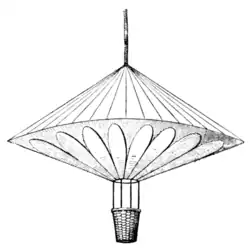
Cocking's Parachute.
check too rapid a descent. He therefore constructed a parachute on this principle, the radius of which at its widest part was about 17 feet. It was stated in the public announcements previous the the experiment that the whole weighed 223 ℔; but from the evidence at the inquest it appeared that the weight must have been over 400 ℔. Mr Cocking's weight was 177 ℔, which was so much additional. On July 24, 1837, the trial took place; and the Nassau balloon, with Mr Green and Mr Spencer, a solicitor, in the car, and having suspended below it the parachute, in the car of which was Mr Cocking, rose from the ground at twenty-five minutes to eight in the evening. A good deal of difficulty was experienced in rising to a suitable height, partly in consequence of the resistance to the air offered by the expanded parachute, and partly owing to its weight. Mr Cocking wished the height to be 8000 feet; but when the balloon reached the height of 5000 feet, it being then nearly over Greenwich, Mr Green called out to Mr Cocking that he should be unable to ascend to the requisite height if the parachute was to descend in daylight. Mr Cocking accordingly let slip the catch which was to liberate him from the balloon. The parachute for a few seconds descended very rapidly but still evenly, until suddenly the upper rim seemed to give way, and the whole apparatus collapsed (taking a form resembling an umbrella turned inside out, and nearly closed), and the machine descended with great rapidity, oscillating very much. When about two or three hundred feet from the ground, the basket became disengaged from the remnant of the parachute, and Mr Cocking was found in a field at Lee, literally dashed to pieces.
Mr Green and Mr Spencer, who were in the car of the balloon, had also a narrow escape. At the moment the parachute was disengaged they crouched down in the car, and Mr Green clung to the valve-line, to permit the escape of the gas. The balloon shot upwards, plunging and rolling, and the gas pouring from both the upper and lower valves, but chiefly from the latter, as the great resistance of the air checked its egress from the former. Mr Green and Mr Spencer applied their mouths to tubes communicating with an air-bag with which they had had the foresight to provide themselves, otherwise they would certainly have been suffocated by the gas. Notwithstanding this precaution, however, the gas almost totally deprived them of sight for four or five minutes. When they came to themselves they found they were at a height of about four miles, and descending rapidly. They effected, however, a safe descent near Maidstone.
Many objections were made, after the result, to the form of Mr Cocking's parachute; but there is little doubt that had it been constructed of sufficient strength, and perhaps of somewhat larger size, it would have answered its purpose. As it was, the upper rim was made of tin, which soon gave way. Mr Wise, the American aeronaut, made some experiments on parachutes of both forms (Garnerin's and Cocking's), and found that the latter always were much more steady, descending generally in a spiral curve.
In 1839 Mr Hampton made three descents in a parachute, on Garnerin's pattern, from his balloon, the "Albion." He followed Garnerin's
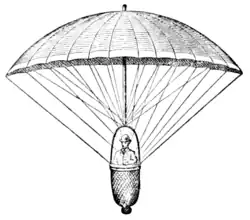
Hampton's Parachute.
example in attaching the parachute to the netting of the balloon, so that when the connection between the two was severed the latter was left to its own devices. Mr Hampton took measures, however, that it should descend soon after the parachute, and it was generally found no great distance off, and returned to him. All his parachute descents were safely performed, although in one he was a good deal shaken.
We may remark that a descending balloon half-full of gas either does rise, or can with a little management be made to rise, to the top of the netting and take the form of a parachute, thus materially lessening the rapidity of descent. Mr Wise, in fact, having noticed this, once purposely exploded his balloon when at a considerable altitude, and the resistance offered to the air by the envelope of the balloon was sufficient to enable him to reach the ground without injury. And a similar thing took place in one of Mr Glaisher's high scientific ascents (April 18, 1863), when, at a height of about 2 miles, the sea appeared directly underneath; the gas was let out of the balloon as quickly as possible, and the velocity of descent was so great, that the 2 miles of vertical height were passed through in four minutes. On the balloon reaching the ground at Newhaven, close to the shore, it was found to be nearly empty. The balloon had, in fact, for the last mile or more, merely acted as a parachute; the shock was a severe one, and all the instruments were broken, but nothing serious resulted to the occupants of the car.
Numerous attempts have been made both to direct balloons and contrive independent flying machines. After the invention of the balloon by the brothers Montgolfier, it was at once thought that no very great difficulty would be found in devising a suitable steering apparatus; in fact, it was supposed that to rise into the air and remain there was the chief difficulty, and that, this being accomplished, the power of directing the aerostat would be a secondary achievement that must follow before long. Accordingly, in most of the early balloons the voyagers took up oars, sails, or paddles, which they diligently worked while in the air; sometimes they thought an effect was produced, and sometimes not. If we consider the number of different currents in the atmosphere, it is no wonder that some should have announced with confidence that their course was changed from that of the wind by means of the sails or oars that they used; in fact, it is not very often that the whole atmosphere up to a considerable height is moving en masse in the same direction, so that generally the course taken by the balloon, as determined merely by joining the places of ascent and descent, is not identical with the direction of the wind, even when it is the same at both places. Although there is no reason why balloons should not be so guided by means of mechanical appliances attached to them as to move in a direction making a small angle with that of the wind, still it must have been evident to any one who has observed a balloon during inflation on a windy day, that any motion in which it would be exposed to the action of a strong current of air must result in its destruction. It has therefore gradually become recognised that the balloon is scarcely a step at all towards a system of aerial navigation; and many have thought that the principles involved in the construction of a flying machine must be very different from the simple statical equilibrium that subsists when a balloon is floating in the air. "To navigate the air the machine must be heavier than the air," has frequently been regarded as an axiom; and there can be no doubt that an apparatus constructed of such light material as is necessary for a balloon must either be destroyed or become ungovernable in a high wind. Recently, however, M. Dupuy de Lôme, an eminent French engineer, has constructed and made experiments with a balloon which he considers satisfies some of the conditions. The balloon is spindle-shaped, the longer axis being horizontal, and it contains about 120,000 cubic feet. The car is suspended below the middle of the balloon, and there are provided a rudder and a screw. The rudder consists of a triangular sail placed beneath the balloon and near the rear, and is kept in position by a horizontal yard, about 20 feet long, turning round a pivot in its forward extremity; the height of the sail is 16 feet, and its surface 160 square feet. Two ropes for working the rudder extend forward to the seat of the steerer, who has before him a compass fixed to the car, the central part of which will contain fourteen men. The screw part is carried by the car, and is driven by four or eight men working at a capstan. A trial was made with the machine on February 2, 1872, on a windy day, and M. de Lôme considered that he had been enabled by his screw and rudder to alter his course about 12°. (See Report of the Aeronautical Society, 1872).
Whatever difficulties may present themselves in regulating the horizontal movement of the balloon, there can be no doubt that the vertical motion could be obtained by means of a screw or other mechanical means; and the power of being able to ascend or descend without loss of ballast would be a considerable gain. In the opinion of many, however, the balloon is not worth improvement; and as ballooning is now generally practised merely as a spectacle by which the aeronaut or showman gains his living, it is not likely that any advancement will be made.
Of flying machines, in which both buoyancy and motion were proposed to be obtained by purely mechanical means, the number has been very great. Most of the projects have been chimerical, and were due to persons possessed of an insufficient knowledge of the principles of natural philosophy, both theoretically and practically. They serve, however, to show how great a number of individuals must have paid attention to the matter, and even at the present time several patents are taken out annually on the subject. We do not propose here to give an account of any of these projects, for but few have ever passed beyond projects, but will merely refer to Mr Henson's aerial carriage, which in 1843 attracted some attention. The apparatus was an elaborate one, and its principal feature was the great expanse of the sustaining planes. The machine was to advance with its front edge a little raised, the effect of which would be to present its under surface to the air over which it was passing; the resistance of this air, acting on it like the strong wind on the sails of a windmill, would, it was thought, prevent the descent of the machine. Mr Henson invented a steam-engine of great lightness, but he proposed that the machine should be started down an inclined plane, so that the steam-engine would only have to make up for the velocity lost by the resistance of the air. The scheme never came to anything.
In the still air of a room it is, of course, not difficult to attach an apparatus to a balloon so as to direct its motion, and even models of flying machines have been made which, when tried in a room, seemed moderately successful. Some instruments which would very nearly support themselves in the air were shown at the Aeronautical Society's exhibition at the Crystal Palace. A good deal would be accomplished if an accurate knowledge of the extant motion of a bird's wing could be obtained; in fact, until this is known, or until sufficient experiments on the resistance experienced by different-shaped laminæ with different motions are made, there seems little chance of the construction of a satisfactory flying machine, unless means can be found to make a steam-engine of much less weight than is at present necessary.
In 1865 the Aeronautical Society of Great Britain was founded, the officers being—President, the Duke of Argyle; Treasurer, Mr J. Glaisher; and Secretary, Mr Brearey. It has published an annual report every year since [1873], containing selections from the papers read to the society, and abstracts of the discussions that took place thereon at the meetings. The numerous papers submitted to this society bear witness to the great number of minds that are engaged on the solution of the problem of aerial navigation. Of course, not a few of the methods proposed are the fanciful projects of ignorant men, but some show the careful thought and elaborate experiment of trained engineers and other qualified persons. In 1868 the society held an exhibition of flying machines, &c., at the Crystal Palace, which was visited by many persons. A fire-balloon of a M. de la Marne, which should have ascended during this exhibition, caught fire and was burnt. In 1871 a series of experiments was made at Penn's factory (Greenwich) on the resistance of different shaped planes placed at different angles, in a current of air produced by a rotary fan. Investigations of this kind not only form the first step towards obtaining data for a true knowledge of the exact nature of flying, but are also independently of high scientific interest. The chief object of the society is to bring together those persons who are interested in the subject of aeronautics (except balloonists by trade, who are ineligible), and to encourage those who, possessing suitable acquirements, are devoting their time to the investigation of the question.
Aerostatic societies have also been founded in other countries; but although they have been inaugurated with considerable éclat, more than one have already terminated a short-lived career. The Vienna society seems, however, to have been unusually active during the recent exhibition of 1873.
The principle in virtue of which a balloon ascends is exactly the same as that which causes a piece of wood or other material to float partially immersed in water, and may be stated as follows, viz., that if any body float in equilibrium in a fluid, the weight of the body is equal to the weight of the fluid displaced. By the "fluid displaced" is meant the fluid which would occupy the space actually occupied in the fluid by the body if the body were removed. When the fluid is inelastic and incompressible, i.e., a liquid, as water, its density is the same throughout, and bodies placed in it either rise to the surface and float there partially immersed, or sink to the bottom. Thus, suppose a body only one-third as heavy as water (in other words, whose specific gravity is one-third) was floating on the surface of water, then, as the weight of the body must be equal to that of the water it displaces, it is clear that one-third of the body must be immersed. In the case, however, of an elastic or gaseous fluid, such as air, the density gradually decreases as we recede from the surface of the earth, for each layer has to support the weight of all above it, and as air is elastic or compressible, the layers near the earth are more pressed upon, and therefore denser than those above. Thus, if a body lighter than the air it displaces be set free in the atmosphere, it rises to such a height that the air there is so attenuated that the weight of it displaced is equal to that of the body, when equilibrium takes place, and the body ascends no higher. In all cases, therefore, a body floating in the air is totally immersed, and it can never get beyond the atmosphere, and float, as it were, upon its surface.
To find, therefore, how high any body (lighter than the air it displaces), such as a balloon, of given capacity and weight, will rise, it is only necessary to calculate at what height the volume of a quantity of air equal to the given capacity will be equal in weight to the given weight. Leaving temperature out of the question, the law of the decrease of density in the atmosphere is such that the density at a height is equal to the density at the earth's surface, being the measure of gravity, and also a constant; the value of is called the height of the homogeneous atmosphere, viz., it is equal to what would be the height of the atmosphere if it were homogeneous throughout, and of the same density as at the earth's surface. Its value may be taken at about feet. Thus, let be the volume of a balloon and its appurtenances, car, ropes, &c. (viz., the number of cubic feet, or whatever the unit of solidity may be, that it displaces), and let be its weight (including that of the gas), then it will rise to a height such that


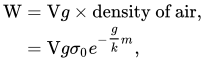
being the value of the force of gravity, and being the density of the air at the surface of the earth. This equation is not quite accurate, for several reasons—(1) because the decrease of temperature that results from increase of elevation has not been taken into account; (2) because has been taken to measure the force of gravity on the earth's surface, whereas it should represent this force at a height this is easily corrected by replacing by where being the radius of the earth, but as is about miles, and is never likely in any ordinary question to exceed miles, we can replace by without introducing sensible error, for the correction due to this cause would be much less than other uncertainties that must arise; and (3) because and could not both remain constant. If the balloon be not fully inflated on leaving, so that the gas contained in it can expand, then the volume of air displaced, will increase; while, if the balloon be full at starting, the envelope must either be strong enough to resist the increased pressure of the gas inside, due to the removal of some of the pressure of the gas inside, due to the removal of some of the pressure outside (owing to the diminished density of the air), or some of the gas must be allowed to escape. The former alternative of the second case could not be complied with, as the balloon would burst; some of the gas must therefore escape, and so is diminished. The weight of gas of which the balloon is thus eased cannot properly be omitted from the calculation, if be considerable; but a good approximation is obtained without it, as the weight of the gas that escapes will generally bear a small proportion to the weight of balloon, car, grapnel, passengers, &c. The true equation (except as regards temperature) is therefore, for a balloon full at starting—


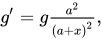



denoting the volume actually occupied by the gas, denoting viz., gravity at height and being the density of the gas on the ground. It will generally be sufficient, especially when temperature is omitted, to take the formula in the approximate form written previously. As the volume of air displaced by the car, ropes, passengers, &c., is usually trifling compared to that displaced by the balloon itself, no great error can arise from taking As an example, let us find how high a balloon of cubic feet capacity would rise if inflated with pure hydrogen gas, carrying with it a weight of ℔ (this including the weight of the balloon itself and appurtenances). A cubic foot of air, at temperature Fahr., and under a pressure of in., weighs ℔, and a cubic foot of hydrogen weighs ℔, so that (supposing the barometer reading on the earth to be in., and the temperature of the air to be ) at the surface of the earth the balloon, &c., weighs ℔, and the weight of the air displaced is ℔. The balloon will therefore approximately rise to such a height that cubic feet of air shall there weight ℔; and is given in feet by the equation


or
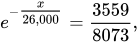

the logarithms being hyperbolic; if common or Briggian logarithms be used, the result must be multiplied by (the reciproval of the modulus). In the above case we find about feet, and as at this height rather more than half the gas will have escaped (it having been supposed that the balloon was full at starting). This only reduces the value by about , and the result of taking it into account is only to increase the height just found by about feet. If ℔ out of the were thrown away during the ascent, the balloon would reach a height of about miles; the weight of the gas that escapes is here important, as, if it be not taken into account, the height given by the formula is only about miles.


In actual aerostation, as at present practised, ordinary coal gas is used, which is many times heavier than hydrogen, being, in fact, usually not less than half the specific gravity of air. Even when balloon are inflated with hydrogen, generated by the action of sulphuric acid on zinc filings, the gas is very far from pure, and its density is often double that of pure hydrogen, and even greater.
The hydrostatic laws relating to the equilibrium of floating bodies were known long previous to the invention of the balloon in 1783, but it was only in the latter half of the 18th century that the nature of gases was sufficiently understood to enable these principles to have been acted on. As we have seen, both Black and Cavallo did make use of them on a small scale, and if they had thought it possible to make a varnish impervious to the passage of hydrogen gas they could have easily anticipated the Montgolfiers. As it was, no sooner was the fire-balloon invented, than Carles at once suggested and practically carried out the idea of the hydrogen or inflammable air balloon.
The mathematical theory of the rate of ascent of a balloon possesses remarkable historic interest, from the fact that it was the last problem that engaged the attention of the greatest mathematician of the last century, Euler. The news of the experiment of the Montgolfiers at Annonay on June 5, 1783, reached the aged mathematician (he was in his 77th year) at St Petersburg, and with an energy that was characteristic of him he at once proceeded to investigate the motion of a globe lighter than the air it displaced. For many years he had been all but totally blind, and was in the habit of performing his calculations with chalk upon a black board. It was after his death, on September 7, 1783, that the board was found covered with the analytical investigation of the motion of an aerostat. This investigation is printed under the title, Calculs sur les Ballons Aérostatiques faits par feu M. Léonard Euler, tels qu'on les a trouvés sur son ardoise, après sa mort arrivée le 7 Septembre 1783, in the Memoirs of the French Academy for 1781 (pp. 264–268). The explanation of the earlier date is that the volume of memoirs for 1781 was not published till 1784. The peculiarity of Euler's memoir is that it deals with the motion of a closed globe filled with a gas lighter than air, whereas the experiments of the Montgolfiers were made with balloons inflated with heated air. The explanation of this must be that either an imperfect account reached Euler, and that he supplied the details himself as seemed to him most probable, or that he, like the Montgolfiers themselves, attributed the rising of the balloon to the generation of a special gas given off by the chopped straw with which the fire was fed. The treatment of the question by Euler presents no particular point of importance—indeed, it could not; but the fact of its having given rise to the closing work of so long and distinguished a life, and having occupied the last thoughts of so great a mind, confers on the problem of the balloon's motion a peculiar interest.
We now proceed to the investigation of the vertical motion of a balloon inflated with gas, the horizontal motion, of course, being always equal to that of the current in which it is placed. In supposing, therefore, the balloon to be ascending vertically into a perfectly calm atmosphere, there is no loss of generality. There are two cases of the problem, viz., when the balloon is only partially filled with gas at starting, and when it is quite filled. The motion in the former case we shall investigate first, as the balloon will ascend till it becomes completely full, and then the subsequent motion will belong to the second case. We may remark that it is usual in investigations relating to the motions of a balloon to regard it in the way that Euler did, viz., as a closed inextensible bag, capable of bearing any amount of pressure. In point of fact, the neck or lower orifice of the balloon is invariably open while it is in the air, so that the pressure inside and outside is practically always the same, and when the balloon continues ascending after it has become quite full, the gas pours out of the neck or is allowed to escape by opening the upper valve. It is to be noticed that we have not thought it necessary to transform the formulæ obtained in such wise that they may be readily adapted to numerical calculations as they stand, as our object is rather to exhibit the nature of the motion, and clearly express the conditions that are fulfilled in the case of a balloon, than deduce a series of formulæ for practical use. We shall, however, indicate the simplifications allowable in practical applications. The effect of temperature, though important, is neglected, as the connection between it and height is still unknown. It was chiefly to determine this relation that Mr Glaisher's ascents were undertaken, and at the conclusion of the first eight he deduced an empirical law which seemed to accord pretty well with the observations; the succeeding twenty ascents, however, failed to confirm this law. In fact, it is evident, even without observation, that the rate of the decline of temperature when the sky is clear must differ from what it is when cloudy, and that, being influenced to a great amount by radiation of heat from the earth's surface, it will vary from hour to hour. Under these circumstances, as our object is not to deduce a series of practical rules for calculating heights, &c., we have supposed the temperature to remain constant throughout the atmosphere. The assumption of any law of decrease would considerably complicate the equations. Perhaps the simplest law, mathematically considered, would be to assume the curve of descent of temperature to be The curve Mr Glaisher deduced from his eight ascents was a portion of a hyperbola, the constants being determined empirically.

The the equation of motion at any time previous to the balloon becoming completely filled is

the last term being due to the resistance of the air, which is assumed to vary directly as the square of the velocity and as the density of the air. In very slow motions the resistance appears from experiments to vary pretty nearly as the velocity; and when the motion is very swift, as in the case of a rifle-bullet, as the cube of the velocity; but when the motion is neither very rapid nor very slow, the law of the square of the velocity probably represents the truth very fairly. By is denoted the value of gravity at the height so that
being, as above, the radius of the earth. In the exponential term, we shall replace by as no sensible error can result therefrom. The value of is constant, as by Boyle's and Marriotte's law it always Writing, therefore, for brevity—


the equation of motion takes the form
whence, following the usual rule for the integration of linear differential equations of the first order, and writing for for convenience of printing,


Herein put so that and we have


whence, by subtraction,
therefore
in which is used to denote the exponential integral of viz.: according to a recognised notation. The values of the integral which may be regarded as a known function, have been tabulated (see Philosophical Transactions for 1870, pp. 367–388).


We thus have, except for temperature, the complete solution of the problem of the motion of the balloon so far as velocity and height are concerned; it would not be possible to connect the time and the height except by the performance of another integration, for the practicability of which it would be necessary to submit to some loss of generality, viz., we should have to regard as small as compared to and take as small, and so on. The equation last written gives the motion until the height (say ) is attained at which the balloon becomes quite full, after which the gas begins to escape, and we have the second case of the problem.


Before proceeding, however, to the discussion of this second case, it is worth while to examine the solution more carefully, leaving out of consideration quantities that make no very great difference in the practical result, for the sake of simplicity. Supposing, then, gravity to be constant at all heights, and to be zero, the equation of motion takes the simple form
and we see, what is pretty evident from general reasoning, that if a balloon, partially filled, rises at all, it will at least rise to such a height that it will become completely full.
The letters meaning the same as before, the equation of motion of a balloon completely filled at starting is
or substituting for and their values


The integral of this differential equation could be obtained in series as before, only that the resulting equations would be more complicated. As we do not propose to discuss the formulæ obtained, it will be sufficient for our purpose to deduce an approximate solution by neglecting compared to viz., neglecting the mass of the gas that has escaped during the ascent compared to the mass of the whole balloon and appurtenances. It must be borne in mind, however, that when coal gas is used, and the ascent is to a great height, the mass of gas that escapes is by no means insensible. The equation thus becomes


or
being This is an equation which can be integrated in exactly the same way as that previously considered, viz., by multiplying by a factor and integrating at once; thus,


and is determined as before by putting when we have


In this case is not zero, except when the balloon starts from the earth quite full. The general case is, when the balloon is only partially filled on leaving; the previous equations then hold until a height at which it becomes quite full, when the motion changes, and is as just investigated. Then becomes the velocity at the height and everything is measured from this height as if from the surface of the earth, being then the radius of the earth the densities at height and at height &c. We have therefore, except as regards time, completely determined the motion of a balloon inflated with gas in an atmosphere of constant temperature. The introduction of temperature would modify the motion considerably, but in the present state of science it cannot be taken into account.


The general principle of the equilibrium of a fire-balloon is, of course, identical with that of a gas-balloon; but the motion is different, as the degree of buoyancy at each moment varies with the temperature of the air within the balloon, and therefore with the heat of the furnace by which the air is warmed. Dry air expands d part of its volume for every increase of temperature of centigrade, or th of its volume for every increase of temperature of Fahr. If, therefore, the air in an envelope or bag be heated Fahr. more than the surrounding air, the air within the bag will expand th of its volume, and this air must therefore escape. The air within the bag weighs less, therefore, than the air it displaces by the th part of the latter; and if the weight of this be greater than the weight of the bag and appurtenances, the latter will ascend. It is, therefore, always easy to calculate approximately the ascensional power of a fire-balloon if the temperature of the surrounding air be known, and also the mean temperature of the air within the balloon. Thus, let the balloon contain cubic feet of hot air at the temperature (Fahr.), and let the temperature of the surrounding air be (Fahr.) Also, suppose the weight of the balloon, car, &c., is ℔, and let the barometer reading be inches, then the ascensional power is equal to the weight of the air displaced weight of the heated air ℔, viz.,


℔ being the weight of a cubic foot of air at temperature under the pressure of one atmosphere, viz., when the reading of the barometer is in. Of course, the motion depends upon the temperature of the air in the balloon as due to the furnace, if the latter is taken up with the balloon; but if the air in the balloon is merely warmed, and the balloon then set free by itself, the problem is an easy one, as the rate of cooling can be determined approximately; but it is destitute of interest. We have said that dry air increases its volume by th part for every increase of (Fahr.), but the air is generally more or less saturated with moisture. This second atmosphere, formed of the vapour of water, is superposed over that of the air, as it were, and, in a very careful consideration of the question, should be taken into account. Even, however, when the air is completely saturated with moisture but little difference is produced; so that for all practical purposes the presence of the vapour of water in the air may be ignored. Of course the amount of vapour depends on the dew-point, and tables of the pressure of the vapour of water at different temperatures are given in most modern works on heat; but, as has been stated, the matter, in an aeronautical point of view, is of very little importance. At first it was supposed that the cause of the ascent of the balloon of the Montgolfiers was traceable to the generation of gas and smoke from the damp straw which was set light to; but the advance of science showed that the fire-balloon owed its levity merely to the rarefaction of the air produced by the heat generated.

A formula giving the height, in terms of the readings of the barometer and thermometer, on the surface of the earth, and at the place the height of which is required, is easily obtained from the principles of hydrostatics. The formula given by Laplace, reduced to English units, is—
being the height required in feet, the heights of the barometer in inches at the lower and upper stations, the temperatures (Fahr.) of the air at the lower and upper stations, the latitude, the approximate altitude, and the earth's mean radius in feet. This was the formula used by Mr Glaisher for the reduction of his observations. It is open to the obvious defect that the temperature is assumed uniform, and equal to the mean of the temperatures at the upper and lower stations; but till the law of decline of temperature is better determined, perhaps this is as good an approximation to the truth as we can have without introducing needless complication in the formula.


A sphere is not a developable surface—i.e., it cannot be divided in any manner so as to admit of its being spread out flat upon a plane, so that no spherical balloon could be made of stiff plane material. However, the silk or cotton of which balloons are manufactured is sufficiently flexible to prevent any deviation from the sphere being noticeable. Balloons are made in gores, a gore being what, in spherical trigonometry, is called a lune, viz., the surface enclosed between two meridians. The approximate shape of these gores is very easy to calculate.
Thus, let be a gore, then the sides are not arcs of circles, but curves of sines, viz., bears to the ratio that does to or, which comes to the same thing, supposing and then It is thus easy, by means of a table of natural sines, to form a pattern gore, whatever the required number of gores may be. Thus, supposing there are to be gores, then must be th of the circumference—viz., ths of and and being given, any number of points can be found on the curve in the manner indicated above. A slight knowledge of spherical trigonometry shows the reason for the above rule. Balloons, as usually constructed, are spherical, except for the neck, which is made to slope down, so that the whole shape resembles rather that of a pear. The pattern gore should originally be made as if for a spherical balloon, and afterwards the slight modification necessary for the formation of the neck should be applied.





The gores are sewn together, and a small portion of the upper end of each is cut away, so as to leave an aperture at the top of the balloon of from to feet in diameter. This space is occupied by the valve, which is generally made of strong wood, and consists of two semicircular shutters hinged to a diameter of the circular frame, and kept closed by a spring. The valve is opened by pulling a string, technically called the valve-line, which passes down through the balloon and out at the lower orifice in which the neck terminates. The net-work which, like the gores, is attached to the circumferences of the valve, passes over the surface of the balloon, and supports the ring or hoop from which the car is suspended by half a dozen strong ropes, of perhaps or feet in length. The network is thus stretched between the valve and the ring. It is very important that all the ropes by which the car hangs from the rings should be so adjusted that each may bear pretty nearly the same weight, as otherwise the whole netting and balloon will be strained, and perhaps to a serious extent. The car is usually merely a large basket made of wicker-work. The neck of the balloon should be or feet above the car, so that the aeronaut can easily reach it by mounting into the ring. The best material for the envelope is silk; but on account of the expense cotton or alpaca is generally used: in all cases it must be varnished, in order to render it more impervious to the gas. The grapnel or anchor is a large five-pronged hook attached to the ring by a rope or feet long. The first care of the aeronaut on leaving the earth is to lower the grapnel gently to the full extent that the rope will permit. Thus, when the balloon is in the air, the grapnel hangs down below it, and when the descent is being effected, is the first thing to touch the ground. If the descent is well managed, and the balloon is moving downwards slowly, the weight of which it is relieved when the grapnel is supported by the earth checks any further descent, and the wind carries the balloon along horizontally, the grapnel trailing over the ground until it catches in some obstruction and is held fast. The balloon is then in much about the same position as a kite held by a string, and if the wind be strong, plunges about wildly, striking the ground and rebounding, until the aeronaut, by continued use of the valve-line, has allowed sufficient gas to escape to deprive it of all buoyancy and prevent its rising again.


The chief danger attending ballooning lies in the descent; for if a strong wind be blowing, the grapnel will sometimes trail for miles over the ground at the rate of ten or twenty miles an hour, catching now and then in hedges, ditches, roots of trees, &c.; and, after giving the balloon a terrible jerk, breaking loose again, till at length some obstruction, such as the wooded bank of a stream, affords a firm hold. If the balloon has lost all its buoyant power by the escape of the gas, the car also drags over the ground. But even a very rough descent is usually not productive of any very serious consequences; as, although the occupants of the car generally receive many bruises, and are perhaps cut by the ropes, it rarely happens that anything worse occurs. On a day when the wind is light (supposing that there is no want of ballast) nothing can be easier than the field in which he will alight. It is very important to have a good supply of ballast, so as to be able to check the rapidity of the descent, as in passing downwards through a wet cloud the weight of the balloon is enormously increased by the water deposited on it; and if there is no ballast to throw out to compensate this accession of mass, the velocity is sometimes very great. It is also convenient, if the district upon which the balloon is descending appear unsuitable for landing, to be able to rise again. The ballast consists of fine baked sand, which becomes so scattered as to be inappreciable before it has fallen far below the balloon. It is taken up in bags containing about ½ cwt. each. The balloon at starting is liberated by a spring catch which the aeronaut releases, and the ballast should be so adjusted that there is nearly equilibrium before leaving, else the rapidity of ascent is too great, and has to be checked by parting with gas. It is almost impossible to liberate the balloon in such a way as to avoid giving it a rotary motion about a vertical axis, which continues during the whole time it is in the air. This rotation makes it difficult for those in the car to discover in what direction they are moving; and it is only by looking down along the rope to which the grapnel is suspended that the motion of the balloon over the country below can be traced. We may mention that the upward and downward motion at any instant is at once known by merely dropping over the side of the car a small piece of paper: if the paper ascents or remains on the same level or stationary, the balloon is descending; while, if it descends, the balloon is ascending. This test is so delicate that it sometimes showedd the motion at a particular instant with more precision than did Mr Glaisher's very delicate instruments.
Contrivances are often proposed by which the valve might be opened in less crude ways than by merely pulling a string attached to it; by which the jerks produced by the catching of the grapnel might be diminished, &c. These improvements are not adopted, because simplicity is requisite before everything. Any mechanical contrivance might be broken and rendered useless by the first blow of the car on the earth; whereas the primitive arrangements in use are such that scarcely any rough treatment can impair their efficiency.
The most important works that have appeared on the subject of aerostation are—
Dædalus, or Mechanical Motions, by Bishop Wilkins, London, 1648; A Treatise on the Nature and Properties of Air and other Permanently Elastic Fluids, by Tiberius Cavallo, London, 1781; Account of the First Aerial Voyage in England, in a Series of Letters to his Guardian, by Vincent Lunardi, London 1784; History and Practice of Aerostation, by Tiberius Cavallo, London, 1785; Annals of some Remarkable Aerial and Alpine Voyages, including those of the author, by T. Forster, London, 1832; Aeronautica, by Monck Mason, London, 1838; A System of Aeronautics, comprehending its Earliest Investigations, by John Wise, Philadelphia, 1850; Astra Castra, Experiments and Adventures in the Atmosphere, by Hatton Turnor, London, 1865; Voyages Aériens, par J. Glaisher, C. Flammarion, W. de Fonvielle, et G. Tissandier, Paris, 1870; the same translated into English and published, edited by James Glaisher, under the title, Travels in the Air, London, 1871.
All of the above books we have seen ourselves, and used in the preparation of the present article. Astra Castra is a work of 530 pp. large quarto; it consists chiefly of extracts from other works and writings, and it is useful as affording data for a history rather than as a history itself. On pp. 463—465 is a list of books and papers of aeronautics, which seems fairly complete up to the date 1864. In the list are also included memoirs and papers which we have not noted in the last paragraph, as the most important of them are referred to under their special subjects in the course of this article. We should advise any one desirous of studying the history of aeronautics to consult Mr Turnor's list in Astra Castra, which is the most perfect we have met with. He has marked with an asterisk those works that may be consulted by the public in the library of the Patent Office, which contains, besides books, a valuable collection of prints and broadsheets on the subject of aerostation.(J. G.)
- ↑ Mr Tytler contributed largely to, and, indeed, appears to have been virtually editor of, the second (1778–83) of the Encyclopædia Britannica.
- ↑ This was a thermometer with a bulb shaped like a gridiron, so as to have a very great surface exposed to the air. It was thought that the ordinary pea-sized bulb would not permit of the thermometer being sufficiently delicate to register the rapid changes of temperature due to the quick motion of the balloon, as it requires some little time for such a thermometer to take up the temperature of the surrounding medium.