Collier's New Encyclopedia (1921)/Japan
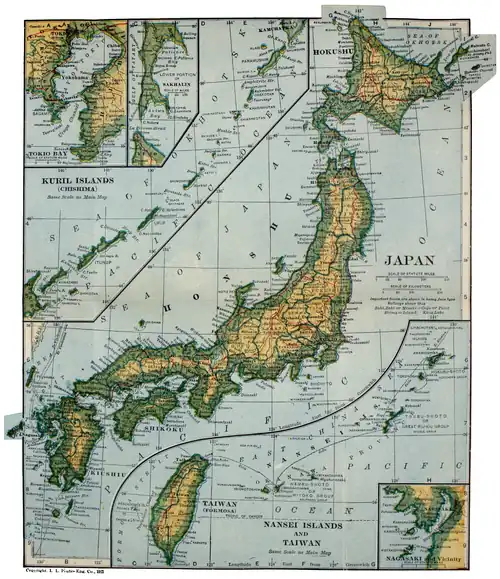
JAPAN, an island empire in the North Pacific Ocean, off the Asiatic coast. Area and Population.—The total area, including Japan proper, Korea, Formosa, Karafuto, Kwantung, and Pescadores, is 260,738 square miles. The population of Japan proper in 1918 was 57,784,935, exclusive of Korea, Formosa, and the army. The population of Korea is about 17,000,000, and of Formosa about 3,700,000. The total population of Japan is about 77,000,000. Japan proper consists of four large and many smaller islands, with an area of 148,756 square miles.
Physical Features.—The islands of Japan appear to be the highest portions of a huge chain of mountains which rises from a deep ocean bed; they are the advanced frontier of the Asiatic continent. This chain, though dotted with volcanoes, is not therefore itself of volcanic origin. Earthquakes occur very frequently in Japan, though the W. slope, facing the Asiatic continent, is exempt. Its plains and valleys, with their foliage surpassing in richness that of any other extratropical region, its arcadian hillslopes and forest-clad heights, give it a claim to be considered one of the fairest portions of the earth. The sublime cone of the sacred Fuji-san (Fusiyama, Aino, “Fire-goddess Mountain”), an extinct or rather dormant volcano, rises from the sea to a height of 12,365 feet.
Climate.—The late autumn is the driest and most agreeable season. The ocean current known as the Kuroshiwo (“Black Stream”) considerably modifies the climate of the S. E. coast; thus, while snow seldom lies more than five inches deep at Tokyo, in the upper valleys of Kaga, near the W. coast, 18 and 20 feet are common. The E. coast of Yezo is visited by a cold current from the Kuriles, which renders the climate foggy in summer and retards cultivation. The rainfall, which varies much in different years, is on an average 62 inches. No month passes without rain; but it is most plentiful in summer.
Mineralogy.—The mineral resources of Japan are considerable. Gold, silver, copper, iron, lead, antimony, tin, sulphur, coal, basalt, felspar, greenstones, granites (red and gray), rock crystal, agate, carnelian, amber, scoriæ and pumice stone, talc, alum, etc., are found in greater or less quantities. Coalbeds extend from Nagasaki to Yezo, near Sapporo, in Yezo.
Production and Industry.—About three-fifths of the land is cultivated by peasant proprietors, and the remaining portion by tenants. In 1919 about 30,000,000 acres were owned by private persons, of which about 10,000,000 were under cultivation. The leading agricultural crops are rice, wheat, barley, rye, tobacco, and tea. The production of rice in 1918 was 34,187,000 quarters; of wheat, 4,053,420 quarters; of barley, about 5,000,000 quarters; of rye, about 5,000,000 quarters; of tobacco, about 850,000 quarters; and of tea, about 765,000 hundredweight. The total number of horses was about 1,300,000, and of cattle about 1,600,000. The chief mineral products in 1918, with their values, were as follows: gold, 10,240,591 yen; copper, 90,390,232 yen; steel, 113,619,943 yen; pig iron, 38,091,576 yen. Other products of importance are coal, 286,032,425 yen; petroleum, 30,479,097 yen; sulphur, antimony, and iron pyrites. There were about 250,000 men employed in collieries, and about 170,000 in metal mines.
Government and Administration.—The government is a hereditary monarchy, the succession being now exclusively in the male line. The cabinet consists of 9 ministers of state, presided over by a minister president, their departments being Foreign Affairs, Home Affairs, Interior, Finance, War, Navy, Justice, Education, Agriculture and Commerce, Communications (post and telegraph, etc.). There is also a privy-council, mostly composed of former ministers of state. The constitution, laid out on German lines, is jealously careful of the supremacy of the throne. The imperial diet consists of two Houses, and its approval is necessary for the passing of every law, debates being held in public. The first general election took place in 1890; provincial assemblies were instituted in 1879. For administrative purposes Japan is divided into ken or prefectures and fu or city governments.
Railways.—The railway system began with two lines, one from Tokyo to Yokohama, and the other from Hyōgo to Osaka and Kyōto. In 1877 a great impetus was given to railway construction by the formation of private companies. There were in 1919 5,999 miles of state railway, 1,835 miles of railway owned by private companies, or a total of 7,834 miles. In 1920 the construction of five railway lines in Manchuria and Mongolia was begun.
Education.—Elementary education is compulsory. There are about 7,500,000 pupils in the elementary schools, and about 165,000 teachers. In special technical schools there are about 400,000 pupils, with about 6,000 teachers. The total number of children of school age is about 10,000,000. There are four universities, Tokio Imperial University, Kyoto Imperial University, Tohuku Imperial University, and Kyushu Imperial University. In these universities there are about 10,000 students, with about 900 instructors. Beginning in 1919–20, the government devoted 44,000,000 yen to extend higher education. There is a special education system in Formosa.
Army and Navy.—See Army; Navy.
Finance.—The estimated revenue for the year ending March 30, 1920, was 1,064,190,340 yen. The chief revenues are derived from taxes, from state property, post and telegraphs, and from monopolies. The chief expenditures are for administration, education, and communication. The public debt on March 31, 1919, was 2,579,946,478 yen.
Religions.—There are two prevailing religions in Japan—Shintô or Kami no Michi (“The way of the gods”), the indigenous faith; and Buddhism, introduced from China in 552. (1) Shintôism: The characteristics of Shintôism in its pure form are “the absence of an ethical and doctrinal code, of idol worship, of priestcraft, and of any teachings concerning a future state, and the deification of heroes, emperors, and great men, together with the worship of certain forces and objects in nature.” The principal divinity is the sun goddess Amaterasu, from whom the Mikado is held to be descended. (2) Buddhism: Of Buddhists there are no fewer than 35 sects. The monks have assumed the functions of priests, and Japanese Buddhist worship presents striking resemblances to that of the Roman Catholic Church. Buddhism is still the dominant religion among the people. Full toleration is extended to all forms of religious belief, in so far as they do not conflict with the peace and order of the community. Francis Xavier introduced Christianity in 1549, but his work was extinguished in blood, till scarcely a trace of it was left. Of the Protestant missions the Presbyterians, five sects working together, and the American Congregationalists are the most flourishing. The American and Canadian Methodists, the Baptists, Episcopalians, and others are also actively at work.

Shintô Priest, Japan
Manufactures.—The latest industrial census was made in 1917. There were 20,966 factories employing more than 10 hands each. The total number of employees was 1,280,964. The chief manufactures were woven goods, silk goods, woolen goods, Japan paper, European paper, matches, earthenware, matting, oil, knitting products, etc. There were 9 sugar factories in 1918. The products were valued at 75,935,000 yen.
Commerce.—The total imports in 1917 were valued at £217,331,933, and the exports at £209,887,261. The chief imports were from the United States, British India, China, and Great Britain. The chief exports were to the United States, China, Great Britain, British India, and France. The chief imports in 1919 were raw cotton, 667,866,651 yen; rice, 162,220,404 yen; iron bar, wrought plates, etc., 156,579,108 yen. Other imports of importance were sugar, beans and peas, wool, machinery, coal, flax and hemp. The chief exports were raw silk, 623,919,491 yen; cotton tissues, 280,061,883 yen; silk manufactures, 101,539,277 yen. Other exports of importance were cotton yarn, coal, matches, earthenware, refined sugar.
History.—The reputed founder of the present dynasty was Jimmu Tennō, who ascended the throne in 660 B.C. The legendary epoch continues for more than 1,000 years, and all Japanese history before A.D. 500 is to be classed as legendary. In A.D. 201 the Empress Jingō is said to have invaded and conquered Korea, and this expedition was followed by the introduction of Korean civilization, the sacred Chinese books “Rongo” and “Senjimon” arriving from Korea in 285. In 552 Buddhism was introduced from Korea, and became 40 years later, the established religion. In 624 a Buddhist hierarchy was established by government. Shortly before this direct relations had been entered upon with China, and Chinese civilization was thereafter rapidly assimilated. At one time (1333–1392) two puppet-dynasties held sway, the North and the South, to one or the other of which the feudal barons rallied. The shôgunate, made powerful by Yoritomo, itself fell into abeyance, but the military genius and astute policy of Hideyoshi, who died in 1598, prepared the way for its revival in 1603 by Tokugawa Iyeyasu, the illustrious general and statesman who gave a lasting peace to Japan. The Portuguese, who first landed in Japan in the year 1543, carried on a lucrative trade; but by-and-by the ruling powers took alarm, and ordered away all foreigners, and interdicted Christianity (1624), believing that foreigners impoverished the country, while their religion struck at the root of the political and religious systems of Japan. The Portuguese continued to frequent Japan till 1638, when they and their religion were finally expelled. From this date the Japanese government maintained the most rigid policy of isolation, till 1853, when they were rudely awakened from their dream of peace and security by Commodore Perry steaming into the harbor of Uraga with a squadron of United States war vessels. He extorted a treaty from the frightened Shôgun, March 31, 1854, and Japan, after a withdrawal of 216 years, entered once more the family of nations. Other countries slowly followed the example of the United States till 16 in all had obtained the same privileges.
The assassination in 1877 of Okubo, chief of the party whose reforms gave rise to the Satsuma rebellion, was followed 12 years later by the assassination of Viscount Mori, a cabinet minister.

Temple at Yeyasou, Japan
The court no longer live in seclusion. The emperor and empress have visited all the chief institutions and are present at public spectacles. The crown prince, Haru, was the first in the long dynasty to be educated at a public school. A new nobility was created in 1884, drawn partly from the old feudal baronage and partly from the new men of 1868, who send representatives to the newly created Upper Chamber. The nation is itself divided into three classes, Kwazoku (“nobility”), Shizoku (“gentry”), and Heimin (“commonalty”). Officials are of four classes, shinnin, chokunin, sōnin, and hannin. Officials constitute the flower of the nation; class jealousy is absent, careers being open to the poorest. The main results of the triumphant war with China in 1894–1895 were the war indemnity, and the acquisition of Formosa. Japan was visited by a terrible earthquake in 1892; and in June, 1896, an earthquake wave cost 10,000 lives. From 1897 to 1900 the question of Korea was warmly debated between Japan and Russia. On Jan. 8, 1904, war broke out between Russia and Japan, and this was terminated by the treaty of Portsmouth Sept. 5, 1905. The losses of Russia, dead and prisoners, were 388,500, and of Japan, 167,500, and of ships, Russia 83, of Japan 12. The treaty was unexpectedly favorable to Russia notwithstanding.
The success of Japan in the Russo-Japanese War made her one of the leading world powers. The war, however, produced a financial stringency which led to economic disturbances for years following. The international relations also caused difficulty and several times threatened a break with the United States. This was chiefly the result of the passage of legislation in California and other States debarring Japanese laborers. In 1906 the school board of San Francisco ordered the segregation of Japanese children. The problem was temporarily solved by the arrival at a so-called gentlemen’s agreement, by which Japan agreed to restrict the immigration of Japanese laborers to the United States. In 1905 an alliance was made with Great Britain for the purpose of preserving the peace of eastern Asia and maintaining the integrity of China, and defending the rights of both countries in the region of eastern Asia and India. In 1911 this treaty was renewed for 10 years. As a result of the Russo-Japanese War, the interest of Japan was recognized as paramount in Korea, and the latter country practically became a province of Japan. In 1909 Prince Ito, the famous Japanese statesman, was assassinated by a Korean patriot. In the year following Korea was formally annexed to Japan, and was renamed Chosen. There were during the years following almost continual political outbreaks in Korea against Japanese government. In 1913 the relations between the United States and Japan again became estranged as a result of the passage in California of the Alien Land Owner’s Law which excluded from the right to own land all aliens who are not eligible to American citizenship. As the Japanese are prohibited from becoming naturalized citizens, it was apparent that this legislation was aimed directly at them. The government of Japan protested vigorously. President Wilson attempted to prevent the passage of the law but was unsuccessful.
The outbreak of the World War brought Japan into conflict as an ally of Great Britain. On Aug. 19, 1914, the British representative at Berlin presented an ultimatum commanding that all German warships should at once be withdrawn from Chinese and Japanese waters and that the entire German concession of Kaiochow be given up by Germany before Sept. 14, 1914, “with a view to the eventual restoration of the same to China.” The German Government refused and Japan declared war on Aug. 23, 1914. Two days later diplomatic relations between Japan and Austria-Hungary were broken. The Japanese navy at once established a blockade of Tientu, the principal town in the German concession, and at the same time began military operations. Later in September the Japanese Expeditionary Force, assisted by East Indian troops, began the siege of Tsing-tau. On Nov. 7, 1914, the Germans surrendered. Japan, with equal promptness, captured some of the Far Eastern German colonies, restricting her activities to the smaller German islands. These included the Marshall Island, the Ladrones, the east and west Caroline archipelago. This constituted the chief military activities of Japan during the war. Following the Russian revolution, however, Japanese troops were sent into Siberia and carried on more or less active campaigns there during 1918–19. See Russia.
By the terms of the Peace Treaty, Japan received all the rights formerly possessed by Germany in the Shantung peninsula. This disposition of Shantung was strongly resisted by many of the representatives at the Peace Conference, but they were obliged to yield on the assurance of Japan that it was her intention to return the Shantung peninsula to China. China strongly protested against the arrangement and throughout 1920 attempted to bring the question of Shantung to an issue, but without success. Japan suspended hostilities with the so-called Soviet Republic of Siberia on July 15, 1920, and later occupied the northern half of the island of Saghalien after extending the Anglo-Japanese treaty for another year. The troops withdrawn from Siberia were sent into Korea, where all efforts to independence were suppressed with a strong hand.