Carmella Commands/Chapter 13

 or some days Carmella eyed her father uneasily. Not since the day of the certified check had he mentioned his affairs to her. She could have wept for eagerness to know what he was doing, and for whom, and with whom.
She adopted the habit of rising in time for breakfast with him, for then, she knew, he was most likely to expand. But even here she failed. Suddenly, one morning, in the midst of her chatter about neighborhood affairs with her brother, Joe, she turned to her father and asked, in Italian:
“Are you a contractor, dad?”
He thought for a moment, looking at her solemnly.
“Not to speak of it,” he said finally.
“Oh! But I told Mrs. Barrington that you were.”
“Not yet,” said Tommaso.
“Maybe, some day?”
“Maybe, some day.”
“But I must tell Mrs. Barrington that I lied. I didn’t mean to, but I did, I suppose.”
Tommaso hesitated, slowly eating his breakfast, before he said:
“You need not tell Mrs. Barrington.”
Carmella looked at her father shrewdly, and said no more. Some day, Tommaso felt, he would be a real contractor. Already he had a few men whom he could hire and with whom he worked when there was a small cellar to be dug. But he had not reached out for big jobs, because he lacked capital to finance workmen and equipment on jobs where his own pay must come after the completion of the work.
But now, with eight thousand dollars to his credit in the bank, he was beginning to think toward bigger things. Carmella’s question had cut sharply into his thoughts on this very subject—thoughts that had begun the night he had sat while the victrola played a love song—the evening he had quarreled with his best-loved daughter.
Eight thousand dollars would finance what had before been impossible. His mind had wandered to Greendale again, for he knew there was to be action in that direction. Greendale fascinated him, moreover, for there alone he had realized the immigrant’s dream of a fair land of quick wealth and no effort. He had wondered how his land had sold so easily and at so round a price. The lots he had bought for a possible future home, surrounded by grape arbors and with a shaded seat on the side of the house.
Of Carmella’s part in it he had not dreamed. And after he had sold, he had heard nothing of the project. American papers he did not read; his Italian weekly dealt with news from Rome under the new régime, and home matters like the building fund of the Sons of Italy. More of this than with new paving plans and new bus lines out of the city.
Even before Carmella asked about contracting, he had resolved to ask about Greendale. On leaving home that morning he encountered Mike Laudini, standing in front of his house down the street. Mike, he remem- bered, was the one who had suggested months ago that he buy land in Greendale. And Mr. Barrington, who had bought those same lots at an unimagined price, was known to be one of Mike’s good customers.
He stopped and they exchanged greetings. Then he asked about the suburb
“They’re building there—building like madmen,” said Mike. “The Barrington crowd and the Cronin crowd, a mile beyond, are trying to beat each other into the market with houses. Why not step into it, Tomas?”
“Maybe,” said Tommaso, moving on. He had learned what he chiefly cared to learn. He walked over to the trolley line and rode downtown, leaving the car within a block of the Central Trust Company, where Mr. Barrington had his offices. He had not yet formulated any clear idea of what he meant to do, as his steps unconsciously turned toward the Central Trust building.
Suddenly he heard himself hailed from the street, and recognized Dixon’s voice. The latter was sitting in the Barrington car, drawn up at the curb.
“Hello, Tommaso Coletta,” Dixon called. “How’s the real estate man?”
Tommaso did not wholly understand the English of the last sentence, but sensed the greeting.
“Buong giorno! How do?” he responded, in Italian and English.
“Two buongs and a giorno for me,” said Dixon, cheerfully. “And how’s Carmella Kid Kate?”
Tommaso caught a tone in the chauffeur’s voice as he asked about Carmella which made him hesitate. Then he said, speaking English:
“Carmella fine! Greendale, how she?”
Dixon laughed, good-naturedly.
“Greendale, she fine too,” he said. “Going down there with the boss pronto. The darn fool don’t know I’ve parked here fifteen minutes overtime already. But he can afford the fine if anything happens. Besides, they don’t often pinch a car with a driver in the seat.”
“Yes,” said Tommaso. “Mucha she build, Greendale?”
“Mucha she build you bet your sweet young building complex. Mucha she builda pronto.”
“Chanca for work?”
Dixon looked intently at Carmella’s father.
“Listen, old bird,” he said. “Listen to me. Why in⸺”
“No spika Eenglish. Parlate Italiano?”
“Not by a damn sight! No spika nix but American for mine. But listen, old man. Listen to me now. Barrington. Get that? Mucha builda house. Get that? Mucha digga cellar. Get that? Helluva hustle! You don’t get that, but you ought to. Listen! Money! Get that? Lotta money for lotta hustle. You spika Barrington, you digga cellar, you getta money, mucha de mon. Get that?”
Tommaso nodded doubtfully. Still, in a way, he got the idea. Dixon was beginning to ask more about Carmella when Mr. Barrington puffed heavily toward the machine.
“To Greendale, quick!” he commanded, as Dixon opened the rear door of the sedan.
“Here’s Mr. Coletta wants to speak to you, sir,” said the chauffeur. “He’s the man you bought those Greendale lots from at a hold-up, through his kid. He’s a contractor, sir. He can hustle. Great reputation in Little It.”
“No time for nonsense,” said Mr. Barrington, jumping into the car and settling into the corner. His hand was shaking as he drew a cigar from his pocket and lit it. “Strike down the line. Damn wops raising hell. Get me to Greendale quick!”
“Yes, sir! Break the record, sir! But if you’ve got a strike, Mr. Barrington, this man here might be good. He’s non-union, and he works with his men. He was on his way to see you when I flagged him. He’ll turn you out cellars clean and quick. He’s sure-fire!”
Mr. Barrington turned and regarded Tommaso. The latter, with an instinct that might have been inherited from his daughter, had lighted a cigarette and was regarding the architecture of nearby buildings. He did not know what Dixon was saying, but with the canny receptivity of the alien he was guiding his ideas by the tone of voice and such few words as he caught. Dixon, having finished his testimonial, shivered and hoped to high heaven that there was a foundation for it.
Mr. Barrington opened the door and leaned out.
“Hello, Mr. Coletta,” he said. “My chauffeur here tells me you’re a wiz at getting cellars dug. Hop in and drive out to Greendale with me and talk it over.”
Tommaso, understanding the one word ‘“Greendale,” hesitated.
“Get in, you dummy,” said Dixon. “In! Get me? Talk digga cellar. Get me?”
He half pulled Tommaso into the car beside Mr. Barrington, slammed the door, and jumped back into his driver’s seat. Dodging traffic and watching signals, he kept an ear turned back.
“Now see here,” began Mr. Barrington. “My chauffeur tells me you can dig cellars. Can you bust a strike? Can you dig cellars with non-union diggers? Can you slam into a job and pull it through doublequick, regardless of damn Bolsheviks and strikers? How about it? How about it in dollars and cents?”
“Non parlo Inglese!” said Tommaso mildly.
“Beg pardon, Mr. Barrington,” said Dixon, keeping his eyes ahead and throwing his voice back. “This bird is good, but he don’t know it. And he has to do his stuff in dago talk. Why not let him get an interpreter? He’s got that kid girl that was over at your house for lunch a while ago, and sold you his lots. Ask him to get her aboard and see what you can do about this strike thing, why don’t you?”
“All right, Dixon,” said his employer. “I approve the idea. But can you jabber with him enough to get it across?”
“I can’t talk to him, but I can make him understand ideas of one syllable,” said Dixon. And then, to Tommaso, he said:
“Greendale! Mucha digga! Mucha da money! But—mucha to talk! Get Kid Kate—Carmella. She talk. She talk⸺”
“Agevolmente,” said Tommaso.
“Whatever that means, yes! She help getta da money. Get me?”
“Carmella, you say?”
“Sure! Carmella. Kid Kate. She talk. Get her.”
They rode a few blocks while Tommaso thought. Finally he said:
“He weesh talk?”
“He sure does,” said Dixon. “And Kid Kate—Carmella—will help you maka da mon.”
“He weesh talk?” repeated Tommaso, pointing to Mr. Barrington.
“He sure does,” answered Dixon, guiding the car skillfully through the heavy downtown traffic. Tommaso looked toward Mr. Barrington, and the latter nodded.
“Money. Dig. Talk first,” he said, taking quick note of Dixon’s method of international speech.
“Doty Street,” said Tommaso. “I get for talk.”
Dixon turned the machine toward Little Italy without orders from his employer, and presently slowed down and stopped in front of the yellow cottage. But Tommaso, instead of going into his own house, hurried to the door of his next neighbor, Mrs. Alibrio. Dixon and his employer saw the two in earnest conversation at the door. Then the woman disappeared, and Tommaso returned to the car.
“She come queeck. She talk.” To Dixon his voice seemed unnatural, as if he had just emerged from his first trip in an airplane. Or as if, perhaps, he had undergone a queer social adventure. Dixon wondered that he had not sought Carmella. But his thoughts were interrupted by Mr. Barrington’s attitude.
“Tell her to be quick!” he growled.
Tommaso turned on him abruptly.
“She queeck if she want. I f she not queeck, we wait.”
Dixon glanced covertly at his employer. The glance convinced him that he was not discharged on the spot, although the Barrington smile had turned into a scowl. Dixon turned then to Tommaso.
“Not Kid Kate?” he asked, looking for an explanation.
“No spika Eenglish,” said the father calmly.
Dixon realized that he had been shut out of a fact.
Presently Mrs. Alibrio appeared, resplendant in red and yellow and navy blue.
The drive to Greendale was made without conversation, except as Tommaso and Mrs. Alibrio exchanged an occasional brief phrase in Italian. Arrived at the place, Mr. Barrington showed Tommaso the condition of the enterprise, the points where haste was most necessary, and outlined the terms he was willing to give. He even had the machine driven to the rival development down the road, in order that he might study the nature of the competition.
Mrs. Alibrio interpreted quietly and without color. Occasionally she did not know one of Mr. Barrington’s words, in which case she asked him to simplify. He was finding this hard to do, because his anger was mounting as he saw the steady digging on the rival project, and as Tommaso’s deliberate manner continued.
At last, after much conversation that Mr. Barrington counted needless, the afternoon saw a preliminary agreement drawn up. Tommaso promised to provide a gang that would dig cellars at a rate unprecedented in Greendale. For speed he was to have a bonus large enough to divide with his men. And then the Barrington car took Tommaso and Mrs. Alibrio back to Doty Street.
Little Italy’s gossip is neither quicker nor harsher nor more daring than any other gossip in the world. It is merely just as much so. By supper time Carmella, coming home from an afternoon with a friend, knew from half a dozen eager informers that Mrs. Alibrio had been taken by her father as interpreter on a busi- ness deal. In vacation, too, when she was not in school. When, in fact, she was just around the corner.
Mrs. Alibrio had been taken as interpreter on a business deal. Carmella’s head rang with the words. Mrs. Alibrio! Interpreter! Mrs. Alibrio! Good God-and-all!
The girl thought furiously. For a few minutes she was dazed. Then, sitting back in the Morris chair and closing her eyes, she thought it through. Aha! Her father was disciplining her. He had sensed her pride in his work and in her occasional part of it. So he had deliberately cut her out of it. Ah! He was a shrewd man, her father. But she would show him.
Carefully she was out of the house when Tommaso came home that afternoon. But, following him in after a few minutes, she went directly to him.
“Are you tired tonight, dad?” she asked in Italian.
“A little,” he answered. “But not so much as some days. Why, piccola ragazza?”
“Because, papa, I so much want to go to the movies
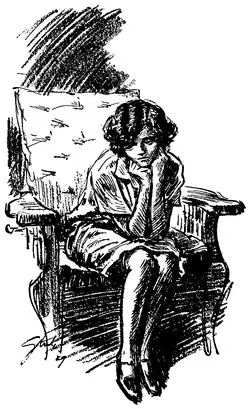
The Girl Thought Furiously
tonight, and I want you to take me. Will you take me to the new Western picture at the Gaiety?”
Tommaso was surprised. And, unfamiliar with feminine indirections, he was secretly pleased.
“Maybe, after supper,” he said.
And after supper he did.