CIA World Fact Book, 2004/Baker Island
.svg.png)
|
Baker Island | 
|
| Introduction | Baker Island |
|---|
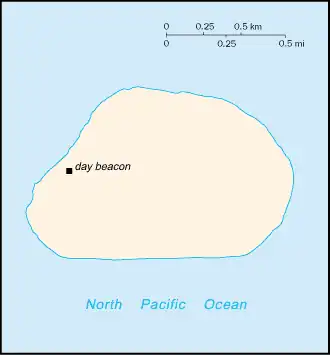
| Background: | The US took possession of the island in 1857, and its guano deposits were mined by US and British companies during the second half of the 19th century. In 1935, a short-lived attempt at colonization was begun on this island - as well as on nearby Howland Island - but was disrupted by World War II and thereafter abandoned. Presently the island is a National Wildlife Refuge run by the US Department of the Interior; a day beacon is situated near the middle of the west coast. |
|---|
| Geography | Baker Island |
|---|
| Location: | Oceania, atoll in the North Pacific Ocean, about half way between Hawaii and Australia |
|---|---|
| Geographic coordinates: | 0 13 N, 176 31 W |
| Map references: | Oceania |
| Area: | total: 1.4 sq km water: 0 sq km land: 1.4 sq km |
| Area - comparative: | about 2.5 times the size of The Mall in Washington, DC |
| Land boundaries: | 0 km |
| Coastline: | 4.8 km |
| Maritime claims: | territorial sea: 12 nm exclusive economic zone: 200 nm |
| Climate: | equatorial; scant rainfall, constant wind, burning sun |
| Terrain: | low, nearly level coral island surrounded by a narrow fringing reef |
| Elevation extremes: | lowest point: Pacific Ocean 0 m highest point: unnamed location 8 m |
| Natural resources: | guano (deposits worked until 1891), terrestrial and aquatic wildlife |
| Land use: | arable land: 0% permanent crops: 0% other: 100% (2001) |
| Irrigated land: | 0 sq km (1998 est.) |
| Natural hazards: | the narrow fringing reef surrounding the island can be a maritime hazard |
| Environment - current issues: | no natural fresh water resources |
| Geography - note: | treeless, sparse, and scattered vegetation consisting of grasses, prostrate vines, and low growing shrubs; primarily a nesting, roosting, and foraging habitat for seabirds, shorebirds, and marine wildlife |
| People | Baker Island |
|---|
| Population: | uninhabited note: American civilians evacuated in 1942 after Japanese air and naval attacks during World War II; occupied by US military during World War II, but abandoned after the war; public entry is by special-use permit from US Fish and Wildlife Service only and generally restricted to scientists and educators; a cemetery and remnants of structures from early settlement are located near the middle of the west coast; visited annually by US Fish and Wildlife Service (2004 est.) |
|---|
| Government | Baker Island |
|---|
| Country name: | conventional long form: none conventional short form: Baker Island |
|---|---|
| Dependency status: | unincorporated territory of the US; administered from Washington, DC, by the Fish and Wildlife Service of the US Department of the Interior as part of the National Wildlife Refuge system |
| Legal system: | the laws of the US, where applicable, apply |
| Flag description: | the flag of the US is used |
| Economy | Baker Island |
|---|
| Economy - overview: | no economic activity |
|---|
| Transportation | Baker Island |
|---|
| Ports and harbors: | none; offshore anchorage only; note - there is one small boat landing area along the middle of the west coast |
|---|---|
| Airports: | 1 abandoned World War II runway of 1,665 m, completely covered with vegetation and unusable (2003 est.) |
| Transportation - note: | there is a day beacon near the middle of the west coast |
| Military | Baker Island |
|---|
| Military - note: | defense is the responsibility of the US; visited annually by the US Coast Guard |
|---|
This page was last updated on 1 January 2003
This is a snapshot of the CIA World Fact Book as it existed on 26 March 2005