Author:Henry Wadsworth Longfellow
 related portals: American literature
 sister projects: Wikipedia article, Commons gallery, Commons category, quotes, Wikidata item
American poet and educator; first American to earn a living solely as a poet and the first American to translate Dante's Divine Comedy into English.  one or more chapters are available in a spoken word format.
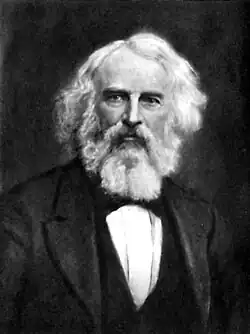
Works
Plays
- Giles Corey of the Salem Farms
- John Endicott
- Judas Maccabaeus
- The Spanish Student (1842)
Prose
- Hyperion (1900) (transcription project)
Poems
Voices of the Night (1839)
- Prelude
- Hymn to the Night
- A Psalm of Life
- The Reaper and the Flowers
- The Light of Stars
- Footsteps of Angels
- Flowers
- The Beleaguered City
- Midnight Mass for the Dying Year
Earlier Poems (1839)
- An April Day
- Autumn (1828)
- Woods in Winter
- Hymn of the Moravian Nuns of Bethlehem
- Sunrise on the Hills
- The Spirit of Poetry
- Burial of the Minnisink
- L'Envoi
Ballads and Other Poems (1841)
- The Luck of Edenhall
- The Skeleton in Armor (1841)
- The Wreck of the Hesperus (1842)
- The Village Blacksmith
- Endymion
- It is not Always May
- The Rainy Day
- God's-Acre
- To the River Charles
- Blind Bartimeus
- The Goblet of Life
- Maidenhood
- Excelsior
Poems on Slavery (1842)
- To William E. Channing
- The Slave's Dream
- The Good Part, that shall not be taken away
- The Slave in the Dismal Swamp
- The Slave singing at Midnight
- The Witnesses
- The Quadroon Girl
- The Warning
The Spanish Student (1842) (see plays)
The Belfry of Bruges and Other Poems (1845) (transcription project)
- Carillon
- The Belfry of Bruges (1845)
- A Gleam of Sunshine
- The Arsenal at Springfield
- Nuremberg
- The Norman Baron
- Rain in Summer
- To a Child
- The Occultation of Orion
- The Bridge
- To the Driving Cloud
- Songs
- The day is done
- Afternoon in February
- To an old Danish Song-Book
- Walter von der Vogelweide
- Drinking Song
- The old Clock on the Stairs
- The Arrow and the Song
- Sonnets
- The Evening Star (also in "By the Seaside")
- Autumn
- Dante
Sonnets. (sometimes grouped with the above)
- Mezzo Cammin (1842)
- Curfew
Evangeline: A Tale of Acadie (1847)
The Seaside and the Fireside (1850)
- By the Seaside
- "The Building of the Ship"
- "The Secret of the Sea"
- "Twilight"
- "Sir Humphrey Gilbert"
- "The Lighthouse"
- "The Fire of Drift-Wood"
- By the Fireside
- "Resignation"
- "The Builders"
- "Sand of the Desert in an Hour-Glass"
- "Birds of Passage" (Also in Flight the First)
- "The Open Window"
- "King Witlaf's Drinking-Horn"
- "Gaspar Becerra"
- "Pegasus in Pound"
- "Tegner's Drapa"
- "Sonnet on Mrs. Kemble's Reading from Shakespeare"
- "The Singers"
- "Suspiria"
- "Hymn for My Brother's Ordination"
The Golden Legend (1851) (start transcription)
The Song of Hiawatha (1855)
The Courtship of Miles Standish (1858)
Birds of Passage (Flight the First; Flight the Second)
Tales of a Wayside Inn (1863)
Flower-de-Luce (1867) (transcription project)
- "Flower-de-Luce"
- "Palingenesis"
- "The Bridge of Cloud"
- "Hawthorne"
- "Christmas Bells" (1863)
- "Kambalu" (1863) (also in Tales of a Wayside Inn)
- "The Wind over the Chimney"
- "The Bells of Lynn"
- "Killed at the Ford"
- "Giotto's Tower"
- "To-morrow"
- "Divina Commedia"
- "Noël"
Birds of Passage (Flight the Third)
The Masque of Pandora
The Hanging of the Crane
Morituri Salutamus
A Book of Sonnets
Birds of Passage (Flight the Fourth)
Kéramos
Birds of Passage (Flight the Fifth)
Ultima Thule (1880) (transcription project)
- Poems
- "Bayard Taylor" (1879)
- "The Chamber over the Gate"
- "From my Arm-Chair" (1879)
- "Jugurtha"
- "The Iron Pen"
- "Robert Burns"
- "Helen of Tyre"
- "Elegiac"
- "Old St. David's at Radnor"
- Folk Songs
- Sonnets
- L'Envoi
In the Harbor (1882)
Fragments
Christus: A Mystery (1872)
Judas Maccabæus
Michael Angelo: A Fragment (1883)
Translations
Appendix
- "Aftermath" (from Flight the Third)
- "Amalfi" (from Flight the Fourth)
- "Auf Wiedersehen" (from In the Harbor)
- "Autumn Within" (from In the Harbor)
- "Azrael" (1863) (from Tales of a Wayside Inn)
- "The Ballad of Carmilhan" (1863) (from Tales of a Wayside Inn)
- "A Ballad of the French Fleet" (from Flight the Fifth)
- "The Baron of St. Castine" (1863) (from Tales of a Wayside Inn)
- "Becalmed" (from In the Harbor)
- "Belisarius" (from Flight the Fourth)
- "The Bell of Atri" (1863) (from Tales of a Wayside Inn)
- "The Bells of Lynn Heard at Nahant" in The Atlantic Monthly, 17 (99) (January, 1866)
- "The Bells of San Blas" (1882) (from In the Harbor)
- "The Birds of Killingworth" (1863) (from Tales of a Wayside Inn)
- "The Brook and the Wave" (from Flight the Third)
- "Cadenabbia" (from Flight the Fourth)
- "The Castle-Builder" (from Flight the Third)
- "Castles in Spain" (from Flight the Fifth)
- "Catawba Wine" in The Atlantic Monthly, 1 (3) (January, 1858)
- "Catawba Wine" (1858) (from Flight the First)
- "The Challenge" (from Flight the Third)
- "Changed" (from Flight the Third)
- "Charlemagne" (1863) (from Tales of a Wayside Inn)
- "Charles Sumner" (1874) (from Flight the Fourth)
- "To Charles Sumner" in Littell's Living Age, 128 (1655) (1874), later published as part of Three Friends of Mine (from A Book of Sonnets).
- "Chaucer" (from A Book of Sonnets)
- "Children" (from Flight the First)
- "The Children's Crusade" (from In the Harbor)
- "The Children's Hour" (1860) (from Flight the Second)
- "Chimes" (from In the Harbor)
- "Chrysaor" (1850) (sometimes grouped with "By the Seaside")
- "The City and the Sea" (from In the Harbor)
- "The Cobbler of Hagenau" (1863) (from Tales of a Wayside Inn)
- "Concord" in The Atlantic Monthly, 14 (82) (1864); published as 'Hawthorne' in Flower-de-Luce.
- "The Cross of Snow" (1879) (from A Book of Sonnets)
- "The Cumberland" (from Flight the Second)
- "A Day of Sunshine" (from Flight the Second)
- "Daybreak" (from Flight the First)
- "Daylight and Moonlight" (from Flight the First)
- "Decoration Day" (from In the Harbor)
- "Delia" (from Flight the Fifth)
- "The Discoverer of the North Cape" (from Flight the First)
- "A Dutch Picture" (from Flight the Fifth)
- "Elegiac Verse" (from In the Harbor)
- "Elizabeth" (1863) (from Tales of a Wayside Inn)
- "Emma and Eginhard" (1863) (from Tales of a Wayside Inn)
- "The Emperor's Bird's-Nest" (from Flight the First)
- "The Emperor's Glove" (from Flight the Fifth)
- "Enceladus" (from Flight the Second)
- "Epimetheus, or the Poet's Afterthought" (from Flight the First)
- "The Falcon of Ser Federigo" (1863) (from Tales of a Wayside Inn)
- "Fata Morgana" (from Flight the Third)
- "The Fiftieth Birthday of Agassiz" (1857) (from Flight the First)
- "Four by the Clock" (from In the Harbor)
- "The Four Lakes of Madison" (from In the Harbor)
- "A Fragment" (from In the Harbor)
- "From my Armchair" in Littell's Living Age, 141 (1818)
- "The Golden Mile-Stone" (1857) (from Flight the First)
- "Haroun Al Raschid." (from Flight the Fifth)
- "The Haunted Chamber" (from Flight the Third)
- "Haunted Houses" (from Flight the First)
- "Hermes Trismegistus" (from In the Harbor)
- "The Herons of Elmwood" (from Flight the Fifth)
- "In the Churchyard at Cambridge" (from Flight the First)
- "Inscription on the Shanklin Fountain" (from In the Harbor)
- "The Jewish Cemetery at Newport" (from Flight the First)
- "King Robert of Sicily" (1863) (from Tales of a Wayside Inn)
- "King Trisanku" (from Flight the Fifth)
- "The Ladder of St. Augustine" (from Flight the First)
- "Lady Wentworth" (1863) (from Tales of a Wayside Inn)
- "The Leap of Roushan Beg" (from Flight the Fifth)
- "The Legend Beautiful" (1863) (from Tales of a Wayside Inn)
- "The Legend of Rabbi Ben Levi" (1863) (from Tales of a Wayside Inn)
- "Loss and Gain" (from In the Harbor)
- "Mad River" (from In the Harbor)
- "The Meeting" (from Flight the Third)
- "Memories" (from In the Harbor)
- "The Monk of Casa-Maggiore" (1863) (from Tales of a Wayside Inn)
- "Monte Cassino" (from Flight the Fourth)
- "Moonlight" (from In the Harbor)
- "The Mother's Ghost" (1863) (from Tales of a Wayside Inn)
- "Mustered Out" ("A Nameless Grave" in A Book of Sonnets)
- "My Books" (from In the Harbor)
- "My Lost Youth" (from Flight the First)
- "Oliver Basselin" (from Flight the First)
- "On Translating the Divina Commedia (first sonnet)" in The Atlantic Monthly, 14 (86) (December, 1864)
- "On Translating the Divina Commedia (second sonnet)" in The Atlantic Monthly, 18 (105) (July, 1866)
- "On Translating the Divina Commedia (third sonnet)" in The Atlantic Monthly, 18 (107) (September, 1866)
- "On Translating the Divina Commedia (fourth sonnet)" in The Atlantic Monthly, 18 (109) (November, 1866)
- Palingenesis (1864)
- "Paul Revere's Ride" (1863) (from Tales of a Wayside Inn)
- "The Phantom Ship" (from Flight the First)
- "The Poet's Calendar" (from In the Harbor)
- "Possibilities" (from In the Harbor)
- "President Garfield" (1881) (from In the Harbor)
- "Prometheus, or the Poet's Forethought" (from Flight the First)
- "The Revenge of Rain-in-the-Face" (from Flight the Fifth)
- "The Rhyme of Sir Christopher" (1863) (from Tales of a Wayside Inn)
- "The Ropewalk" (from Flight the First)
- "Sandalphon" (from Flight the First)
- "Santa Filomena" (from Flight the First)
- "Scanderbeg" (from Tales of a Wayside Inn) (1863)
- "Seaweed" (1850) (sometimes grouped with "By the Seaside")
- "The Sermon of St. Francis" (from Flight the Fourth)
- "Snow-Flakes" (from Flight the Second)
- "Something Left Undone" (from Flight the Second)
- Song: "Stay, Stay at Home, my Heart, and Rest." (from Flight the Fifth)
- "Songo River" (from Flight the Fourth)
- "Stars of the Summer Night (1842) (A "Serenade" from The Spanish Student)
- "Sundown" (from In the Harbor)
- "There Was a Little Girl" (attributed)
- "The Three Kings" (from Flight the Fifth)
- ""The Tides" in Littell's Living Age, 128 (1655)" (also in A Book of Sonnets)
- "To the Avon" (from In the Harbor)
- "To the River Yvette" (from Flight the Fifth)
- "Torquemada" (1863) (from Tales of a Wayside Inn)
- "Travels by the Fireside" (from Flight the Fourth)
- "The Two Angels" (from Flight the First)
- “Untitled”, excerpted from "Hiawatha's Childhood"; in Birdcraft (1895) by Mabel Osgood Wright.
- "Victor and Vanquished" (from In the Harbor)
- "Victor Galbraith" (from Flight the First)
- "Vittoria Colonna" (from Flight the Fifth)
- "Vox Populi" (from Flight the Third)
- "The Warden of the Cinque Ports" (from Flight the First)
- "Weariness" (from Flight the Second)
- "The White Czar" (from Flight the Fifth)
- "A Wraith in the Mist" (from Flight the Fifth)
Collections
- The Complete Poetical Works of Henry Wadsworth Longfellow (1893) IA
- Voices of the Night (1839)
- Ballads and Other Poems (1841)
- Poems on Slavery (1842)
- The Belfry of Bruges and Other Poems (1845)
- The Seaside and the Fireside (1850)
- The Courtship of Miles Standish and Other Poems (1858)
- Tales of a Wayside Inn (1863)
- Flower-de-Luce (1867)
- Christus: A Mystery (1872)
- Ultima Thule (1880)
- In the Harbor (1882)
- Michael Angelo (1883)
- Birds of Passage
Translations
- Divine Comedy, 3 vols. (1867) by Dante
- Excerpts:
- "The Celestial Pilot", Purg. II, 13-51 (Ed ecco, qual, sorpreso dal mattino)
- "The Terrestrial Paradise", Purg. XXVIII, 1-33 (Vago già di cercar dentro e dintorno)
- "Beatrice", Purg. XXX, 13-33, 85-89; XXXI, 13-21 (Quali i beati al novissimo bando ... Sì come neve tra le vive travi...; Confusione e paura insieme miste)
- Kong Kristian (Danish: Kong Christian stod ved højen mast)
- "The Blind Girl of Castèl-Cuillè" (L'abuglo de Castèl‑Cuillé by Jacques Jasmin)
- "Wanderer's Night-Songs" (Wandrers Nachtlied; Ein gleiches) by Johann Wolfgang von Goethe
- I Hear Along Our Street, a Christmas carol (J'antan po no ruë from the Noei borguignon by Bernard de la Monnoye)
- Coplas de Manrique, by Jorge Manrique
- "The Good Shepherd" (Pastor que con tus silbos amorosos by Félix Lope de Vega y Carpio, in Rimas sacras, 1614)
- "To-morrow" (¿Qué tengo yo, que mi amistad procuras? by Félix Lope de Vega y Carpio, in Rimas sacras, 1614)
- "To the native land" (Clara fuente de luz, nuevo y hermoso by Francisco de Aldana)
- "The image of God" (La imagen de Dios), tr. of an unidentified sonnet by Francisco de Aldana. May be a very free translation of Reconocimiento de la vanidad del mundo, a.k.a. "En fin, en fin, tras tanto andar muriendo".
- "The brook" (A un arroyuelo) tr. of an unidentified anonymous sonnet.
- Tr. of ancient Spanish ballads:
- Romance de Sayavedra, a.k.a. Río Verde, río Verde
- "Don Nuno, Count of Lara"; a ballad about his defiance of Alfonso the Eighth
- "The peasant leaves his plough afield"; a ballad about Bernardo's march to Roncesvalles
- Vida de San Millán de la Cogolla by Gonzalo de Berceo
- "San Miguel, The Convent" (La imagen respetada by Gonzalo de Berceo, in Milagros de Nuestra Señora)
- "She is a maid of artless grace", tr. of an unidentified Spanish song
- "Santa Teresa’s Book-Mark" (Nada te turbe) by Teresa Sánchez de Cepeda y Ahumada
- "Eyes so tristful, eyes so tristful" (¡Ojos tristes! ¡Ojos tristes! [1] by Diego de Saldaña)
- "Some day, some day" (Alguna vez [2] by Cristóbal de Castillejo)
- "Come, O Death, so silent flying", an expanded version (four additional stanzas) of Ven, muerte, tan escondida, a quatrain by Comendador Escrivá
- "Glove of black in white hand bare", tr. of an unidentified Spanish source "from the Cancioneros"
- Passages from Esaias Tegnér's Frithiofs saga.
- "The Children of the Lord's Supper" (Nattvardsbarnen by Esaias Tegnér)
- "The Elected Knight", tr. from Swedish or Danish, but otherwise unidentified.
- "Childhood" (Da jeg var lille by Jens Immanuel Baggesen)
- "The Happiest Land", tr. "from the German"
- "The wave" (Die Welle by Christoph August Tiedge)
- "The dead" (Wie sie so sanft ruhen by August Cornelius Stockmann
- "The bird and the ship", tr. of a poem by Wilhelm Müller; possibly a very free translation of Seefahrers Abschied from Gedichte aus den hinterlassenen Papieren eines reisenden Waldhornisten, section Reiselieder.
- "Whither?" or "I heard a brooklet gushing" (Wohin? or Ich hört' ein Bächlein rauschen, by Wilhelm Müller from Gedichte aus den hinterlassenen Papieren eines reisenden Waldhornisten, section Die schöne Müllerin)
- "Beware!" or "I know a maiden fair to see," (Hut du duch! or Ich weiß mir'n Mädchen hübsch und fein, a traditional German song)
- "Song of the Bell" (original source unclear, but the text is very loosely reminiscent of Johann Christoph Friedrich von Schiller's Das Lied von der Glocke)
- "The Castle by the Sea" (Das Schloß am Meere by Johann Ludwig Uhland)
- "The Black Knight" (Der schwarze Ritter by Johann Ludwig Uhland)
- "Song of the Silent Land" (Ins stille Land! by Johann Gaudenz Gubert von Salis-Seewis)
- "The Luck of Edenhall" (Das Glück von Edenhall by Johann Ludwig Uhland)
- "The Two Locks of Hair" (Der Junggesell by Gustav Pfizer)
- "The Hemlock Tree", may be a very free translation of O Tannenbaum by Ernst Anschütz
- "Annie of Tharaw" (Ännchen von Tharau or Anke van Tharaw, by Simon Dach)
- "The Statue over the Cathedral Door", tr. of an unidentified poem by Julius Mosen
- "The Legend of the Crossbill" (Der Kreuzschnabel, Als der Heiland litt am Kreuze by Julius Mosen)
- "The Sea Hath its Pearls" (Das Meer hat seine Perlen by Christian Johann Heinrich Heine, in Buch der Lieder, Die Nordsee, Erster Zyklus, 7. Nachts in der Kajüte, 1. Das Meer hat seine Perlen)
- Poetic Aphorisms from the Sinngedichte of Friedrich von Logau: "Money", "The best medicines", "Sin", "Poverty and blindness", "Law of life", "Creeds", "The restless heart", "Christian Love", "Art and tact", "Retribution", "Truth", "Rhymes".
- "Silent Love" ("Who love would seek"), tr. from the German
- "Blessed are the Dead" (O wie selig seid ihr doch, ihr Frommen! by Simon Dach)
- "Remorse", or "How I started up in the night, in the night" (Wie rafft' ich mich auf in der Nacht, in der Nacht by August von Platen-Hallermünde, in Gedichte, Romanzen und Jugendlieder)
- "Forsaken" ("Something the heart must have to cherish"), tr. from the German
- "Allah", or "Allah gives light in darkness" (Allah gibt Licht in Nächten by Siegfried August Mahlmann, from Kleine Erzählungen, Gedichte und prosaische Aufsätze, Benno. Eine Erzählung)
- "The Grave" ("For thee was a house built"), tr. from Old English
- "Beowulf's expedition to Heort", an excerpt from Beowulf (lines 189-257), tr. from Old English
- "The Soul's Complaint Against the Body", tr. from Old English
- "Hark! Hark! Pretty lark!", song "From the Paradise of Love", tr. from French
- "And whither goest thou, gentle sigh", song, tr. from French
- "The Return of Spring", or "Now Time throws off his cloak again" (Le temps a laissié son manteau by Charles d'Orléans)
- "Spring", or "Gentle Spring! in sunshine clad" (Bien moustrez, Printemps gracieux by Charles d'Orléans)
- "The Child Asleep", or "Sweet babe! true portrait of thy father's face" (O cher enfantelet! vray pourtraict de ton père by "Clotilde de Surville")
- "Death of Archbishop Turpin" (Tr. from the Chanson de Roland by Turold(?), excerpted from CLXV-CLXVII)
- "Consolation To M. Duperrier, Gentleman of Aix in Provence, on the Death of his Daughter" (Consolation à M. du Perier, gentil-homme d'Aix en Provence, sur la mort de sa fille by François de Malherbe)
- "To Cardinal Richelieu" ("Thou mighty Prince of Church and State") tr. from an unidentified poem by François de Malherbe
- "The Angel and the Child" ("An angel with a radiant face"), tr. of L'ange et l'enfant (Un ange au radieux visage) by Jean Reboul
- "On the Terrace of the Aigalades", or "From this high portal, where upsprings" (Sur la Terrasse des Aygalades by Joseph Méry)
- "To My Brooklet" ("Thou brooklet, all unknown to song"), tr. of À mon ruisseau (Ruisseau peu connu, dont l'eau coule) by Jean-François Ducis
- "Barréges" or "I leave you, ye cold mountain chains", by Jean-Jacques Lefranc de Pompignan
- "Will ever the dear days come back again?", tr. from French
- "At La Chaudeau", or "At La Chaudeau,—'t is long since then" (À la Chaudeau, voilà longtemps by Xavier Marmier)
- "A Quiet Life", or "Let him who will, by force or fraud innate", tr. from the French
- "The Wine of Jurançon", or "Little sweet wine of Jurançon" (Petit vin doux de Jurançon by Charles Coran)
- "Friar Lubin" ("To gallop off to town post-haste", or "Friar Lubin cannot do it"), tr. from De frere Lubin (Pour courir en poste à la ville or Frere Lubin ne le peult faire) by Clement Marot
- "Love, love, what wilt thou with this heart of mine?" (Amours, amours, que volés de moi faire! by Jean Froissart, in Rondelés Amoureus, no. 51)
- "My Secret" ("My soul its secret has, my life too has its mystery"), tr. from Sonnet imité de l'italien (Mon âme a son secret, ma vie a son mystère) by Félix Arvers
- "To Italy" or "Italy! Italy! thou who'rt doomed to wear" (Italia, Italia, o tu, cui feo la sorte by Vincenzo da Filicaja)
- Seven Sonnets and a Canzone by Michelangelo di Lodovico Buonarroti Simoni: "The Artist" (Non ha l'ottimo artista alcun concetto), "Fire" (Sol pur col foco il fabbro il ferro stende), "Youth and Age" (Tornami al tempo, allor che lenta e sciolta), "Old Age" (Giunto è già 'l corso della vita mia), "To Vittoria Colonna : Lady, how can it chance—yet this we see" (Com'esser, donna, può quel c'alcun vede), "To Vittoria Colonna : When the prime mover of my many sighs" (Quand'el ministro de' sospir mie tanti), "Dante" (Quante dirne si de' non si può dire), "Canzone : "Ah me! ah me! when thinking of the years" (Oilmè, oilmè, ch'i' son tradito, abridged)
- "The Nature of Love" by Guido Guinizelli (Al cor gentil rempaira sempre amore)
- Song ("If thou art sleeping, maiden") by Gil Vicente
- "The Fugitive" tr. from "a Tartar song"
- "The Siege of Kazan", Eastern source
- "The Boy and the Brook", Eastern source
- "To the Stork", Eastern source
- "Virgil's First Eclogue", by Vergil
- "Ovid in Exile", by Ovid (Tristia, bk. III, Elegies X, XII)
As editor
Works about Longfellow
Encyclopedia articles
- "Longfellow, Henry Wadsworth," in The American Cyclopædia (1879)
- "Longfellow, Henry Wadsworth," in Alumni Oxonienses: the Members of the University of Oxford, 1715-1886, by Joseph Foster, London: Parker and Co. (1888–1892) in 4 vols.
- "Longfellow, Henry Wadsworth," in A Short Biographical Dictionary of English Literature, by John William Cousin, London: J. M. Dent & Sons (1910)
- "Longfellow, Henry Wadsworth," by Thomas Davidson in Encyclopædia Britannica (11th ed., 1911)
Poems about Longfellow
- "H. W. Longfellow" in Littell's Living Age, 1 (1) (1844)
- A Fable for Critics by James Russell Lowell (1848)
- "To H. W. L." by James Russell Lowell (1867)
- "To H. W. Longfellow" by Oliver Wendell Holmes (1868)
- "The Craigie House" by Charlotte Fiske Bates (1879)
- "Our Dead Singer" by Oliver Wendell Holmes (1882)
- "Longfellow" by James Whitcomb Riley (1907)
- "Henry Wadsworth Longfellow" by Florence Earle Coates (1909)
On his works
- Review of Ballads and Other Poems by Edgar Allan Poe (1842)
- "Evangeline," in The New Student's Reference Work, Chicago: F.E. Compton and Co. (1914)
- "Minnehaha," in The New International Encyclopædia, New York: Dodd, Mead and Co. (1905)

Some or all works by this author were published before January 1, 1930, and are in the public domain worldwide because the author died at least 100 years ago. Translations or editions published later may be copyrighted. Posthumous works may be copyrighted based on how long they have been published in certain countries and areas.
Public domainPublic domainfalsefalse