Appletons' Cyclopædia of American Biography/Palmer, Ray
|
|
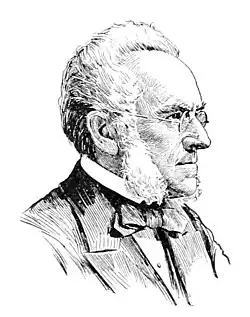
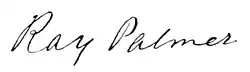
PALMER, Ray, hymnologist, b. in Little Compton, R. I., 12 Nov., 1808; d. in Newark, N. J., 29 March, 1887. He was graduated at Yale in 1830, and engaged for several years in teaching in New York city and New Haven, Conn. He was licensed to preach by the New Haven west association of Congregational ministers in 1832, ordained in 1835, and settled in Bath, Me., where he officiated fifteen years. In 1850 he removed to Albany, N. Y., serving there nearly sixteen years, and in 1866 he became secretary of the Congregational union, holding the office twelve years. In 1885 he suffered a stroke of paralysis, and lived in retirement till the second and fatal one. Union college gave him the degree of D. D. in 1852. Besides numerous works, pamphlets, and special contributions to religious periodicals, he was the author of "Spiritual Improvement, or Aid to Growth in Grace" (Boston, 1839; republished as "Closet Hours," Albany, 1851); "Remember Me" (Boston, 1855; new ed., New York, 1873); "Hints on the Formation of Religious Opinions" (New York, 1860); "Hymns and Sacred Pieces" (1865); "Hymns of My Holy Hours" (1866); "Home, or The Unlost Paradise" (1868); "Earnest Words on True Success in Life" (1873); "Complete Poetical Works" (1876); and "Voices of Hope and Gladness" (1880). In the special line of hymnology Dr. Palmer held the first place among American writers. His first hymn that attracted attention, entitled "My Faith looks up to Thee," was written in 1831 while he was teaching in New York, but was not published for several years. It has since been translated into more than twenty languages. Next to this, his best-known hymns are "Fount of Everlasting Love" (1832); "Thou who roll'st the Year Around" (1832); "Away from Earth my Spirit turns" (1833); "Stealing from the World Away" (1834); "Before Thy Throne with Tearful Eyes" (1834); "Wake Thee, O Zion! Thy Mourning is Ended" (1834); "When Downward to the Darksome Tomb" (1842); "And is There, Lord, a Rest?" (1843); "O Sweetly Breathe the Lyres Above!" (1843); "Eternal Father, Thou hast Said" (1860); "Jesus, Lamb of God, for Me" (1863); "Take Me, My Father! Take Me" (1864); "Thou Saviour, from Thy Throne on High" (1864); and "Lord, Thou on Earth did'st Love Thine Own" (1864).