CHAP VIII.
REFRACTION AT SPHERICAL SURFACES.
75.Prop. A RAY of light is refracted at a spherical surface, bounding two different media; given the point where it meets the axis; required the point where the refracted ray meets the axis.
Figs. 66, 67, 68, 69, represent four different cases.
- (1) A denser refracting medium with a concave surface. Fig. 66.
- (2) A denser medium with a convex surface, Fig. 67.
- (3) A rarer medium with a concave surface, Fig. 68.
- (4) A rarer medium with a convex surface, Fig. 69.
In all these figures  is the incident ray cutting the axis
  in
in  ;
;  the refracted ray cutting in
  .
.  is the centre of the surface.
Let  ,
,





- Then

76. It is not possible to obtain a general, simple, algebraical expression from this, but if merely the ultimate value of  be required, that is, the limit of its value when the angle
  is diminished sine limite, we may put
  , for
, for  , for
, for  [1]; we have then
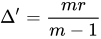
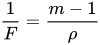
that is, (Case1, 3.) 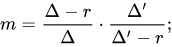


(Case 1, 4.) 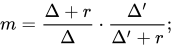


77. There is another expression sometimes used, in which the distances are measured from the centre, (Fig. 70.)
Let 



78. It will be observed, that we have taken  to represent the ratio of the sines of incidence and refraction in all cases, whether the passage of the light be into a denser or a rarer medium; if we chuse that should always represent the ratio of the sines of incidence and refraction out of the rarer into the denser, we must, in Cases 3 and 4, put
  for .
for .
Then 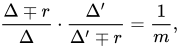 and
and 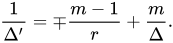
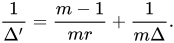
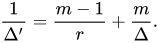
We may now tabulate our results as follows:
| Case. |
Refracting
Medium. |
Surface. |
Equation.
|
| 1. |
Denser, |
Concave, |
|
| 2. |
Denser, |
Concave, |
|
| 3. |
Rarer, |
Convex, |
|
| 4. |
Rarer, |
Convex, |
|
79.The distance being independent of the angle  provided that angle be extremely small, we may consider as the focus in which the refracted rays meet when several incident rays proceed from in an extremely small pencil nearly coincident with the axis.
80.In order to find the principal focal distance, which we call  as in Chap. II, we have of course only to make
  infinite in the equations just given; we have then in
Case 1,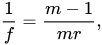 or
or 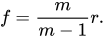
2, or 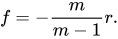
3,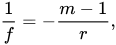 or
or 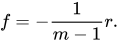
4,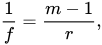 or
or 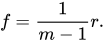
We might of course easily have found this directly; thus, let  (Figs. 71—74.) be an incident ray parallel to the axis
  the refracted ray cutting the axis in
  the principal focus.

and putting  for
for  as before,

whence

as above.
It is important to observe, that in all cases, the distance (AF) of the principal focus from the surface is to its distance (EF) from the centre as the sine of incidence to the sine of refraction.
81. If we introduce the distance  into the formulæ, we shall have in
Cases 1 and 2,
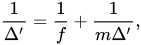
3 and 4,
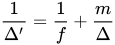
.
82. A spherical refracting surface may, in fact, be said to have two principal foci, one for rays proceeding, parallel to the axis, from the rarer into the denser medium, the other for parallel rays proceeding in the contrary direction. They are on opposite sides of the surface, and at different distances from it, as may easily be seen from the formulæ, for in Cases 1 and 4, is positive, that is, lies on the side whence the light proceeds; in cases 2 and 3, is negative.
In Fig. 75 and 76, and are the two principal foci above described, for parallel rays entering the denser medium, for those proceeding out of it into the rarer one.
83. We will now proceed to examine the varieties of position that and , the conjugate foci, are capable of.
Case 1. In the first place, when is at an infinite distance, the place of is , (Fig. 71.)
When is at  is likewise at
In all intermediate cases, that is, when is beyond lies between and  (Fig. 66.)
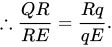
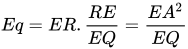
When is between  and , is between and This may easily be seen from the geometrical construction, (Fig. 77.) or it may be shown from the formula: for

which shows that is greater or less than  according as it is greater or less than
When comes to , coincides with it.
By differentiating the equation 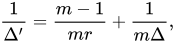 we find

which shows that the distance  is at a maximum in the space between and when
  , or
, or
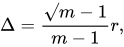
for when  is at a maximum
  and
and 
If we place on the other side of  (Fig. 78.) or make negative, we shall have
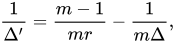
whence we collect that as long as 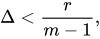 is negative and increasing: that when
 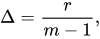 or is at , is infinite, and that afterwards it becomes positive, or that goes to the other side of
Obs. It will probably have occurred to the reader, that by placing within the denser medium, we have virtually passed from the first case to the fourth, with the only difference that the places of and are inverted. I have, however, purposely placed in all possible positions, in order to illustrate the connexion between the cases, and to show that the conjugate foci are convertible, as in reflexion, and that what are incident rays in one point of view, may be considered in another as refracted, and vice versâ.
84. It will be observed that in this, and in all other cases of refraction, the conjugate foci move in the same direction, whereas in reflexion they always come towards, or recede from each other.
The following are corresponding values of and
Case 2.Here we have 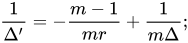 whence it appears that as long as
 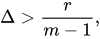 or beyond (Fig. 76.) is negative, or on the contrary side of from
When or is at is infinite.
 When or is between and is positive; so that and are on the same side of
  is at first infinitely distant, and its change of place must be very much quicker than that of , for while this moves from to , comes from an infinite distance to the same point.
When is negative, or within the denser medium, Fig. 79.
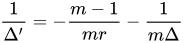
is then necessarily negative, as we might expect, the two foci moving together from in the same direction.
is at first greater than  but the two points coincide in
  and afterwards gets beyond
  and, in fact, it moves from to an infinite distance while goes from to .
The following therefore are corresponding values,
| ∆ |
= |
∞, |
r/m−1, |
0, |
−r, |
∞
|
| ∆′ |
= |
−mr/m−1, |
∞, |
0, |
−r, |
mr/m−1.
|
Cases 3 and 4 have, in fact, been discussed in the two others, we will therefore only exhibit the principal corresponding values of ∆ and ∆′.
| Case 3. |
∆ |
= |
∞, |
mr/m−1, |
r, |
0, |
∞,
|
|
∆′ |
= |
−r/m−1, |
−∞, |
r, |
0, |
−r/m−1.
|
| Case 4. |
∆ |
= |
∞, |
0, |
−r, |
−mr/m−1, |
∞,
|
|
∆′ |
= |
r/m−1, |
0, |
−r, |
∞, |
r/m−1.
|
Upon the whole we may collect the following results.
In Case 1, divergency is given to incident rays, except when they proceed from a point between the centre and the surface.
In Case 2, convergency is given.
In Case 3, convergency, except when the focus of incident rays is between the centre and surface.
In Case 4, divergency in all cases.
Of course we except the case of rays proceeding from, or to the centre of a surface, which are not refracted at all.
85. We now pass on to a more useful part of this subject, which treats of Lenses, that is, of refracting media terminated by two spherical surfaces.
There are several kinds of these:
- The double convex, of which Fig. 80. represents a section through the axis.
- The plano-convex, Fig. 81, which may be considered as a variety of this, the radius of one of the spheres becoming infinite.
- The double-concave, Fig. 82.
- The plano-concave, Fig. 83.
- The meniscus, Fig. 84, bounded by a concave and a convex surface which meet.
- The concavo-convex, Fig. 85, in which the surfaces do not meet.
86. Prop. To find the direction of a ray after refraction through a lens.
The method we shall follow here is to consider a ray refracted at the first surface, as incident on the second, and there again refracted; we shall have occasion to add to the letters hitherto used
∆″ for the distance of the focus after the second refraction,
t the thickness of the lens;
r′ the radius of the second surface.
Then taking, for instance, the concavo-convex lens in which both the centres are on the same side, (Fig. 86.)
1/∆′=1/m∆+m−1/mr for the first refraction,
1/∆″+t=m/∆′+t−m−1/r′, for the second,
t being added to ∆′ and ∆″ as the distances are now to be measured from the second surface. However, in order to simplify the expressions, it is usual to suppose the thickness of the lens inconsiderable in comparison of ∆′ and ∆″, in which case we may write
| 1/∆″ |
= |
m/∆′−m−1/r′
|
|
= |
1/∆+m−1/r−m−1/r′
|
|
= |
m−1(1/r−1/r′)+1/∆.
|
87.
Now in the first place it will be immediately seen that this expression gives the
principal focal distance, which we will call
, by leaving out the last term, which is equivalent to making

, or
infinite: we have thus
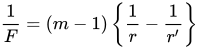 [2]
[2]and then,
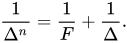
It appears from the former of these that is positive or negative according as  is so: let us examine what sign this is affected with in different cases.
In the concavo-convex lens placed as in Fig. 86,  and is positive.
When this lens is turned the contrary way,  , but they are both negative, we have then
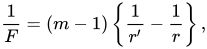
and is positive as before.
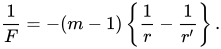
In the meniscus, either  both being positive, and then
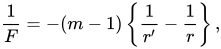
or , and both are negative: so that
In the double-concave lens  is negative,
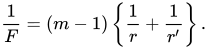
In the double-convex  is negative,
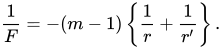
In the plano-concave either is infinite, or is infinite, and negative; therefore putting for the single radius

In the plane-convex,

When in the double-concave, or double-convex lens the radii are
equal,
 [3]
[3]
88.It appears from all this, that the place of the principal focus is the same, whichever side of a lens is turned towards the incident light, and that
| The concavo-convex[4] |
 |
make parallel rays diverge.
|
| the double-concave
|
| and the plano-concave
|
| The meniscus |
|
make parallel rays converge.
|
| the double-convex
|
| and the plano-convex
|
89. The equation
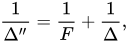
or
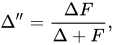
when put into geometrical language, gives rise to the following proportion, (Fig. 88.)

or if  that is, if be the principal focus for rays incident on the contrary side of the lens to

which it is more convenient to state thus

From this we derive another useful proportion,

From either the equations or the proportions it will be easy to prove that when the distance of from the lens is varied, that is, when the place of is changed, the lens remaining fixed, the two foci move in the same direction.
The following are corresponding values of and  for a concave lens:


The following are for a convex one


90. The distance between the foci is represented by  or
or  according as the lens is concave or convex, but as the equation gives
  negative in the latter case, we may take
  as its general value.
Now
 that is,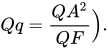
This quantity evidently admits of a minimum value. To find this, we will equate to 0 the differential of its logarithm, which gives

The negative sign shows that the incident rays are converging to a point beyond the lens.
91. To return to the original question: if it be not thought proper to neglect  the thickness of the lens, we may make the calculation rather simpler by measuring from the second surface.
Then, 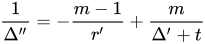


The binomial in the second term may be expanded, and as many terms taken as thought proper.
If we consider only parallel incident rays, the equation becomes of course much simpler;



In any particular case it is easy to put the proper values of  and in the equations, and determine accurately the value of or but no simple general expression can be obtained for them.
92.The sphere may be considered as a sort of lens. In fact, it is a particular species of double convex, in which the thickness is twice the radius.
In investigating its focal length, it will be most convenient to refer the distances to the centre, as in Art. 77.
In Fig. 89, if  we have
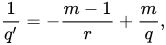
 and
and  being in the same direction,
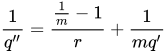 (Here is negative.)
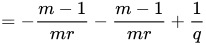
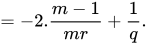
The principal focal length is of course  the negative sign meaning that the focus is on the opposite side from that whence the light proceeds.
If the sphere be of glass, and placed in air,  and
and 
if of water,  and
and 
93.There is one case in which a ray will pass through a lens without deviation, that is, the emergent ray will be parallel to the incident: it is when the surfaces at which it enters and emerges, are parallel.
This is shown in Figs. 90, 91, 92, 93, where  is the course of the light, and it will easily be seen that the spherical surfaces at
  can be parallel only when the radii
  are so.
The point  where the refracted ray cuts the axis, is called by some writers, the centre of the lens; it is within the lens in the cases of double-concave and double-convex lenses, but without, in the meniscus and concavo-convex.
The point  is invariably the same at whatever angle the parallel radii be drawn, for

The point where the incident ray cuts the axis is easily found: we have only to put the value of  for in the equation, for the single refracting surface, and find

Then 
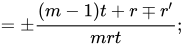
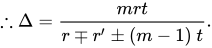
If the thickness of the lens be supposed inconsiderable, may be taken as a straight line, and  as one point.
It appears from this, that when a pencil of rays enters a thin lens obliquely, that ray which passes through the centre is not refracted at all: it serves as an axis to the pencil, and the focus of refracted rays lies on it at the same distance from the centre of the lens as when the axis of the pencil coincides with that of the lens, though the refraction is not quite accurate.
94. To return to the simple approximate formula of the lens.
Let  represent the distance hitherto called
Then, 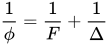 or
or 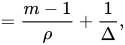 (vid. Note, p. 62.)
Now, suppose a second lens be placed close to the first, (Fig. 94.) having for its principal focal length  or
or 
In order to find  the distance of the focus after the second refraction, we must consider and
  as representing and in the formula, so that
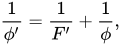
or
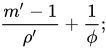
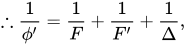
or
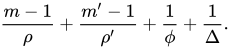
And in like manner, if there be any number  of lenses acting together, we shall have

or

so that their joint effect is the same as that of a single lens, having, for its principal focal length unity divided by

or

95. Mr. Herschel calls the reciprocal quantity  the power of a lens, and enounces the last result thus:
"The power of any system of lenses is the sum of the powers of the component lenses."
Of course, regard must be had to the signs: the power of a concave-lens must be considered as positive, that of a convex one, negative.
96. The same method by which we found the focal length of a lens may be easily applied to any number of surfaces, having a common axis.
Let  be the successive radii, each having its own
proper sign as well as magnitude.
be the successive radii, each having its own
proper sign as well as magnitude.
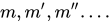 the indices of refraction at the several surfaces.
the original focal distance.
 those after one, two, three, refractions.
Then, if only we neglect the distances between the surfaces along the axis, we shall have

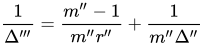

and so on.
When the surfaces are those of lenses, 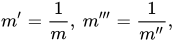 and the equations are reducible to those we have already seen.