A Life of William Shakespeare
WILLIAM SHAKESPEARE

THE MACMILLAN COMPANY
NEW YORK • BOSTON • CHICAGO
ATLANTA • SAN FRANCISCO
MACMILLAN & CO., Limited
LONDON • BOMBAY • CALCUTTA
MELBOURNE
THE MACMILLAN CO. OF CANADA, Ltd.
TORONTO
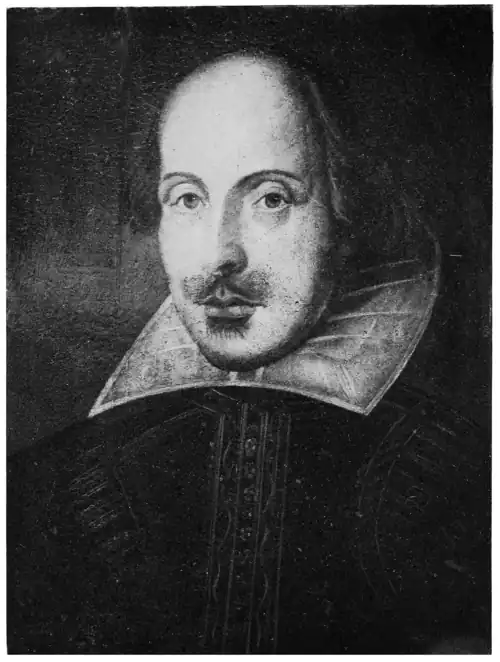
Walker & Boutall. ph. sc.
William Shakespeare
from the "Droeshout" painting now in the
Shakespeare Memorial Gallery at Stratford-on-Avon.
A LIFE
OF
WILLIAM SHAKESPEARE
BY
SIDNEY LEE
WITH PORTRAITS AND FACSIMILES
NEW AND REVISED EDITION
WITH A NEW PREFACE
New York
THE MACMILLAN COMPANY
1909
All rights reserved
Copyright, 1909,
By THE MACMILLAN COMPANY.
Set up and electrotyped. Published April, 1909.
Norwood Press
J. S. Gushing Co.—Berwick & Smith Co,
Norwood, Mass., U.S.A.
CONTENTS
| Preface to the New and Revised Edition (not in original TOC) | v | |
| Preface to the First Edition (not in original TOC) | xxv | |
| I | ||
| PARENTAGE AND BIRTH | ||
| PAGE | ||
| Distribution of the name of Shakespeare | 1 | |
| The poet's ancestry | 2 | |
| The poet's father | 4 | |
| His settlement at Stratford | 5 | |
| The poet's mother | 6 | |
| 1564, | April. The poet's birth and baptism | 8 |
| Alleged birthplace | 8 | |
| II | ||
| CHILDHOOD, EDUCATION, AND MARRIAGE | ||
| PAGE | ||
| The father in municipal office | 10 | |
| Brothers and sisters | 11 | |
| The father's financial difficulties | 12 | |
| 1571-7 | Shakespeare's education | 13 |
| His classical equipment | 15 | |
| Shakespeare's knowledge of the Bible | 17 | |
| 1575 | Queen Elizabeth at Kenilworth | 18 |
| 1577 | Withdrawal from school | 18 |
| 1582, | Dec. The poet's marriage | 19 |
| Richard Hathaway of Shottery | 19 | |
| Anne Hathaway | 20 | |
| Anne Hathaway's cottage | 20 | |
| The bond against impediments | 21 | |
| 1583, | May. Birth of the poet's daughter Susanna | 23 |
| Formal betrothal probably dispensed with | 24 | |
| III | ||
| THE FAREWELL TO STRATFORD | ||
| PAGE | ||
| Early married life | 26 | |
| Poaching in Charlecote | 28 | |
| Unwarranted doubts of the tradition | 29 | |
| Justice Shallow | 30 | |
| 1585 | The flight from Stratford | 30 |
| IV | ||
| ON THE LONDON STAGE | ||
| PAGE | ||
| 1586 | The journey to London | 32 |
| Richard Field, Shakespeare's townsman | 33 | |
| Theatrical employment | 33 | |
| A playhouse servitor | 35 | |
| The acting companies | 35 | |
| The Lord Chamberlain's company | 36 | |
| Shakespeare a member of the Lord Chamberlain's company | 37 | |
| The London theatres | 37 | |
| Place of residence in London | 39 | |
| Actors' provincial tours | 40 | |
| Shakespeare's alleged travels | 41 | |
| In Scotland | 42 | |
| In Italy | 43 | |
| Shakespeare's rôles | 44 | |
| His alleged scorn of an actor's calling | 45 | |
| V | ||
| EARLY DRAMATIC WORK | ||
| PAGE | ||
| The period of Shakepeare's dramatic work, 1591-1611. | 47 | |
| His borrowed plots | 48 | |
| The revision of plays | 48 | |
| Chronology of the plays | 49 | |
| Metrical tests | 50 | |
| 1591 | Love's Labour's Lost | 51 |
| 1591 | Two Gentlemen of Verona | 54 |
| 1592 | Comedy of Errors | 55 |
| 1592 | Romeo and Juliet | 56 |
| 1592, | March. Henry VI | 58 |
| 1592, | Sept. Greene's attack on Shakespeare | 59 |
| Chettle's apology | 60 | |
| Divided authorship of Henry VI | 61 | |
| Shakespeare's coadjutors | 62 | |
| Shakespeare's assimilative power | 63 | |
| Lyly's influence in comedy | 64 | |
| Marlowe's influence in tragedy | 65 | |
| 1593 | Richard III | 65 |
| 1593 | Richard II | 67 |
| Shakespeare's acknowledgments to Marlowe | 67 | |
| 1593 | Titus Andronicus | 68 |
| 1594, | August. The Merchant of Venice | 70 |
| Shylock and Roderigo Lopez | 71 | |
| 1594 | King John | 73 |
| 1594, | Dec. 28. Comedy of Errors in Gray's Inn Hall | 74 |
| Early plays doubtfully assigned to Shakepeare | 75 | |
| Arden of Feversham (1592) | 75 | |
| Edward III | 75 | |
| Mucedorus | 76 | |
| Faire Em (1592) | 77 | |
| VI | ||
| THE FIRST APPEAL TO THE READING PUBLIC | ||
| PAGE | ||
| 1593, | April. Publication of Venus and Adonis | 78 |
| 1584, | May. Publication of Lucrece | 80 |
| Enthusiastic reception of the poems | 82 | |
| Shakespeare and Spenser | 83 | |
| Patrons at Court | 85 | |
| VII | ||
| THE SONNETS AND THEIR LITERARY HISTORY | ||
| PAGE | ||
| The vogue of the Elizabethan sonnet | 87 | |
| Shakespeare's first experiments | 88 | |
| 1594 | Majority of Shakespeare's sonnets composed | 89 |
| Their literary value | 91 | |
| Circulation in manuscript | 92 | |
| Their piratical publication in 1609 | 93 | |
| A Lover's Complaint | 95 | |
| Thomas Thorpe and 'Mr. W. H.' | 95 | |
| The form of Shakespeare's sonnets | 99 | |
| Their want of continuity | 100 | |
| The two 'groups' | 100 | |
| Main topics of the first 'group' | 102 | |
| Main topics of the second 'group' | 103 | |
| The order of the sonnets in the edition of 1640 | 104 | |
| Lack of genuine sentiment in Elizabethan sonnets | 104 | |
| Their dependence on French and Italian models | 105 | |
| Sonnetteers' admissions of insincerity | 109 | |
| Contemporary censure of sonnetteers' false sentiment | 110 | |
| Shakespeare's scornful allusions to sonnets in his plays | 111
| |
| VIII | ||
| THE BORROWED CONCEITS OF THE SONNETS | ||
| PAGE | ||
| Slender autobiographical element in Shakespeare's sonnets | 113 | |
| The imitative element | 113 | |
| Shakespeare's claims of immortality for his sonnets a borrowed conceit | 117 | |
| Conceits in sonnets addressed to a woman | 122 | |
| The praise of 'blackness' | 122 | |
| The sonnets of vituperation | 124 | |
| Gabriel Harvey's Amorous Odious sonnet | 125 | |
| Jodelle's Contr' Amours | 126 | |
| IX | ||
| THE PATRONAGE OF THE EARL OF SOUTHAMPTON | ||
| PAGE | ||
| Biographic fact in the 'dedicatory' sonnets | 129 | |
| The Earl of Southampton the poet's sole patron | 130 | |
| Rivals in Southampton's favour | 134 | |
| Shakespeare's fear of another poet | 136 | |
| Barnabe Barnes probably the chief rival | 137 | |
| Other theories as to the chief rival's identity | 138 | |
| Sonnets of friendship | 140 | |
| Extravagances of literary compliment | 142 | |
| Patrons habitually addressed in affectionate terms | 143 | |
| Direct references to Southampton in the sonnets of friendship | 146 | |
| His youthfulness | 147 | |
| The evidence of portraits | 148 | |
| Sonnet cvii the last of the series | 151 | |
| Allusions to Queen Elizabeth's death | 151 | |
| Allusion to Southampton's release from prison | 153 | |
| X | ||
| THE SUPPOSED STORY OF INTRIGUE IN THE SONNETS | ||
| PAGE | ||
| Sonnets of melancholy and self-reproach | 155 | |
| The youth's relations with the poet's mistress | 157 | |
| Willobie his Avisa (1594) | 159 | |
| Summary of conclusions respecting the sonnets | 162 | |
| XI | ||
| THE DEVELOPMENT OF DRAMATIC POWER | ||
| PAGE | ||
| 1594-5 | Midsummer Night's Dream | 165 |
| 1595 | All's Well that Ends Well | 167 |
| 1595 | The Taming of The Shrew | 168 |
| Stratford allusions in the Induction | 169 | |
| Wincot | 169 | |
| 1597 | Henry IV | 172 |
| Falstaff | 174 | |
| 1597 | The Merry Wives of Windsor | 177 |
| 1598 | Henry V | 179 |
| Essex and the rebellion of 1601 | 181 | |
| Shakespeare's popularity and influence | 183 | |
| Shakespeare's friendship with Ben Jonson | 183 | |
| The Mermaid meetings | 184 | |
| 1598 | Meres's eulogy | 185 |
| Value of his name to publishers | 186 | |
| 1599 | The Passionate Pilgrim | 188 |
| 1601 | The Phenix and the Turtle | 190 |
| XII | ||
| THE PRACTICAL AFFAIRS OF LIFE | ||
| Shakespeare's practical temperament | 192 | |
| His father's difficulties | 193 | |
| His wife's debt | 194 | |
| 1596-9 | The coat-of-arms | 195 |
| 1597, | May 4. The purchase of New Place | 200 |
| 1598 | Fellow-townsmen appeal to Shakespeare for aid | 202 |
| Shakespeare's financial position before 1599 | 203 | |
| Shakespeare's financial position after 1599 | 207 | |
| His later income | 209 | |
| Incomes of fellow-actors | 210 | |
| 1601-1610 | Shakespeare's formation of his estate at Stratford | 211 |
| 1605 | The Stratford tithes | 212 |
| 1600-1609 | Recovery of small debts | 213 |
| XIII | ||
| MATURITY OF GENIUS | ||
| Literary work in 1599 | 214 | |
| 1599 | Much Ado about Nothing | 215 |
| 1599 | As You Like It | 216 |
| 1600 | Twelfth Night | 217 |
| 1601 | Julius Caesar | 219 |
| The strife between adult actors and boy-actors | 220 | |
| Shakespeare's references to the struggle | 223 | |
| 1601 | Ben Jonson's Poetaster | 225 |
| Shakespeare's alleged partisanship in the theatrical warfare | 227 | |
| 1602 | Hamlet | 228 |
| The problem of its publication | 230 | |
| The First Quarto, 1603 | 231 | |
| The Second Quarto, 1604 | 231 | |
| The Folio version, 1623 | 231 | |
| Popularity of Hamlet | 232 | |
| 1603 | Troilus and Cressida | 233 |
| Treatment of the theme | 235 | |
| 1603, | March 24. Queen Elizabeth's death | 238 |
| James I's patronage | 239 | |
| XIV | ||
| THE HIGHEST THEMES OF TRAGEDY | ||
| 1604, | Nov. Othello | 243 |
| 1604, | Dec. Measure for Measure | 245 |
| 1606 | Macbeth | 247 |
| 1607 | King Lear | 249 |
| 1608 | Timon of Athens | 251 |
| 1608 | Pericles | 252 |
| 1608 | Antony and Cleopatra | 254 |
| 1609 | Coriolanus | 255 |
| XV | ||
| THE LATEST PLAYS | ||
| PAGE | ||
| The placid temper of the latest plays | 257 | |
| 1610 | Cymbeline | 258 |
| 1611 | The Winter's Tale | 260 |
| 1611 | The Tempest | 261 |
| Fanciful interpretations of The Tempest | 265 | |
| Unfinished plays | 267 | |
| The lost play of Cardenio | 267 | |
| The Two Noble Kinsmen | 268 | |
| Henry VIII | 269 | |
| The burning of the Globe Theatre | 269 | |
| XVI | ||
| THE CLOSE OF LIFE | ||
| PAGE | ||
| Plays at Court in 1613 | 273 | |
| Actor-friends | 273 | |
| 1611 | Final settlement at Stratford | 275 |
| Domestic affairs | 275 | |
| 1613, | March. Purchase of a house in Blackfriars | 276 |
| 1614, | Oct. Attempt to enclose the Stratford common fields | 279 |
| 1616, | April 23. Shakespeare's death | 280 |
| 1616, | April 23. Shakespeare's burial | 281 |
| The will | 282 | |
| Shakespeare's bequest to his wife | 283 | |
| Shakespeare's heiress | 284 | |
| Legacies to friends | 285 | |
| The tomb in Stratford Church | 286 | |
| Shakespeare's personal character | 286 | |
| XVII | ||
| SURVIVORS AND DESCENDANTS | ||
| PAGE | ||
| Mrs. Judith Quiney (1585-1662) | 289 | |
| Mrs. Susanna Hall (1583-1649) | 290 | |
| The last descendant | 291 | |
| Shakespeare's brothers, Edmund, Richard, and Gilbert | 292 | |
| XVIII | ||
| AUTOGRAPHS, PORTRAITS, AND MEMORIALS | ||
| PAGE | ||
| Extant specimens of Shakespeare's handwriting | 293 | |
| His mode of writing | 294 | |
| The poet's spelling of his surname | 294 | |
| 'Shakespeare' the accepted form | 295 | |
| Shakespeare's portraits | 297 | |
| The Stratford bust | 298 | |
| The 'Stratford' portrait | 298 | |
| Droeshout's engraving | 299 | |
| The 'Droeshout' painting | 300 | |
| Later portraits | 303 | |
| The 'Chandos' portrait | 303 | |
| The 'Jansen' portrait | 305 | |
| The 'Felton' portrait | 305 | |
| The 'Soest' portrait | 306 | |
| Miniatures | 306 | |
| The Garrick Club bust | 307 | |
| Alleged death-mask | 307 | |
| Memorials in sculpture | 308 | |
| Memorials at Stratford | 309 | |
| XIX | ||
| BIBLIOGRAPHY | ||
| PAGE | ||
| Editions of the poems in the poet's lifetime | 311 | |
| Posthumous quartos of the poems | 311 | |
| The 'Poems' of 1640 | 312 | |
| Editions of the plays in the poet's lifetime | 313 | |
| Posthumous quartos of the plays | 314 | |
| 1623 | The First Folio | 315 |
| The publishing syndicate | 315 | |
| The prefatory matter | 318 | |
| The value of the text | 319 | |
| The order of the plays | 320 | |
| The typography | 320 | |
| Irregular copies | 320 | |
| The Sheldon copy | 321 | |
| Jaggard's presentation copy of the First Folio | 323 | |
| Estimated number of extant copies | 326 | |
| Reprints of the First Folio | 327 | |
| 1632 | The Second Folio | 327 |
| 1663-4 | The Third Folio | 328 |
| 1685 | The Fourth Folio | 328 |
| Eighteenth-century editors | 328 | |
| Nicholas Rowe (1674-1718) | 329 | |
| Alexander Pope (1688-1744) | 330 | |
| Lewis Theobald (1688-1744) | 331 | |
| Sir Thomas Hanmer (1677-1746) | 333 | |
| Bishop Warburton (1698-1779) | 334 | |
| Dr. Johnson (1709-1783) | 334 | |
| Edward Capell (1713-1781) | 334 | |
| George Steevens (1736-1800) | 335 | |
| Edmund Malone (1741-1812) | 337 | |
| Variorum editions | 337 | |
| Nineteenth-century editors | 338 | |
| Alexander Dyce (1798-1869) | 339 | |
| Howard Staunton (1810-1874) | 339 | |
| Nikolaus Delius (1813-1888) | 339 | |
| The Cambridge edition (1863-6) | 339 | |
| The Bankside edition | 339 | |
| Other nineteenth-century editions. | 340 | |
| XX | ||
| POSTHUMOUS REPUTATION | ||
| PAGE | ||
| Views of Shakespeare's contemporaries | 342 | |
| Ben Jonson's tribute | 343 | |
| English opinion between 1660 and 1702 | 345 | |
| Dryden's view | 346 | |
| Restoration adaptations | 347 | |
| English opinion from 1702 onwards | 348 | |
| Stratford festivals | 350 | |
| Shakespeare on the English stage | 350 | |
| The first appearance of actresses in Shakespearean parts | 351 | |
| David Garrick (1717-1779) | 352 | |
| John Philip Kemble (1757-1823) | 353 | |
| Mrs. Sarah Siddons (1755-1831) | 354 | |
| Edmund Kean (1787-1833) | 354 | |
| William Charles Macready (1793-1873) | 355 | |
| Recent revivals | 355 | |
| Shakespeare in English music and art | 357 | |
| Boydell's Shakespeare Gallery | 357 | |
| Shakespeare in America | 358 | |
| Translations | 358 | |
| Shakespeare in Germany | 358 | |
| German translations | 360 | |
| Modern German critics | 362 | |
| Shakespeare on the German stage | 363 | |
| Shakespeare in France | 364 | |
| Voltaire's strictures | 365 | |
| French critics' gradual emancipation from Voltairean influence | 366 | |
| Shakespeare оп the French stage | 368 | |
| Shakespeare in Italy | 369 | |
| In Holland | 370 | |
| In Russia | 370 | |
| In Poland | 370 | |
| In Hungary | 371 | |
| In other countries | 371 | |
| XXI | ||
| GENERAL ESTIMATE | ||
| PAGE | ||
| General estimate | 372 | |
| Shakespeare's defects | 372 | |
| Character of Shakespeare's achievement | 373 | |
| Its universal recognition | 374 | |
APPENDIX
| I | ||
| THE SOURCES OF BIOGRAPHICAL KNOWLEDGE | ||
| PAGE | ||
| Contemporary records abundant | 377 | |
| First efforts in biography | 377 | |
| Biographers of the nineteenth century | 378 | |
| Stratford topography | 379 | |
| Specialised studies in biography | 380 | |
| Epitomes | 380 | |
| Aids to study of plots and text | 380 | |
| Concordances | 380 | |
| Bibliographies | 381 | |
| Critical studies | 381 | |
| Shakespearean forgeries | 381 | |
| John Jordan (1746-1809) | 382 | |
| The Ireland forgeries (1796) | 382 | |
| List of forgeries promulgated by Collier and others (1835-1849) | 383 | |
| II | ||
| THE BACON-SHAKESPEARE CONTROVERSY | ||
| PAGE | ||
| Its source | 386 | |
| Sir Tobie Matthew's letter of 1621 | 387 | |
| Chief exponents of the theory | 388 | |
| Its vogue in America | 388 | |
| Extent of the literature | 389 | |
| Absurdity of the theory | 389 | |
| III | ||
| THE YOUTHFUL CAREER OF THE EARL OF SOUTHAMPTON | ||
| PAGE | ||
| Shakespeare and Southampton | 390 | |
| Southampton's parentage | 390 | |
| 1573 | Oct. 6. Southampton's birth | 391 |
| His education | 391 | |
| Recognition of Southampton's beauty in youth | 393 | |
| His reluctance to marry | 394 | |
| Intrigue with Elizabeth Vernon | 395 | |
| 1598 | Southampton's marriage | 395 |
| 1601-3 | Southampton's imprisonment | 396 |
| Later career | 396 | |
| 1624, | Nov. 10. His death | 397 |
| IV | ||
| THE EARL, OF SOUTHAMPTON AS A LITERARY PATRON | ||
| PAGE | ||
| Southampton's collection of books | ||
| References in his letters to poems and plays | 398 | |
| His love of the theatre | 399 | |
| Poetic adulation | 400 | |
| 1593 | Barnabe Barnes's sonnet | 400 |
| Tom Nash's addresses | 401 | |
| 1595 | Gervase Markham's sonnet | 403 |
| 1598 | Florio's address | 403 |
| The congratulations of the poets in 1603 | 404 | |
| Elegies on Southampton | 405 | |
| V | ||
| THE TRUE HISTORY OF THOMAS THORPE AND 'MR. W. H.' | ||
| PAGE | ||
| The publication of the 'Sonnets' in 1609 | 406 | |
| The text of the dedication | 407 | |
| Publishers' dedications | 408 | |
| Thorpe's early life | 409 | |
| His ownership of the manuscript of Marlowe's Lucan | 409 | |
| His dedicatory address to Edward Blount in 1600 | 410 | |
| Character of his business | 411 | |
| Shakespeare's sufferings at publishers' hands | 412 | |
| The use of initials in dedications of Elizabethan and Jacobean
books |
413 | |
| Frequency of wishes for 'happiness' and 'eternity' in dedicatory
greetings |
414 | |
| Five dedications by Thorpe | 415 | |
| 'W. H.' signs dedication of Southwell's 'Poems' | 416 | |
| 'W. H.' and Mr. William Hall | 418 | |
| The 'onlie begetter' means 'only procurer' | 419 | |
| VI | ||
| 'MR. WILLIAM HERBERT' | ||
| PAGE | ||
| Origin of the notion that Mr. W. H.' stands for William Herbert | 422 | |
| The Earl of Pembroke known only as Lord Herbert in youth | 423 | |
| Thorpe's mode of addressing the Earl of Pembroke | 424 | |
| VII | ||
| SHAKESPEARE AND THE EARL OF PEMBROKE | ||
| PAGE | ||
| Shakespeare with the acting company at Wilton in 1603 | 427 | |
| The dedication of the First Folio in 1623 | 428 | |
| No suggestion in the 'Sonnets' of the youth's identity with Pembroke | 429 | |
| Aubrey's ignorance of any relation between Shakespeare and Pembroke | 431 | |
| VIII | ||
| THE 'WILL' SONNETS | ||
| PAGE | ||
| Elizabethan meanings of 'will' | 432 | |
| Shakespeare's uses of the word | 433 | |
| Shakespeare's puns on the word | 434 | |
| Arbitrary and irregular use of italics by Elizabethan and Jacobean printers | 435 | |
| The conceits of Sonnets cxxxv-vi interpreted | 436 | |
| Sonnet cxxxv | 437 | |
| Sonnet cxxxvi | 439 | |
| Sonnet cxxxiv | 441 | |
| Sonnet cxliii | 442 | |
| IX | ||
| THE VOGUE OF THE ELIZABETHAN SONNET, 1591-1597 | ||
| PAGE | ||
| 1557 | Wyatt's and Surrey's sonnets published | 443 |
| 1582 | Watson's Centurie of Love | 444 |
| 1591 | Sidney's Astrophel and Stella | 444 |
| I. | Collected sonnets of feigned love | 445 |
| 1592 | Daniel's Delia | 446 |
| Fame of Daniel's sonnets | 447 | |
| 1592 | Constable's Diana | 447 |
| 1593 | Barnabe Barnes's sonnets | 448 |
| 1593 | Watson's Tears of Fancie | 449 |
| 1593 | Giles Fletcher's Licia | 449 |
| 1593 | Lodge's Phillis | 449 |
| 1594 | Drayton's Idea | 450 |
| 1594 | Percy's Cœlia | 451 |
| 1594 | Zepheria | 451 |
| 1595 | Barnfield's sonnets to Ganymede | 451 |
| 1595 | Spenser's Amoretti | 451 |
| 1595 | Emaricdulfe | 452 |
| 1595 | Sir John Davies's Gullinge Sonnets | 452 |
| 1596 | Linche's Diella | 453 |
| 1596 | Griffin's Fidessa | 453 |
| 1596 | Thomas Campion's sonnets | 453 |
| 1596 | William Smith's Chloris | 453 |
| 1597 | Robert Tofte's Laura | 454 |
| Sir William Alexander's Aurora | 454 | |
| Sir Fulke Greville's Cælica | 454 | |
| Estimate of number of love-sonnets issued between 1591 and 1597 | 455 | |
| II. | Sonnets to patrons, 1591-1597 | 456 |
| III. | Sonnets on philosophy and religion | 456 |
| X | ||
| BIBLIOGRAPHICAL NOTE ON THE SONNET IN FRANCE, 1550-1600 | ||
| PAGE | ||
| Ronsard (1524-1585) and 'La Pléiade' | 458 | |
| The Italian sonnetteers of the sixteenth century | 458n | |
| Philippe Desportes (1546-1606) | 459 | |
| Chief collections of French sonnets published between 1553 and 1584 | 460 | |
| Minor collections of French sonnets published between 1553 and 1605 | 460 | |
Index . . . . . . . . . . . . . . . . . . . . . . . . . . . . . . . . . . . . . . . . . . . . . . . . . . . . . . . . . . . . . . . . . . . . . . . . . . . . . . . . . . . . . . . . . . . . . . . . . . . |
463 | |
LIST OF ILLUSTRATIONS


| WILLIAM SHAKESPEARE | Frontispiece | |
| From the 'Droeshout' painting, now in the Shakespeare Memorial Gallery, Stratford-on-Avon. | ||
| HENRY WRIOTHESLEY, Third Earl of Southampton, as a young man | To face p. 149 | |
| From the painting at Welbeck Abbey. | ||
| SHAKESPEARE'S AUTOGRAPH-SIGNATURE to the purchase-deed of a house in Blackfriars, dated March 11, 1612-3 | To face p."276 | |
| From the original document now preserved in the Guildhall Library, London. | ||
| SHAKESPEARE'S AUTOGRAPH-SIGNATURE to a mortgage-deed relating to the house purchased by him in Blackfriars, dated March 11, 1612–3 | To face p."278 | |
| From the original document now preserved in the British Museum. | ||
| THREE AUTOGRAPH-SIGNATURES severally written by Shakespeare on the three sheets of his will | To face p."282 | |
| From the original document at Somerset House, London. | ||
| WILLIAM SHAKESPEARE | To face p."307 | |
| From a plaster-cast of the terra-cotta bust now in the possession of the Garrick Club. | ||
| CONTEMPORARY INSCRIPTION in Jaggard's presentation copy of the First Folio | To face p."323 | |
| Now belonging to Mr. Coningsby Sibthorp. | ||

This work is in the public domain in the United States because it was published before January 1, 1930.
The longest-living author of this work died in 1926, so this work is in the public domain in countries and areas where the copyright term is the author's life plus 98 years or less. This work may be in the public domain in countries and areas with longer native copyright terms that apply the rule of the shorter term to foreign works.

Public domainPublic domainfalsefalse