1911 Encyclopædia Britannica/Regalia
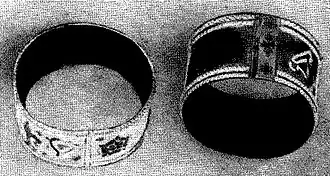
REGALIA (Lat. regalis, royal, from rex, king), the ensigns of royalty. The crown (see Crown and Coronet) and sceptre (see Sceptre) are dealt with separately. Other ancient symbols of royal authority are bracelets, the sword, a robe or mantle, and, in Christian times, a ring. Bracelets, as royal emblems, are mentioned in the Bible in connexion with Saul (2 Sam. i. 10), and they have been commonly used by Eastern monarchs. In Europe their later use seems to have been fitfully confined to England, although they were a very ancient ornament for kings among the Teutonic races. Two coronation bracelets are mentioned among the articles of the regalia ordered to be destroyed at the time of the Commonwealth, and two new ones were made at the Restoration. These are of gold, 11/2 in. in width, and ornamented with the rose, thistle, harp and fleur-de-lis in enamel round them. They have not been used for modern coronations.
The sword is one of the usual regalia of most countries, and is girded on to the sovereign during the coronation. In England the one sword has been developed into five. The Sword of State is borne before the sovereign on certain state occasions, and at the coronation is exchanged for a smaller sword, with which the king is ceremonially girded. The three other swords of the regalia are the “Curtana,” the Sword of Justice to the Spirituality, and the Sword of Justice to the Temporality. The Curtana has a blade cut off short and square, indicating thereby the quality of mercy.
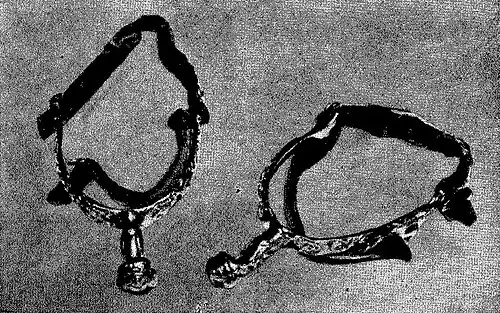
The mantle, as a symbol of royalty, is almost universal, but in the middle ages other quasi-priestly robes were added to it (see Coronation). The English mantle was formerly made of silk; latterly cloth of gold has been used., The ring, by which the sovereign is wedded to his kingdom, is not of so wide a range of usage. That of the English kings held a large ruby with a cross engraved on it. Recently a sapphire has been substituted for the ruby. Golden spurs, though included among the regalia, are merely used to touch the king’s feet, and are not worn.
The orb and cross was not anciently placed in the king’s hands during the coronation ceremony, but was carried by him in the left hand on leaving the church. It is emblematical of monarchical rule, and is only used by a reigning sovereign. The idea is undoubtedly derived from the globe with the figure of Victory with which the Roman emperors are depicted. The larger orb of the English regalia is a magnificent ball of gold, 6 in. in diameter, with a band round the centre edged with gems and pearls. A similar band arches the globe, on the top of which is a remarkably fine amethyst 11/2 in. in height, upon which rests the cross of gold outlined with diamonds. There is a smaller orb made for Mary II., who reigned jointly with King William III.
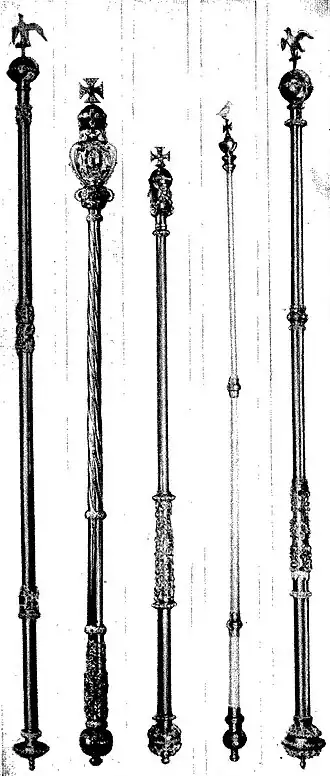
The English regalia, with one or two exceptions, were made for the coronation of Charles II. by Sir Robert Vyner. The Scottish regalia preserved at Edinburgh comprise the crown, dating, in part, from Robert the Bruce, the sword of state given to James IV. by Pope Julius II., and two sceptres.
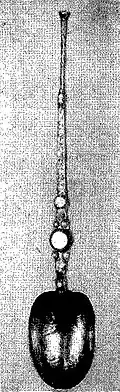
Besides regalia proper, certain other articles are sometimes included under the name, such as the ampulla for the holy oil, and the coronation spoon. The ampulla is of solid gold in the form of an eagle with outspread wings. It weighs 10 oz., and holds 6 oz. of oil. The spoon was not originally used for its present purpose. It is of the 12th or 13th century, with a long handle and egg-shaped bowl. Its history is quite unknown.
See Cyril Davenport, The English Regalia, with illustrations in colour of all the regalia; Leopold Wickham Legg, English Coronation Records; The Ancestor, Nos. 1 and 2 (1902); Menin, The Form, &c., of Coronations (translated from French, 1727).
| Plate I. | ||||||||
| ||||||||
| ||||||||
| ||||||||


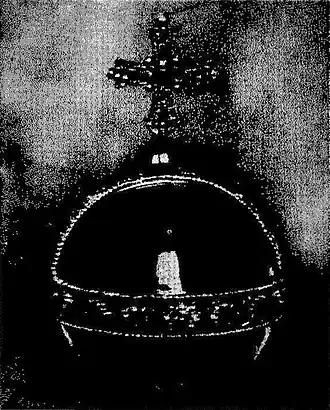

Plate II. | |||||||||||||||||||||||||
|
7.—THE St GEORGE’S SPURS. | ||||||||||||||||||||||||



| Plate III. | |||||||||||||||||
|
| ||||||||||||||||



| Plate IV. | ||
 |
| |
| 1.—Silver-Gilt Altar Dish dated 1660, with representation of the Last Supper; it forms part of the Altar plate at the Coronation and is in the custody of the Chapels Royal. |
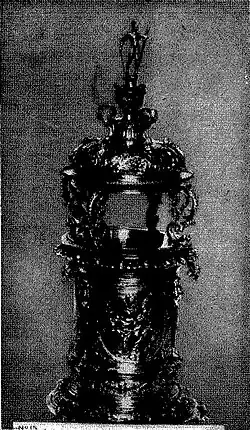
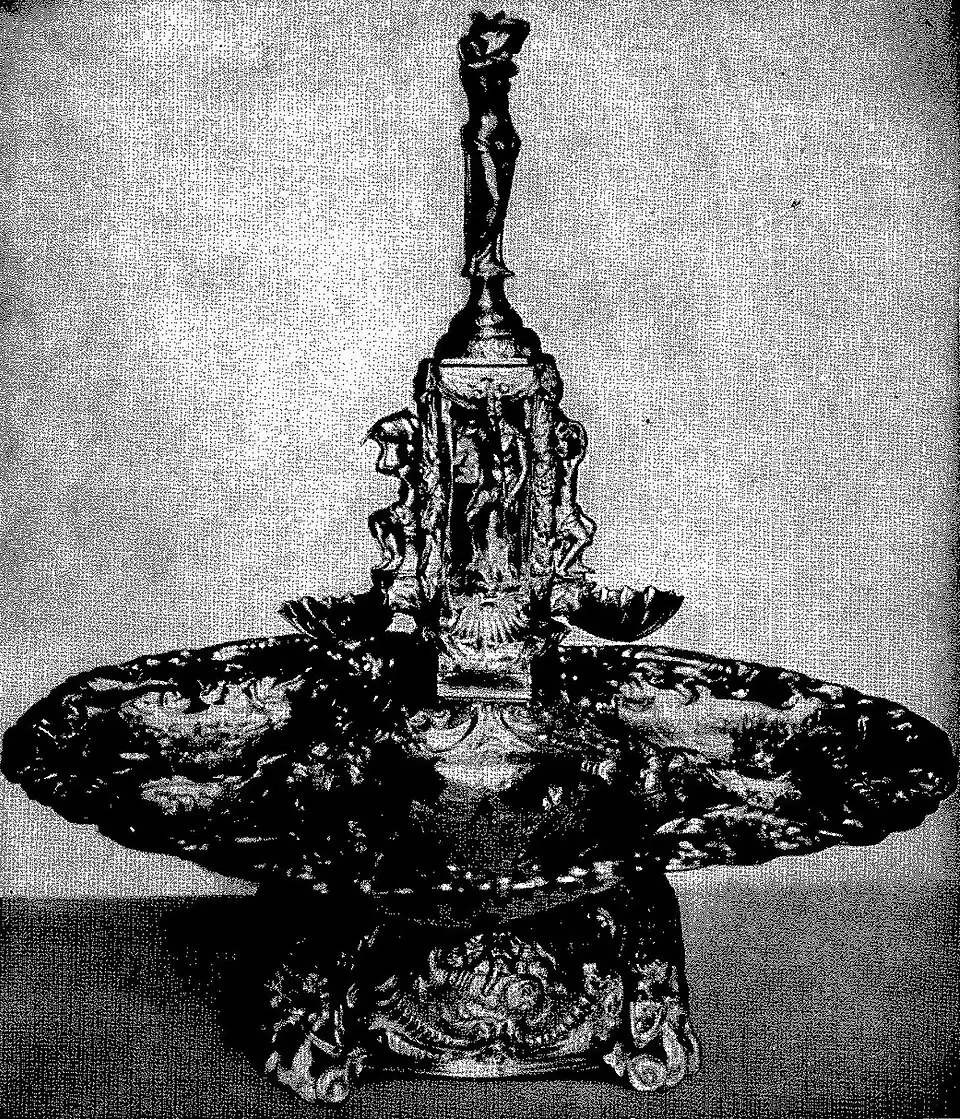
2.—The Wine Fountain State Crown, presented to Charles II. by the Corporation of Plymouth. | |